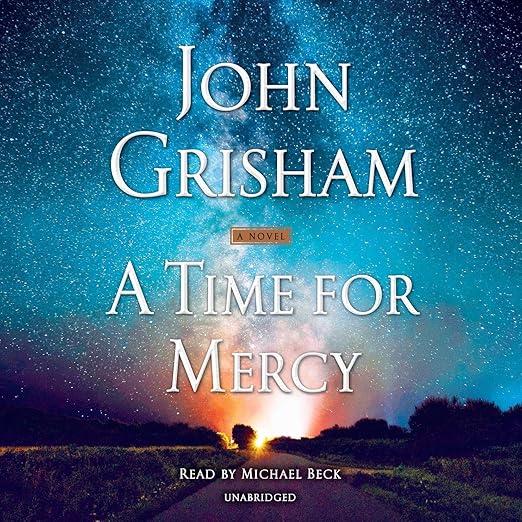
Key Details
- Performance: Michael Beck delivers a measured Southern drawl that suits Grisham's Clanton courtroom atmosphere without overdoing the regional texture.
- What it covers: Small-town justice, moral ambiguity in the law, class and race in the rural South
- Feel: Slow-burn and procedural, with genuine emotional stakes in the final stretch
- Our call: The third Jake Brigance novel earns its place in the series, though it asks a lot of patience before the courtroom comes fully alive.
I finished A Time for Mercy on a Saturday evening after listening in chunks throughout the week, mostly during long walks and one particularly slow commute. I had been sitting on it for a while, having loved A Time to Kill years ago and felt vaguely protective of that memory. John Grisham's Jake Brigance is one of those characters who matters more than any individual plot he navigates, and I was genuinely curious whether the third outing, set five years after Sycamore Row in 1990 Clanton, Mississippi, would give him something worthy to argue.
It does, though not without taking its time getting there. The setup is clean: Jake Brigance is appointed to defend Drew Gamble, a sixteen-year-old boy who shot and killed his mother's abusive boyfriend, a local deputy sheriff. The community wants the death penalty. Jake's instinct says there's more to the story. What follows across nearly twenty hours is Grisham doing what he has always done best, which is less about dramatic courtroom surprises than about the grind and human cost of building a defense for someone most people have already condemned.
A Closer Look at A Time for Mercy
Part of the pleasure of returning to Clanton is how completely Grisham has built this world over three novels. Judge Noose is back, and Sheriff Ozzie, and the ensemble of local lawyers and coffee-shop opinion-formers who constitute the Greek chorus of small-town Mississippi legal drama. Readers who came to this novel fresh would still follow it, but longtime fans get the additional layer of knowing who Jake was before the financial pressure, before Carla's anxiety about their safety, before he became the kind of attorney who takes court appointments he can't afford because he can't turn away a kid nobody else will defend.
Michael Beck's narration handles this ensemble well. He doesn't attempt broad character differentiation through accent, which is probably wise given the size of the cast, but he maintains a tonal consistency that respects the pace Grisham sets. One reviewer described the novel as leaving itself "open to the next book in the series," and Beck's understated reading supports that feeling of a community in ongoing motion rather than a sealed story.
What Makes A Time for Mercy Worth Hearing
The strongest sections of the audiobook are the ones dealing with what Jake's commitment to this case does to his family and his practice. Grisham has always been interested in the economics of small-town law, and here that interest sharpens into something genuinely uncomfortable. Jake is not a crusader in the Hollywood sense. He worries about his fee. He worries about his marriage. He takes the case partly because the court orders it and partly because he cannot look at a scared teenager and walk away, and that tension between principle and pragmatism is more interesting than any plot twist.
One reviewer noted that this is "not heavily entrenched with racial issues" compared to A Time to Kill, which is accurate. The moral question here is different: not whether a killing was justified by circumstances of extreme injustice, but whether a frightened boy protecting his mother from a violent man deserves a fair hearing in a community that reveres the badge. It's a quieter ethical problem, which is both what makes it feel more contemporary and what occasionally makes the middle section feel slow.
Things to Know Before Starting A Time for Mercy
At just under twenty hours, this is a long audiobook by any standard, and honesty requires acknowledging that the pacing is uneven. The first half moves carefully through setup: the community politics, Drew's family situation, the preliminary legal maneuvering. A reviewer described being "totally absorbed until the last sentence," and I understand that response, but it's more accurate to say the final third earns the patience the earlier sections demand. The courtroom sequences, when they finally arrive, have the compressed procedural energy Grisham handles better than almost anyone writing in the genre.
Michael Beck sustains the energy through these sections more effectively than through the slower community-building chapters, where the reading can feel slightly neutral. But the overall performance serves the book's tone: this is a novel about what justice actually looks like when it's not cinematic, and Beck doesn't try to manufacture drama where Grisham hasn't placed it.
Who John Grisham Is Writing For
If you've read or listened to A Time to Kill and Sycamore Row, this is an easy recommendation regardless of where you think those novels rank in Grisham's catalog. The investment in Jake Brigance pays compound interest in the third installment.
If this is your first Grisham or first Jake Brigance novel, it works as a standalone, but I'd genuinely suggest starting with A Time to Kill first. The emotional weight of returning to Clanton comes partly from knowing what Jake has already survived there. And if you find the slow-build legal procedural frustrating, this one asks for more patience than some of Grisham's leaner standalone thrillers. But for those who want the full texture of a specific place and a specific man's commitment to an idea of justice that keeps costing him, twenty hours is not too long.
Is the narration by Michael Beck a good fit for Grisham's Southern setting?
Beck handles the material competently without being exceptional. He maintains a steady pace and doesn't overplay the regional accents, which keeps a large cast distinguishable. Some listeners may prefer a narrator with more vocal range for the courtroom sequences, but he never gets in the way of the story.
At nearly twenty hours, is the pacing a problem for audiobook listeners?
The middle section is deliberately slow as Grisham builds the community context and financial pressure on Jake. Listeners who find procedural detail satisfying will appreciate the texture. Those who prefer lean, fast-moving thrillers may lose patience. The final third accelerates significantly and delivers the courtroom sequences the earlier setup earns.