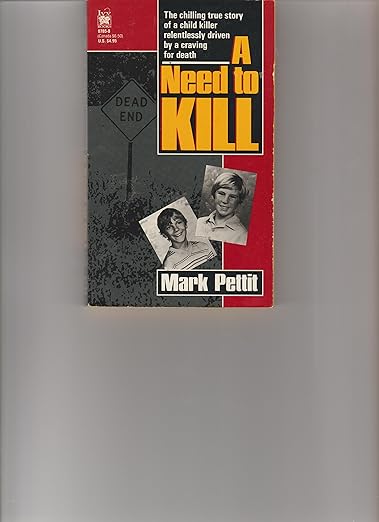
Three young boys and a convicted killer named Joubert sit at the center of this audiobook, though reviewers note it leans hardest into two of those three cases rather than splitting attention evenly across all three. This listing carries no synopsis to preview the case, so what follows leans on what the audiobook's own audience has said about it. Mark Pettit narrates his own material here, and reviewer Justin Bousquet credits him with detail precise enough to make 'the hair on the back of my neck stand up,' the kind of specificity that usually comes from someone who spent real time inside a case rather than summarizing it secondhand.
Primarily About Two of the Three Boys
According to reviewer Donna J., the book is 'primarily about 2 of the boys,' even though Joubert was convicted of killing three; the third victim's case surfaces about halfway through the book and then, in her account, isn't returned to again until the end. That's a structural choice worth knowing going in. Reviewer Iron Dragon locates this book within 'a series of 3' Pettit has written about the case, which suggests the fuller three-victim story may be distributed across multiple audiobooks rather than contained in this single one. Listeners expecting one tightly balanced account of all three crimes in this installment alone should recalibrate that expectation before pressing play.
Iron Dragon's review leans into the emotional weight of the material directly, calling the case 'riveting and tragic' and noting that whatever resolution the book offers only counts as a happy ending 'if you can call it that.' That qualified, uneasy framing tells you something real about the book's tone: this isn't true crime played for pure entertainment value or shock, it's presented with an awareness of the human cost underneath the case details. For a genre that can sometimes drift into treating victims as plot devices, that qualification from a listener who clearly finished the book carries real weight.
True crime built around a specific, well-documented case occupies a different space than true crime chasing a still-unsolved mystery; the interest here isn't whodunit, since Joubert's conviction is a matter of public record, it's how the crimes actually unfolded and how investigators closed in. That distinction matters for setting expectations: listeners drawn to the genre for pure mystery-solving may find less of that here than listeners drawn to it for the procedural and human detail of how a real case actually came together, which based on how consistently reviewers single out Pettit's level of detail seems to be exactly where his strengths lie.
An Unspoken Sense of Having Been There
Self-narrated true crime carries a specific kind of authority when the author clearly has firsthand investment in the material, and the level of detail Justin Bousquet describes, precise enough to be physically unsettling, suggests Pettit isn't working from secondhand press clippings. Hearing an author narrate their own true crime reporting tends to land differently than a hired narrator reading the same words; an implicit claim of firsthand credibility rides along every specific detail Pettit's own voice delivers about the case, an unspoken sense of having been there for the reporting that a studio narrator can't replicate.
Justin Bousquet's review credits the book with keeping him 'in suspense and disbelief yearning to read more with every turn of the page,' strong language for a true crime account where the audience typically already knows a conviction happened. That suggests Pettit's storytelling carries real narrative tension independent of outcome uncertainty, built more from pacing and detail than from any mystery about who did it. For listeners who gravitate toward true crime specifically for that kind of immersive, hard-to-look-away quality rather than pure procedural fact-recitation, that's a meaningful signal.
Donna J Calls This a Fast Read
The subject matter itself is the biggest thing to know going in: this is a case involving the murder of children, described by more than one reviewer in genuinely difficult, unflinching terms. Listeners sensitive to that content, understandably a hard line for many true crime fans, should know upfront rather than discover it mid-listen. Beyond content, the practical caveat is structural: since Iron Dragon places this book inside a three-book series about the same case, listeners wanting the complete picture of all three young victims may need to track down the other two installments rather than expecting this single audiobook to cover everything.
With no synopsis on file and a runtime just over six hours, this is a leaner true crime listen than some of the genre's longer, more exhaustively researched entries. Donna J. calls it 'a fast read,' which tracks with that runtime. That brevity is worth weighing against the series structure noted above: a focused six-hour treatment of two of the three cases likely moves faster and hits harder emotionally than a single exhaustive account trying to cover all three with equal depth, but it does mean this installment alone won't be a complete accounting of Joubert's crimes for listeners who want that.
Self-published or independently narrated true crime carries a mixed reputation industry-wide, since quality varies enormously without a major publisher's editorial process behind it. What separates a book like this from the weaker end of that spectrum is specificity: reviewers here consistently point to concrete, granular detail rather than vague, recycled case summaries lifted from earlier press coverage, which is usually the clearest sign of an author who did real, direct reporting rather than repackaging existing accounts. That's a meaningful quality signal for a genre where independent publication can otherwise be a reason for real caution.
Pettit's Own Voice Carries Real Weight
True crime listeners who already recognize the Joubert case, per Donna J.'s comment that these are 'names you have probably already heard if you are a true-crime reader,' are an obvious fit, but so are listeners newer to the genre who want a tightly paced entry point rather than a sprawling, multi-hundred-page-equivalent investigation. Fans of self-narrated true crime, where the author's own voice and evident closeness to the case carry real weight, should find exactly that quality here based on how consistently reviewers single out the level of detail.
A complete, single-volume account of all three of Joubert's young victims is not what this delivers on its own, so anyone wanting that full picture should plan on seeking out the other two books in Pettit's series as well. The subject matter's weight also means this isn't a casual or background listen; it asks for real attention and a genuine tolerance for difficult content about crimes against children.