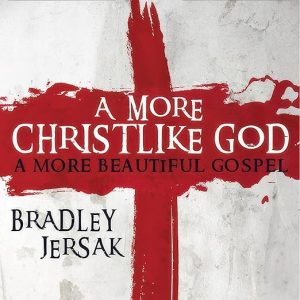
I came to A More Christlike God after a conversation with someone who had left their church because the God being preached there did not match the Jesus they read about in the New Testament. That particular tension, between the wrathful judge of Western Christian tradition and the self-giving figure of the gospels, is exactly what Brad Jersak is writing about. I finished the audiobook in two sessions and found myself spending considerably longer sitting with what it proposes.
Jersak is a Canadian theologian and author whose work sits in the tradition of patristic retrieval, the recovery of early church fathers' understandings of God and salvation that predate the juridical frameworks that came to dominate Western Christianity. A More Christlike God is his most accessible book, and the audiobook format suits it: this is theological argument delivered in a pastoral register, meant to be heard and felt as much as analyzed.
God Must Be Entirely Christlike, Never Partly
The book's organizing principle is as simple to state as it is radical in its implications: if Christ is the image of the invisible God, as Colossians 1:15 puts it, then God must be entirely Christlike. Not partially Christlike. Not Christlike in his New Testament behavior while retaining the violence of the Old Testament warrior deity. Entirely Christlike: self-giving, radically forgiving, co-suffering love. That premise, as one reviewer notes, should be uncontroversial for Christians on its face. Taken to its logical conclusion, it undoes a significant portion of what Western Christianity, particularly evangelical Christianity in the United States, has been teaching about the nature of God and the mechanism of salvation.
The atonement theology Jersak challenges most directly is penal substitution: the model in which God's wrath required satisfaction that Christ provided by absorbing divine punishment on humanity's behalf. This good cop/bad cop distortion of the divine, as he calls it, is one Jersak argues is both historically recent and theologically incoherent given a Christlike framework. His alternative, variously described as Christus Victor, moral influence, and what he calls the cruciform understanding, locates salvation in the revelatory and restorative dimensions of the incarnation rather than in the satisfaction of divine wrath.
From Anselm to Calvin, Tracing a Distortion
What distinguishes Jersak from some academic theologians working similar ground is his pastoral attentiveness. The book is not only arguing a theological position. It is written for people whose relationship with God has been damaged by the toxic images he names in the opening: the punishing judge, the doting grandfather, the deadbeat dad, the vengeful warrior. One reviewer described arriving at this theology after nearly reaching a suicidal crisis over their sense of divine condemnation, and Jersak's work being part of what shifted their understanding. That is the readership he is consciously writing for.
The historical survey of how distorted images of God arose and became dominant in Western Christianity is among the book's most valuable sections. Jersak traces the influence of Roman legal frameworks on early medieval atonement theology, the specific contributions of Anselm of Canterbury and later Calvin, and how those frameworks produced the version of Christianity that many people raised in evangelical or fundamentalist contexts have inherited and eventually rejected. That genealogy is important for understanding why the alternative he proposes is not heterodox innovation but retrieval.
Boyd Barrett Reads With Quiet Authority
Theological argument is demanding audiobook territory. The concepts require precision, the vocabulary is specialized, and the argument builds across chapters in ways that require the narrator to convey both the internal logic of the progression and the pastoral warmth of the application. Barrett does this with what I would describe as quiet authority: he reads Jersak's more challenging theoretical passages without either rushing through them or treating them as self-evident, and he brings genuine feeling to the pastoral sections without becoming mawkish.
Ten hours is a substantial commitment for a theology title, and Barrett sustains engagement throughout. His voice does not have the theatrical range of a full cast narrator, but that is not what this material requires. Jersak is making an argument, not telling a story, and Barrett's measured, consistent delivery keeps the listener oriented within the structure of that argument across the book's full length.
Three Audiences Feeling the Same Theological Tension
A More Christlike God speaks most directly to three overlapping audiences. The first is Christians who have felt the tension between the God of their tradition and the Jesus of the gospels and have not found adequate theological language for that tension. The second is people who have left Christianity, or are considering leaving, specifically because of the image of God they encountered in their communities. The third is Christians who are already oriented toward progressive or post-evangelical theology and who want a more systematically developed argument for the Christlike God position than they have encountered elsewhere.
Readers who are fully settled in their evangelical or Reformed theology and who find penal substitutionary atonement compelling will find this book deeply uncomfortable. Jersak is not arguing that their tradition is slightly off in its emphases. He is arguing that its core image of God is distorted in ways that have produced genuine harm. That is a serious claim, and he makes it seriously. The reviewers who have found the book reformational and life-changing are the audience it is built for. If you are among them, this free audiobook may be among the more significant ten hours you spend listening this year.
How does this audiobook compare to Rob Bell's Love Wins or other progressive Christian titles on similar themes?
Jersak goes considerably deeper theologically than Bell's more accessible and intentionally provocative Love Wins. Both books challenge traditional evangelical images of God and argue for a more loving divine character, and they are often read in sequence by the same audience. Jersak's book provides more systematic theological grounding for the intuitions Bell raises.
Is this book suitable for someone without a strong theological background?
Jersak writes with pastoral accessibility as a priority, and he defines his terms as he introduces them. Readers without formal theology training will encounter unfamiliar vocabulary but the argument is constructed to be followable without prior academic preparation. The audiobook format helps because Barrett's pacing allows concepts to land before the next is introduced.
Does Boyd Barrett's narration add anything beyond a clear reading of the text?
Barrett brings a quality of genuine engagement to the pastoral sections in particular, the moments where Jersak addresses people whose image of God has caused them real harm. That engagement is audible without being performative, and it makes the difference between a narrator who is reading theology and one who appears to understand why it matters.