Of the memoirs about late-diagnosed autistic women now arriving every season, this is the one I would put first, and the audiobook has an advantage the printed edition cannot match. The description opens with a single flat line: this program is read by the author. Marian Schembari spent decades hiding tics and shutting down in public before she learned at thirty-four that she was autistic, and the recording hands the story back to the voice that was doing the hiding.
The Least Discussed, Most Useful Guilt
Diagnostic history forms the spine of the book, and it is bleak reading laid out plainly. Therapists gave Schembari Tourette's syndrome, obsessive-compulsive disorder, sensory processing disorder, social anxiety and recurrent depression, in various combinations across the years. They prescribed breathing techniques and gratitude journaling. Nothing worked, because none of it was aimed at what was actually happening, and the book is unsparing about how long that took to establish and how much of a life went past while it did.
Geography keeps it from reading as a case study. The account moves from the mountains of New Zealand to the tech offices of San Francisco, from a first love to a first child, and the autism material threads through those episodes rather than replacing them. Schembari is writing a life that had a diagnosis in it, not a diagnosis with a life attached, and the difference shows up in how much room the ordinary parts of the story are allowed to take.
Izzy, writing from inside the same experience as a late-diagnosed and high-masking autistic woman, awards five stars and reports that the book "healed something in me" and flags the strand about the guilt carried by a neurodivergent parent as the part worth recommending onward. That guilt material is the least discussed and probably the most useful thing in here, and it is not what the description leads with. Parents who spent years being told they were anxious rather than autistic will recognize the specific shape of that guilt immediately.
Performance and Subject Are the Same Activity
Self-narration is not a neutral choice on a book about masking. The central experience being described is the effort of controlling how you sound and appear in front of other people, and having the author perform her own account puts that effort on the record in a way a hired reader could only approximate. The performance and the subject are the same activity across all seven hours and fifty-two minutes of it, which is rare enough to be worth paying for. Nothing in the reading calls attention to itself, which on this subject is the correct decision and a harder one than it sounds.
Writing at five stars, Laura V. sets out what the prose actually does, listing missed social cues, never quite fitting into social circles, sensory sensitivities and burnout, and calling the treatment "sometimes heartbreaking and sometimes hilarious". That tonal range is the technical achievement here, and it depends more on delivery than anything else in the recording, since the comic beats sit directly against the painful ones without a paragraph break to signal the switch.
A Broken Vase Unavailable to a Listener
Expectations need setting on the research half. The description makes a structural argument about testing improvements, about women and girls dismissed for decades by parents and doctors, and about gender-biased research producing a diagnostic gap that persists. That argument holds up and is well made, but it arrives as reported context inside a personal narrative rather than as a survey with a bibliography, and anyone wanting a systematic account of the science should treat this as a companion to that reading rather than a replacement for it.
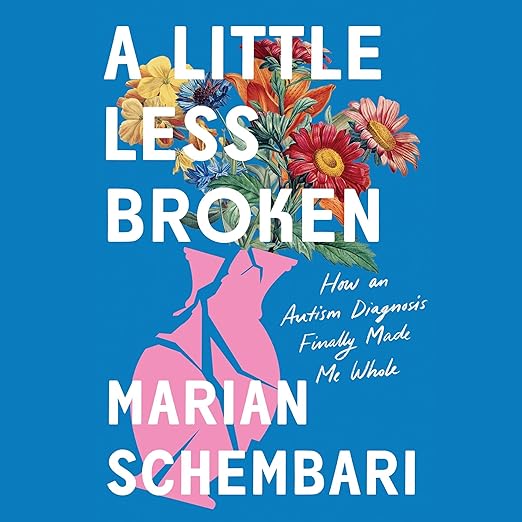
One notice describes something the audio edition cannot deliver. A five-star account posted in August spends a paragraph on the cover art, explaining that the image is a broken vase and that for several days it had been read as a shattered head and neck with flowers growing out of the brain. Both readings work, and both are unavailable to a listener, which is a small loss on a book whose title is doing similar work. Anyone buying the recording as a gift should probably mention the image rather than assume it will come across.
The Single Most Valuable Sentence on the Page
Uniform enthusiasm marks the written pool in a way the aggregate does not quite support. Four of the five visible accounts award five stars against an average of 4.8 across two hundred and twenty-one ratings, so the reservations exist somewhere outside the sample you are able to read. One handle on the page is a platform-generated placeholder rather than a chosen name, which is worth noticing when you are weighing how much considered judgment sits behind each account.
Comparative claims are rare in a pool this warm, and one arrives in October 2025. That five-star account observes that many memoirs about autistic women are now available, argues this one stands above them, and adds that it avoided the internalized ableism the same reader has found elsewhere in the category. Specific and checkable judgment of that kind is more useful than any amount of praise, and it is the single most valuable sentence anyone has left on this page.
A Manual for Understanding Another Person
Adults who suspect they are autistic and have been handed three other labels first are the primary audience, and the book will do more for them than most clinical material. The value is in the sequence of misdiagnoses rather than in the diagnosis, because recognizing your own history in somebody else's file is what usually precedes doing anything about it. The book is careful never to prescribe that recognition, which is part of why it works.
People close to a late-diagnosed adult are the second group served here, particularly anyone trying to understand what the masking actually cost. Caufeegal's four-star notice makes that case from outside the experience, describing accounts like this one as a kind of manual for understanding another person, and warning against the reflex to judge a story you are only ever hearing the outside of. That is a generous reading and a fair description of what the book can do for a reader who does not share the diagnosis.
Against that, anyone looking for a practical guide to seeking assessment will need to look elsewhere, since the book is a memoir first and the systemic argument sits underneath the narrative rather than in a chapter you can skip to. The cover-art point matters for anyone who wants something visual to hold, and readers who find first-person accounts of prolonged medical dismissal difficult should approach the early chapters carefully.
At a Glance
- Narration: Marian Schembari performs her own account of masking, which puts the book's central effort into the delivery rather than only into the text
- Themes: Late autism diagnosis in women, decades of misdiagnosis, masking and burnout, neurodivergent parenthood
- Mood: Candid and funny in the same breath as devastating
- Verdict: The strongest recent memoir of late-diagnosed autism, and the author reading it is a real reason to choose audio over print.
Questions Listeners Ask
Does Marian Schembari narrate the A Little Less Broken audiobook herself?
Yes, and the description states it in its opening line. On a memoir about masking, controlling how you sound in public is the subject as well as the task, so hearing the author deliver her own account adds something a hired reader could only imitate. The credits list no additional voices.
Is this audiobook a memoir or a book about autism research?
A memoir first. The description makes a real argument about testing improvements, gender-biased research and women dismissed by doctors, but it arrives as context inside the personal story rather than as a survey. Pair it with something more systematic if you want the research on its own terms.
Does the audiobook cover parenting as well as diagnosis?
Yes, and it is one of the book's more useful surprises. Parenthood arrives late in the account, and the guilt carried by an undiagnosed neurodivergent parent gets sustained attention once it does. The listing barely signals that strand, so anyone buying for the diagnosis story alone will get more than expected.