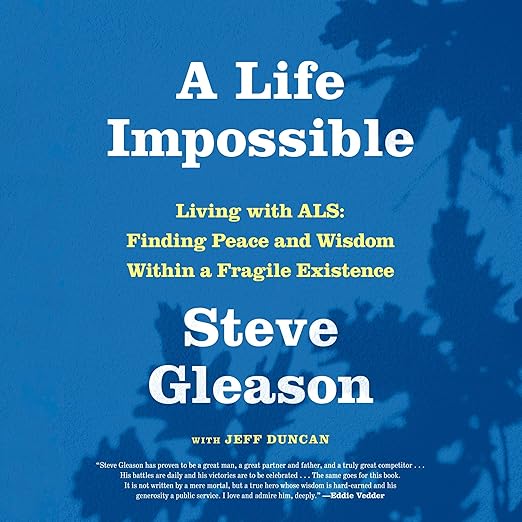
Steve Gleason's audiobook A Life Impossible is built on a paradox the title refuses to resolve neatly. Gleason was an NFL player for the New Orleans Saints, a man whose entire identity was rooted in what his body could do. In 2011, three years after retiring, doctors diagnosed him with ALS and told him he had three years to live. He was thirty-three. By the time this book was written, he was more than a decade past that deadline, breathing with a ventilator, communicating with eye-tracking technology, and still, somehow, not done. The memoir that emerged from those years is one of the more honest accounts of physical deterioration and continuing life that any former athlete has produced.
Daniel Cummings narrates with the precision this material demands. A memoir this intimate requires a voice that can hold grief and dark humor in the same sentence without forcing a resolution between them. Cummings manages it. The eleven hours and thirty-eight minutes never feel padded; Gleason's life before and after diagnosis is dense with specific detail, and Cummings moves through it with the steady authority of someone who understands that the listener needs time to absorb what is actually being described. The narration is a form of respect toward the material, and it shows in every session.
Gleason's Refusal to Give Easy Comfort
Gleason writes with the candor of someone who no longer has anything to lose by being honest. The pre-ALS chapters cover his NFL career with the Saints, including the blocked punt in the first post-Katrina home game that became one of the franchise's most celebrated plays and eventually became the subject of a nine-foot bronze statue outside the Superdome. But Gleason is not interested in trading on that moment indefinitely. He places it in context, as one chapter of a life that was about to be reorganized entirely by forces outside his control, and he moves past it with the same decisiveness he brought to the field.
What follows the diagnosis is where A Life Impossible becomes genuinely unusual among sports memoirs and illness narratives alike. Gleason does not perform acceptance or manufacture a tidy arc of spiritual transformation. He describes the terror, the loss of muscle function piece by piece, his wife Michel's unmatched steadiness alongside her own pain, and the practical and existential reconfigurations that come from watching your body become inaccessible while your mind remains fully engaged. The New York Times called him a symbol of resilience, hope, and optimism, and NFL Commissioner Roger Goodell said he has changed the world, but neither quote quite captures what makes this book worth your time. It is Gleason's refusal to give you easy comfort.
Another Form of Voice Through Technology
The audio format has specific relevance here. Gleason now communicates through technology, but his memoir was composed in full sentences carrying the full weight of a writer who chose every word deliberately. Cummings gives those words back their physicality. Fitting about hearing A Life Impossible rather than reading it: Gleason's own voice is now mediated by technology, and the audiobook, another form of voice-through-technology, carries that resonance quietly in the background throughout the eleven-hour runtime.
Reviewer Pat Montanaro notes that you will cry, laugh, and think, and that is accurate. Gleason has a dark humor that surfaces in places you do not expect it, and those moments of levity do not soften the hard material so much as they prove his point. The human capacity to find absurdity inside catastrophe is itself a form of survival, and Gleason documents it without romanticizing it. Reviewer Doc, citing the Gleason Foundation motto of No White Flags, captures something about the book's moral center: this is not a story about accepting defeat gracefully. It is a story about refusing to organize your life around what you cannot do, and about the specific, daily work that refusal requires.
Worst Circumstances Become Infrastructure for Others
This is not a memoir that resolves. ALS does not resolve. Gleason is still living with a degenerative disease, and the book does not pretend otherwise. Listeners expecting a triumphant recovery narrative will find instead something rarer and more valuable: a clear-eyed account of what it means to remain fully alive inside a body that is incrementally closing down. The memoir argues, as one reviewer puts it, that true strength does not reside solely in one's body but also in the ability to face unfathomable adversity and still be able to love and treasure life. That argument is made through accumulation rather than proclamation, and it earns its conclusion honestly.
The Gleason Foundation, which grew out of Steve and Michel's experience navigating the healthcare and technology landscape for ALS patients, appears in the memoir as both a personal project and a wider mission. Reviewers note it has helped numerous people with ALS. The book does not function as a fundraising document, but the foundation's existence gives the story a dimension beyond individual survival: Gleason found a way to convert his worst circumstances into infrastructure for others facing the same diagnosis, and that conversion is as much a part of the story as the blocked punt ever was.
Cummings Gives Every Detail Its Full Weight
This audiobook belongs in the hands of anyone facing serious illness, caring for someone who is, or simply trying to understand what human endurance actually looks like up close, not in the edited version but in the daily, complicated, sometimes terrifying reality. Saints fans will find specific resonances, but the book reaches well beyond football. Literary memoir readers who appreciate honesty over sentiment will find Gleason an unexpectedly precise writer. The audio production serves the material with quiet dignity throughout, and Cummings's narration gives the text's physical details their full weight without ornament or inflation.
Common Questions
Does the audiobook version of A Life Impossible include any bonus material or author commentary?
The audiobook runs eleven hours and thirty-eight minutes narrated by Daniel Cummings. It does not appear to include bonus recordings or author additions beyond the text of the memoir itself.
Is this audiobook accessible to listeners who do not follow NFL football?
Yes. While Gleason's Saints career is covered in detail, including the famous blocked punt in the first post-Katrina home game, the football chapters are written to stand on their own as life narrative. The diagnosis and post-ALS chapters, which form the core of the book, require no sports knowledge.
Is this audiobook appropriate to listen to with family members who are facing serious illness?
Many readers have noted its impact in caregiving and illness contexts, and one reviewer specifically describes it as resonant for families facing ALS. Its honesty makes it powerful rather than easy, so individual readiness matters, but the book was written with that audience explicitly in mind.