Chloe Davis was twelve years old when six teenage girls vanished from her small Louisiana town, and by the end of that summer, her own father had confessed to killing them. Stacy Willingham's debut thriller opens with that premise already resolved, which turns out to be the smartest structural decision in the whole book: the mystery here was never going to be whodunit twenty years ago, it is whether Chloe, now a psychologist in Baton Rouge days away from her own wedding, can trust her own instincts when a new teenage girl disappears and the old pattern seems to be repeating. This audiobook, read by Karissa Vacker, helped earn Willingham a spot on the New York Times bestseller list and an AudioFile Earphones Award, and both credentials hold up on a close listen rather than reading as marketing dressing.
What We Made of It
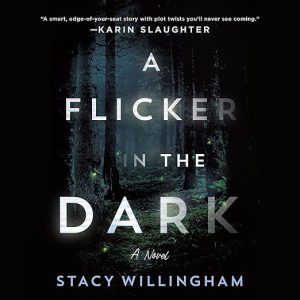
Karin Slaughter's cover blurb calls it 'a smart, edge-of-your-seat story with plot twists you'll never see coming,' and the structural choice described above is exactly why that holds together: Willingham is not hiding a killer's identity from the reader so much as hiding whether Chloe's own perception of the present can be trusted, which is a harder trick to sustain across a full novel and a riskier one for a debut author to attempt.
The dual pressure on Chloe, psychologist to a caseload of troubled teens by day, daughter of a convicted killer by night, gives the book a genuine structural spine rather than a simple past-versus-present toggle. Her patients externalize the same adolescent volatility she spent her own adolescence trying to understand in her father, and Willingham uses that overlap to keep raising the question of whether Chloe's professional expertise is actually protecting her judgment or quietly distorting it.
The wedding timing matters more than it first appears: Chloe is not simply an adult confronting old trauma in the abstract, she is doing it in the exact stretch of weeks she is supposed to be stepping into a new, stable identity as someone's wife, and Willingham stacks that personal deadline against the external one, a missing girl, on purpose. The two pressures compound rather than simply coexist, which is part of why the middle section of the book never lets the tension slacken even between disappearances.
The title itself, A Flicker in the Dark, works as a fair description of Chloe's own experience throughout: brief, uncertain glimpses of pattern and threat that never quite resolve into full clarity until the book finally allows them to.
What Makes A Flicker in the Dark Worth Hearing
Vacker's confirmed strengths lean toward warm clarity with children and young readers rather than adult psychological suspense specifically, so her casting here reads as a genuine register stretch rather than a known quantity, and it is one worth noting honestly rather than assuming automatic success just because the production is otherwise well credentialed through Macmillan Audio and Minotaur Books, and that stretch is exactly the kind of casting choice worth confirming with a sample chapter before committing to the full runtime.
Reviewer Heather T in Tucson gives the strongest direct account of how the pacing actually lands, writing that the book 'devoured my attention from the moment I opened it' and describing 'a deliberately intense pace' sustained across the runtime. Pairing a controlled, unhurried vocal performance against prose that reviewers describe as relentless is a real tension worth listening for in the first hour specifically, since that is where the tonal contract between narrator and material gets set.
Karin Slaughter's endorsement carries specific weight in this genre beyond a generic cover blurb: she has built her own career on morally complex procedural thrillers grounded in the American South, and her willingness to vouch for a debut author working similar territory reads as a credible genre-insider signal rather than a publisher-arranged courtesy quote. AudioFile Magazine's Earphones Award adds a second, independent data point recognizing the production quality specifically, useful for a debut audiobook that has not yet built up years of listener reviews.
Macmillan Audio backing a debut author's psychological thriller with this level of promotional weight (a genre-name blurb, an Earphones Award nod, festival-circuit attention) signals a publisher betting seriously on Willingham's career rather than treating this as a quiet mid-list release, a useful signal for listeners trying to gauge a completely new name in a crowded genre.
What Might Not Land
Reviewer Joseph J. Truncale approaches the book from an unusual angle for this genre, describing himself as 'a voracious reader for more than 7 decades' who stumbled onto it browsing physical bookstore shelves rather than an audio catalog, a reminder that this material is reaching well beyond the demographic thriller marketing usually targets.
The subject matter (missing teenage girls, a parent's violence, a protagonist whose professional and personal lives both orbit trauma) is handled without gratuitous detail in the synopsis itself, but listeners sensitive to child-endangerment plotlines specifically should know that going in rather than discovering it mid-chapter. The small-town Louisiana setting also does real work here, giving the past crimes a claustrophobic, everyone-knows-everyone texture that a bigger city setting would dilute.
A psychologist protagonist is a well-worn device in this genre because it hands an author a built-in vocabulary for discussing trauma and unreliable perception without resorting to an info dump, but it is also a device that can tip into cliche fast if the character's expertise never gets complicated. Willingham avoids that trap by letting Chloe's clinical distance from her own patients visibly crack under personal pressure, so her professional authority becomes part of what is genuinely at stake rather than a static credential she carries unchanged.
Willingham's choice to set the story in Louisiana rather than a more commonly used thriller backdrop adds real regional texture: oppressive summer humidity, a slower everyday cadence that makes any disruption register more sharply, atmosphere that does as much work as the plot mechanics themselves.
The Right Listener for A Flicker in the Dark
Psychological thriller listeners, dual-timeline mystery fans, and readers who already trust Karin Slaughter's taste given her cover endorsement will find this squarely in their lane, as will anyone drawn to protagonists whose professional expertise is directly, uncomfortably relevant to their personal crisis.
Listeners who prefer their thrillers grounded in a specific, fully realized place rather than an interchangeable suburban backdrop will appreciate how much weight the small Louisiana setting carries here, a town close enough that everyone still recognizes Chloe's last name two decades after her father's arrest.
Listeners fatigued by the unreliable-woman-with-a-buried-past subgenre that has crowded shelves since Gone Girl may clock some familiar opening beats before Willingham's small-town specificity and psychologist framing fully distinguish themselves, so anyone burned out on that exact shape of premise should expect a slower build to the payoff than the cover copy implies.