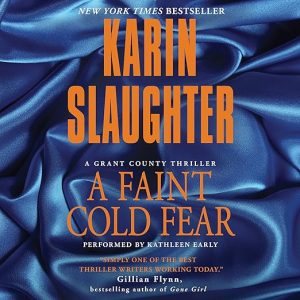
Karin Slaughter opens A Faint Cold Fear with Sara Linton arriving at a college campus in Heartsdale, Georgia to examine what appears to be a student suicide, and the audiobook establishes within its first hour two things that will shape everything that follows: the deaths are not suicides, and the person who might have the information to stop them is barely holding herself together. The third Grant County novel is a procedural in structure but something considerably closer to psychological portraiture in practice, and Kathleen Early's narration of the thirteen-hour production maintains that distinction throughout. The audiobook works because Early understands that the material requires restraint rather than amplification to convey what Slaughter is actually doing.
A Closer Look at A Faint Cold Fear
Slaughter's reputation rests partly on her refusal to treat violence and its aftermath as efficient plot mechanism to be processed and moved past, and A Faint Cold Fear is one of the clearest expressions of that commitment in the Grant County catalog. The rash of staged suicides that Sara and police chief Jeffrey Tolliver investigate are horrifying partly for what the mutilated bodies reveal about the killer's method and partly for what they reveal about the campus community itself, how much suffering can accumulate in plain sight, how successfully certain kinds of darkness sustain a surface of normality. Slaughter does not exploit these scenarios; she examines them with the same careful attention she gives to the characters, and that distinction separates her from thriller writers who use violence primarily as spectacle.
The most interesting structural decision in the book is making Lena Adams, the former detective who survived the unthinkable events of the first Grant County novel and has paid a continuous price for that survival ever since, the pivotal figure on whom the investigation may turn. Lena is not a detective here in any functional sense. She is a campus security guard haunted by her own history, making decisions from a state of significantly compromised judgment, and the question the audiobook builds toward is not simply whether she has information relevant to the investigation but whether she is in a psychological state to use it and whether the cost of acting outweighs the cost of silence. That is a different kind of thriller question than the standard procedural poses, and it is the source of this entry's distinctive emotional weight.
One reviewer described A Faint Cold Fear as compelling with particularly excellent character development for the principal female characters, and that characterization is precise. Sara, Lena, and the victims all receive the kind of individual specificity that separates Slaughter from writers who use women primarily as catalysts for male detective action. Jeffrey Tolliver's presence as Sara's ex-husband and the police chief adds interpersonal complication to scenes that would otherwise be purely procedural.
Kathleen Early's narration is calibrated carefully for Slaughter's particular prose voice: direct, precise, emotionally controlled in a way that allows darkness to accumulate gradually rather than being released through vocal performance. Early handles the shifts between procedural investigation, the troubled history between Sara and Jeffrey, and the anguished interior life of Lena Adams without losing the distinct register of each mode. For a thirteen-hour production carrying this level of tonal complexity, that sustained control is not incidental, it is what makes the audiobook cohere over its full runtime.
Slaughter's prose style also suits the audio format specifically. Her sentences are short and rhythmically consistent in ways that read efficiently on the page but carry more accumulated weight when spoken aloud at Early's deliberate pace. The campus setting, the geography of a small college embedded in the rural Georgia town the series has made its own, benefits from being described rather than visualized, and Early's narration gives the landscape the enclosed, claustrophobic quality that Slaughter clearly intends throughout.
Things to Know Before Starting A Faint Cold Fear
This is the third book in the Grant County series, and the reviewer who described it as their least favorite in the series while still rating it highly was making a relative rather than an absolute judgment. The specific observation, that it lacks the gripping tension from the first two that kept them reading long after bedtime, is accurate in the sense that A Faint Cold Fear prioritizes character interiority and psychological weight over relentless procedural momentum. Listeners who came to the series primarily for investigative energy and forward narrative pace will find this a different experience than the earlier entries. Listeners who came for the depth of Slaughter's character work will find it a meaningful deepening of exactly what they came for.
The content is genuinely dark. Slaughter does not spare detail around the mutilated bodies, the staged suicide scenarios, or the specific history of violence in Lena Adams's past. Listeners with particular sensitivities around campus violence, sexual assault and its psychological aftermath, or sustained depictions of trauma should approach this audiobook with that awareness rather than being surprised by its intensity.
Who Karin Slaughter Is Writing For
Grant County series listeners who have finished the first two audiobooks and are continuing should not skip this entry even if the pacing difference gives them pause: the Lena Adams material here establishes character dynamics that will carry significant weight in later volumes. Listeners new to the series should start at the beginning; Slaughter builds these relationships with deliberate care across multiple books, and the weight of Sara and Jeffrey's history and of what happened to Lena requires that foundation to carry its full meaning. Listeners who appreciate female-centric crime fiction with genuine psychological depth, fans of Tana French or Val McDermid, particularly, will find Slaughter's approach very much on their frequency.