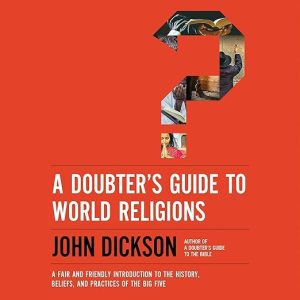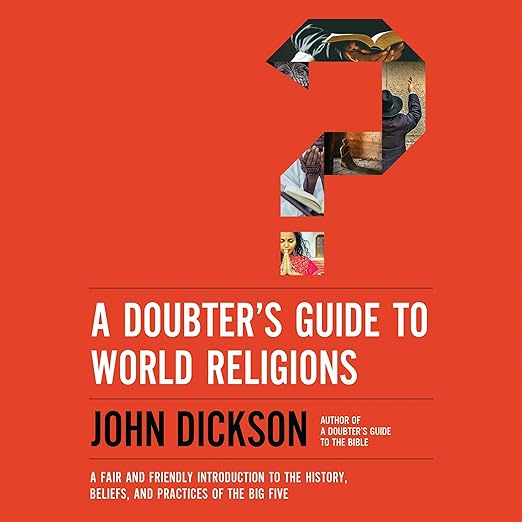
Five faith traditions, one voice, and a stated refusal to argue for any of them. Those are the terms this audiobook sets out, and the description declares the second of the three before anything else: the first line on the page is a note that the author reads it himself. John Dickson, historian and theologian, covers Hinduism, Buddhism, Judaism, Christianity and Islam across seven hours and thirty-nine minutes, published by Zondervan in April 2022, with forty-nine grades behind a 4.6 average.
A Closer Look at A Doubter's Guide to World Religions
Dickson's organizing metaphor is doing real work and deserves stating up front. He describes his role as that of an art curator in a gallery, hanging each tradition in its best light and letting it have its say. That is a specific methodological commitment rather than a pleasantry: it means the chapter on Islam is written to satisfy a Muslim reader, the chapter on Buddhism to satisfy a Buddhist, and the author's own convictions are held back from the frame. Whether that is achievable is the question the whole book stands or falls on.
Each tradition also arrives with a name attached, which tells you how the material is organized. Hinduism is presented as the Way of Release, Buddhism as the Way of Enlightenment, Judaism as the Way of the Torah, Christianity as the Way of the Christ, Islam as the Way of Submission. Underneath sits a common set of questions put to all five: who are we, what is our worth, how should we live, are we alone. The comparison is therefore structural rather than doctrinal, which is a more honest way to compare religions than lining up their claims about the afterlife.
Readers on this page seem to think the neutrality holds, and they say so in terms that suggest they were checking. One notes approvingly that the book is "written not as an apologetic for or from a particular religious perspective" and reports "not a lot of religious jargon". Another describes an overview of five faiths delivered "without the author trying to persuade for or against". A four-star response, more measured, credits the author with clearly articulating the main concepts of each religion and judges the result useful for clergy and laypeople alike.
Reading it himself is the decision that lets a listener test the method, and it is more than a cost saving. A book whose entire claim is that the author will not tilt the presentation has to prove that claim in performance as well as in wording, since a raised eyebrow in the wrong sentence would undo a chapter. A reader here arrived already knowing the voice, and appreciates Dickson "both in his writing and in his audio podcast", which tells you that speaking into a microphone is familiar territory for him. I would sample the opening of whichever tradition you already know best, because that is where any tilt would show.
What Makes A Doubter's Guide to World Religions Worth Hearing
Strongest of all is the argument the book makes against a comfortable modern reflex. One response captures it exactly: acting as though the five are all the same is, in that reader's words, "arrogant and lazy". Treating every faith as a different route up the same mountain feels generous and is actually a way of declining to learn what any of them says. A book that insists on the differences, and then presents each difference in the terms its own adherents would use, is doing something more respectful than the flattening it replaces.
This also solves a practical problem for a specific listener: the person who wants to understand the religious commitments of colleagues, in-laws or neighbors and has no intention of enrolling in a course. Under eight hours makes it a weekend. The description promises history, doctrine, belief and practice for each tradition, which is the right four-part checklist, and a reader who finishes will be able to follow a conversation rather than merely nod through one.
Things to Know Before Starting A Doubter's Guide to World Religions
Do the arithmetic before you set expectations. The full runtime divided five ways leaves roughly ninety minutes per tradition, and that is before the framing chapters take their share. Ninety minutes is enough for the shape of a religion and its major commitments. It is not enough for internal diversity, and any listener who belongs to one of the five will notice how much of their own tradition has been compressed into a summary.
Companion material sits outside the audio, and on this title that matters more than usual. The description lists accompanying visuals, recommended resources and a glossary in the PDF download. A glossary is precisely what a listener needs when five vocabularies arrive in one week, and a recording cannot hand it to you at the moment of confusion. Open the PDF alongside if you can, and treat the recommended resources as the actual next step rather than as an appendix.
One listing oddity deserves flagging: a book covering five major religions is filed on this page under a single Islam tag. That is a cataloging decision rather than a description of the contents, and it may explain why a reader browsing for comparative religion never finds it. Judge the book by the five-part structure described in the copy, not by where the shelf label puts it.
Who John Dickson Is Writing For
Its title names the audience honestly. This is built for the doubter, the curious secular listener and the believer who has never seriously read about anyone else's faith, and the responses on this page suggest it lands with all three. The four-star reader specifically recommends it for pastors as well as for general readers, which is a useful signal: it is substantial enough for someone with professional obligations and plain enough for someone with none.
Anybody preparing to travel, teach or work across religious lines will want the structure rather than the anecdotes. Knowing that Judaism organizes itself around Torah and Islam around submission is more useful in a real conversation than a handful of festival names.
Critique is not on the menu. The curator method means each tradition is presented as its own adherents would wish, which is exactly what some listeners come to comparative religion to avoid. Readers already working in this field will get more from the recommended resources in the PDF than from chapters that are, by design, a single session per tradition.
- Narration: Read by the author, a fact the description places in its opening line rather than in the credits.
- Themes: Comparative religion, the difference between traditions, doubt as a starting point
- Mood: Even-handed, curious, unhurried
- Verdict: The best kind of introduction, honest about being one, provided you accept ninety minutes per tradition as the ceiling.