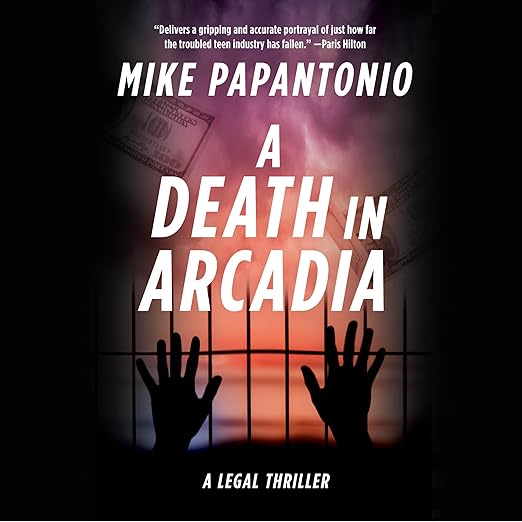
What does a lawyer do when a case walks into his firm carrying his own childhood inside it? That question is the engine of this audiobook, and Mike Papantonio builds eight hours and thirty-six minutes of legal thriller on top of it. A fifteen-year-old named Trayvon Clapper is killed by a guard at a Florida facility called Camp B. His mother and her boyfriend arrive at Bergman-Deketomis wanting to sue. Nicholas Deketomis, the lawyer everyone calls Deke, hears the details and starts remembering a boy named Bucky, who died the same way and about whom he has never spoken to his wife or his children.
The Review
Papantonio has built the case and the wound out of the same material, which is the structural decision that makes this book work better than its premise suggests. Deke grew up without stable parents, passed between several families over the years, staying out of the foster system by a margin. Bucky did not manage it. That is the guilt the novel keeps pressing on, and because Deke has never named it to anyone, the courtroom action doubles as a confession he cannot make in words.
Around that sits a corporate apparatus drawn with less subtlety and considerably more energy. Phoenix Industries owns Camp B and other facilities filed under child protective services, and its interests are handled by a corrupt congressman named Bob Minds and a colleague named Skyler Bannock, who between them deal in bribery, intimidation and worse. Skyler's brother Midas does the work the other two prefer not to describe. The villains are not complicated people, and the book does not pretend they are; they function as a machine that has to be dismantled rather than as characters to be understood.
The third strand is domestic, and it is the one I would watch. Cara Deketomis is a young lawyer at her father's firm, working the same case, close enough to see that something is wrong with him and unable to reach it. An opportunity in her own life then drives a wedge between them at exactly the wrong moment. One reader who marked the book down to four stars still singled this out, writing that Deke here "is a lot more vulnerable" than in earlier books and that a different side of him becomes visible.
Jeffrey Machado reads, and the practical demand is range across registers rather than volume. A congressman, a fixer, a professional killer, a grieving mother described in the copy as fringe-living, a young attorney and her father all have to remain separable by ear alone, and the father-daughter scenes need the opposite of the villain scenes: restraint, since the whole point is what Deke will not say. Sample a passage with Deke and Cara in the same room rather than an action sequence, because the thriller machinery mostly reads itself and that relationship does not.
The authority behind the procedural detail is the strongest selling point, and readers here keep returning to it. One five-star response argues that only a working lawyer who has seen a great deal could tell this particular story. Another puts the value more usefully: "It's easy to condemn lawyers from afar," that reader writes, before describing a book that puts you inside the job in a close and personal way. Legal thrillers written by people who have never filed anything read differently, and audiences notice.
Subject matter gives this weight independent of the plotting. Responses on this page describe anger rather than entertainment, one of them asking how a broken system could have been allowed to run so long, another summarizing the material as children abused in a system with so many problems, so many holes, so many ways for a child to end up exploited. A four-star notice calls the book the most eye-opening one this author has written and says it does not let up. That is not the vocabulary readers use about a disposable thriller.
One response comes from a reader who lives in Arcadia, which gives the setting a specificity most thrillers never get, and another comes from a school leader who works with troubled teenagers and calls the book an eye-opener. Those two perspectives, the local and the professional, are the ones I would weigh most heavily, because both readers had grounds to spot a false note and neither reports finding one.
Weak Spots in A Death in Arcadia
Heaviness is not oversold here. A child dies in the opening premise, the institutional abuse is described rather than implied, and one response singles out the daily fear these boys lived with as the detail that stayed longest. Audio removes the small mercy of skimming; a paragraph you would have skated over in print arrives at full length in your ear. Anyone with proximity to the juvenile justice or foster systems should decide deliberately rather than casually.
Arithmetic is the other caution. Eleven ratings produce the 4.9 you see, and all five written responses were filed within two weeks of the March release, four of them inside the first ten days. Nothing on this page is improper and launch-week enthusiasm is normal, but a rating base this small moves several tenths on a single grade, and three of the five who wrote refer to having read this author before. A fourth arrived having read none of them and finished planning to read them all, which is enthusiasm of a different kind again.
Who It's For
Readers who follow courtroom fiction for the procedure rather than the twist will find the most here, as will anyone who came to this author through the earlier Deketomis books, since the payoff of Deke's backstory depends partly on having watched him be unbreakable before. Newcomers are fine: the case is self-contained and the copy positions this as a new kind of gamble for the character rather than a continuation.
It also suits listeners who want fiction with a stake in something real. Two readers on this page describe checking the book against their own knowledge, one of the town and one of the population it concerns, and both came away persuaded.
Puzzle readers will feel underemployed. The antagonists are identified early and the pleasure lies in the dismantling rather than the discovery, so anybody who needs to be outguessed should look elsewhere. Institutional cruelty to children is also, across nearly nine hours, not a background detail but the entire architecture, which makes this the wrong choice if that is a subject you keep out of your fiction.
Key Details
- Read by: A single credit on a series entry whose emotional weight sits in what one character refuses to say out loud.
- At its heart: Institutional abuse of children, corporate cover-up, inherited guilt, a father and daughter at odds
- Vibe: Angry, propulsive, heavier than the genre usually allows
- Short version: A legal thriller with a real grievance behind it, worth the time if you can carry the subject matter for nearly nine hours.
Frequently Asked Questions
Do I need the earlier Deketomis audiobooks before this one?
No. The lawsuit is self-contained and the description frames this as a different kind of case for the character. Returning readers get more from Deke's backstory, since his composure in earlier books is what the revelations here work against, but a newcomer loses plot clarity nowhere.
How graphic is the abuse material in this audiobook?
Heavy, and central rather than incidental. The premise opens with the killing of a fifteen-year-old by a guard, and readers describe sadness and anger as their dominant reactions. One notes the daily fear the boys endured. Listening removes the option of skimming a difficult page, so choose your moment.
Is the Camp B storyline based on real events?
The book is fiction. What readers on the page keep saying is that the author blends fact and invention closely, with one calling the story ripped from the headlines and another hoping the out-of-court conduct is the invented part. Treat the institutional detail as informed rather than documentary.
Is a 4.9 average from eleven ratings worth trusting?
Only lightly. Eleven grades move substantially on a single opinion, and every written response arrived within two weeks of the March release, most of them from readers already following this author. The enthusiasm looks genuine, but the sample is small and self-selected at this stage.