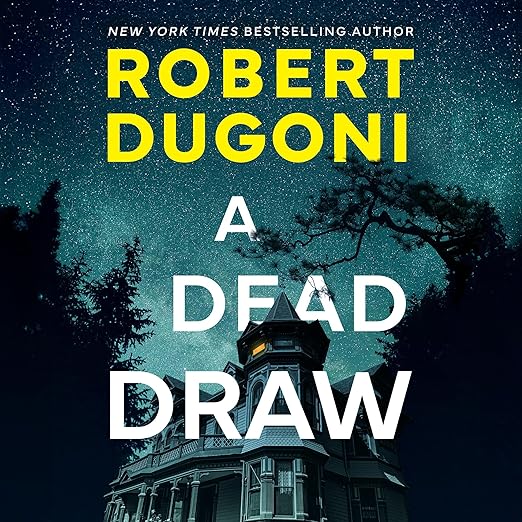
Robert Dugoni has built the Tracy Crosswhite series across eleven books on the foundation of Pacific Northwest atmosphere, procedural detail, and the long shadow of a personal tragedy that refuses to fully recede. A Dead Draw, the eleventh audiobook in the series, brings that shadow into the foreground in ways that feel earned by everything that came before. The antagonist Erik Schmidt carries ties not just to two cold case killings but to the specific man who murdered Tracy's sister - a connection that does not remain theoretical for long. When Schmidt exploits a legal glitch to walk free, and when Tracy has reason to believe he has followed her to the family's weekend house in Cedar Grove, the novel moves from procedural into something more nakedly personal. Emily Sutton-Smith, who has narrated the Crosswhite series with consistency and skill from the beginning, handles that shift with exactly the tonal calibration the situation demands.
A Closer Look at A Dead Draw
Dugoni is clear-eyed about the stakes in ways that long-running thriller series do not always manage. Tracy breaks. The interrogation sequence with Schmidt - a taunting, deliberate performance from a suspect who knows exactly which psychological buttons to push - produces a professional error during a shooting exercise, and that error has real consequences. Dugoni does not smooth it over or resolve it quickly. Tracy is, in effect, sent home on leave, and the pastoral safety of the weekend house in Cedar Grove - husband, daughter, nanny - becomes the venue for the cat-and-mouse endgame the novel has been constructing. Reviewer Janice noted that this installment "brought together Tracy's history with her current status of wife and mother" in a way that felt "genuinely integrated rather than grafted on," and that is one of the novel's real structural achievements. The domestic life is not a backdrop to the thriller. It is the thing at risk.
Schmidt himself is characterized with more care than standard thriller antagonists. His taunt during interrogation is effective precisely because it is informed - he knows details about Tracy's sister's murder that he has no legitimate reason to know, and the question of where that knowledge came from is one of the novel's sustaining mysteries. Dugoni is also attentive to what Schmidt represents psychologically for Tracy beyond the immediate threat: a figure who forces her to examine whether the professional and personal stability she has built is as secure as it appears.
What Makes A Dead Draw Worth Hearing
Emily Sutton-Smith has been the series' consistent voice throughout its eleven-book run, and her performance in A Dead Draw draws on all that accumulated characterization. Sutton-Smith's Tracy is not a generic detective voice applied to a protagonist name - she carries specific behavioral patterns, specific emotional textures, and specific ways of processing stress and threat that series listeners will recognize as character rather than character type. In an installment built around psychological destabilization, that specificity is essential to the audiobook's effect. When Tracy experiences nightmares and flashbacks, when she works to maintain professional composure in situations explicitly designed to undermine it, when the pressure of Schmidt's freedom closes in on a location she thought was safe, Sutton-Smith's narration makes the internal struggle legible without overstating it.
Reviewer LEE noted that A Dead Draw "started off slow but took off about a quarter from the beginning" with the last half becoming compelling enough to compel finishing in a single session. That pacing description tracks with Dugoni's method across the series: he builds context carefully before the threat fully materializes, and the payoff for that patience in A Dead Draw is a second half that is among the most tense in the series. The Cedar Grove setting - Tracy's hometown and a recurring location in the books - carries accumulated associations for series listeners that Dugoni uses deliberately here.
Things to Know Before Starting A Dead Draw
This is unambiguously a series audiobook rather than a standalone. New listeners who encounter A Dead Draw first will be able to follow the plot without prior knowledge, but the emotional weight of Schmidt's specific connection to Tracy's sister, and the psychological cost of that history across more than a decade of her life, reads very differently if you have been with the series from the beginning. The sister's murder is not backstory in this installment - it is the central wound, and Schmidt knows exactly how to reopen it. The effectiveness of that strategy as a plot mechanism depends on the listener having some existing relationship with that history's weight. Series-new listeners will understand it intellectually. Series-longtime listeners will feel it.
Reviewer Janice also noted the introduction of Lydia, "a character living on the spectrum," as an example of Dugoni incorporating "insight into societal issues" alongside the thriller mechanics. That secondary character thread adds texture to the Cedar Grove scenes and reflects Dugoni's consistent interest in giving the world around Tracy social and human dimensions that extend beyond the procedural plot.
Who Should Pick Up A Dead Draw
Tracy Crosswhite series listeners who have followed Dugoni's long structural game with the sister's murder as the emotional spine of Crosswhite's character will find A Dead Draw the most direct engagement with that material in the series' history. The combination of external procedural threat and internal psychological crisis gives this installment a different texture from the pure cold case entries, and Sutton-Smith's narration makes full use of that distinction. New listeners are better served by starting with the series' first book - the Cedar Grove history and Tracy's sister's murder need context that A Dead Draw does not pause to provide. Fans of Pacific Northwest crime fiction who want a series that takes its protagonist's psychology as seriously as its plot mechanics will find Dugoni consistently reliable. A Dead Draw is one of the stronger entries in a series that has earned its readership across eleven installments.
The Short Version
- Performance: Emily Sutton-Smith is the established voice of Tracy Crosswhite, and her performance in A Dead Draw captures both Crosswhite's professional competence and the specific psychological fracturing that defines this installment.
- What it covers: Trauma resurfacing under deliberate pressure, family as vulnerability, cat-and-mouse in an isolated setting
- Feel: Tense and psychologically layered, with a personal urgency that distinguishes it from procedural entries
- Our call: A Dead Draw is among the most personal of the Tracy Crosswhite entries, using a direct confrontation with the sister's murder to force a reckoning that earlier books circled without landing.
Good to Know
Is Emily Sutton-Smith's narration in A Dead Draw consistent with her performance in earlier Tracy Crosswhite audiobooks?
Yes. Sutton-Smith has narrated the full series and her A Dead Draw performance benefits from all that accumulated characterization. Her reading tracks Tracy's psychological fracturing with precision - the professional competence, the controlled fear, the moments of genuine breakdown - in ways that distinguish this from generic thriller narration.
Does the A Dead Draw audiobook resolve Tracy's history with her sister's murder?
A Dead Draw brings that thread closer to direct confrontation than any previous series entry, particularly through Schmidt's specific knowledge of the original crime. Whether Dugoni considers the matter resolved is something the audiobook's ending addresses. Series readers expecting full closure should calibrate their expectations - Dugoni tends to complicate threads more than he closes them.