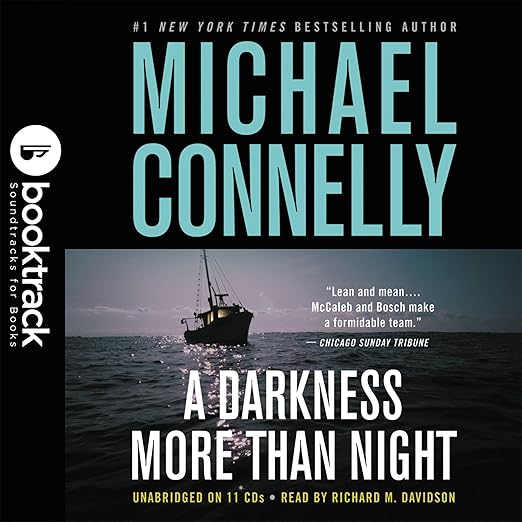
Harry Bosch in a murder trial. Terry McCaleb on a Catalina Island dock looking at a case that should not concern him anymore. In the audiobook A Darkness More Than Night, Michael Connelly places both men in positions of deliberate stillness before forcing them into motion, and that structural choice is what makes this entry feel different from most of the Bosch series. The narrative splits early and stays split for a long time before the two cases begin their convergence, and Connelly is patient enough to let that separation do its work before pulling the threads together in ways the setup makes inevitable but the execution makes surprising.
The Booktrack edition format noted in the synopsis adds a musical score to the narration. This is worth flagging at the outset: the audiobook pairs traditional narration with background music synced to the action on the page. Whether that enhances the experience is a question of individual taste. Some listeners find it cinematic; others find it intrusive. The narration itself is identical to the standard edition, so the story content is unchanged. Those who prefer unaccompanied narration should seek out an alternative edition if one is available in their preferred format.
Bosch and McCaleb's Cases Split Before They Merge
The structure is Connelly working at the edge of his usual approach. The Harry Bosch novels typically follow one detective and one investigation with the intensity of a magnifying glass held steady. Here, Connelly splits the narrative between Bosch's high-profile Hollywood murder trial and McCaleb's quiet, self-assigned investigation of an unreadable murder in the sheriff's jurisdiction. One reviewer described the plot as among the more complicated Connelly has written, noting that the central premise of the murder stretched credibility beyond his more grounded work. That is fair. This book asks more of its readers than the average procedural in the series, and it asks it in exchange for a more psychologically unsettling resolution than most crime fiction manages.
The Hollywood setting is used with real intelligence. Bosch's case involves a movie director charged with murdering an actress during sex and staging her death as suicide, and the circus of celebrity-mad Los Angeles serves as an ironic counterpoint to the quieter, more methodical evil McCaleb is tracking on the other side of the story. Connelly is interested throughout his career in what spectacle conceals, and the dual-case structure lets him pursue that interest from two angles simultaneously, creating a book that operates on a psychological level most procedurals do not attempt.
The Catalina Island sections deserve specific mention. McCaleb's retirement there is described with the kind of specific sensory detail that makes the disruption of his peace feel like a genuine loss. Connelly understands that the drama of a man being pulled back into investigative work requires that reader to feel what he is leaving behind, and the opening McCaleb chapters earn that investment before the case intrudes. When the sheriff's office asks him to take a quick look at a murder book he cannot put down, the reluctance is credible because the alternative has been established with real care.
Davidson Separates Two Voices Through Pacing Alone
Richard Davidson's narration handles the dual-protagonist structure with workmanlike clarity. He does not distinguish Bosch and McCaleb through radically different voices, which would risk caricature across twelve hours, but through pacing and tone. Bosch's sections carry tightness and forward momentum; McCaleb's breathe with the cooler, more analytical register of profiling work. That tonal differentiation matters in audio because it helps listeners orient to whose perspective they occupy without needing visual chapter markers as anchors.
This is also a book where one reviewer's response captures the essential experience: reading it while a spouse had already finished it, and hearing her say, I miss it already. That kind of response, the loss you feel when a world closes, is produced by a book that has successfully made you inhabit two specific men across a sustained period. Connelly achieves that here, and Davidson's narration is the vehicle for that inhabitation. The audio format is particularly suited to this kind of sustained character immersion when the narrator knows how to carry different modes of attention simultaneously.
The Long Setup Earns Its Final Revelation
The setup is long. Connelly is establishing two separate cases, two separate characters, and a web of circumstantial connection before the stories begin to converge. Listeners who favor Connelly's faster-paced entries may find the first third of the audiobook testing their patience. But the architecture is load-bearing and intentional. When the investigations finally merge, the payoff requires everything that was established before it. Skipping ahead would be like reading the last chapter of a legal case and missing the evidence that makes the verdict meaningful.
The most interesting development in the book involves a character you may come to distrust, and Connelly does not telegraph which character that is. The investigation McCaleb is conducting leads him somewhere genuinely alarming, and the book's final revelation asks listeners to reassess what they thought they had understood about events they witnessed directly. That kind of disorientation is more effective in audio because Davidson's narration has been carrying both perspectives with apparent even-handedness throughout.
Series Fans Get the Most From This Entry
Connelly fans who have been working through the Bosch series in order will find this a satisfying and unusually ambitious entry, the kind of book that demonstrates what a long-running series can do when it brings established characters into genuine conflict with each other. Listeners new to Connelly can enter here, but the emotional stakes are higher with prior acquaintance with both Bosch and McCaleb. Those who need their crime fiction tightly plotted and psychologically grounded will find this one more baroque than usual. That is the right description, and it is also, in its way, the point of what Connelly is attempting.
Good to Know
Can I listen to this audiobook without having read the earlier Harry Bosch books?
You can follow the plot without prior Bosch experience, but this is also a Terry McCaleb crossover, and the emotional stakes are considerably higher for listeners who know both characters. Connelly handles characterization well enough that newcomers are not lost, but this is not the ideal entry point into either series.
What is the Booktrack format, and does it affect the audiobook narration?
Booktrack adds a background musical score synced to the narration. The narration itself is identical to the standard edition. Whether the music enhances or distracts from the experience is genuinely individual, the story content is unchanged either way.
Is A Darkness More Than Night one of the stronger audiobooks in the Harry Bosch series?
It is structurally more ambitious than most entries, splitting between Bosch and McCaleb in a way the series rarely does. Reviewers describe it as complicated and slightly far-fetched at the plot level but rewarding for the character work and the convergence of the two investigations.
How does Richard Davidson handle the dual-protagonist challenge of voicing both Bosch and McCaleb in this audiobook?
Davidson differentiates the two through pacing and tone rather than extreme vocal distinction. Bosch's sections are tighter and more propulsive; McCaleb's breathe more slowly. The approach keeps both voices credible without caricature across the full twelve-hour runtime.