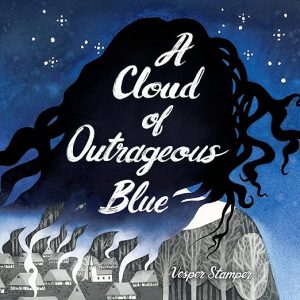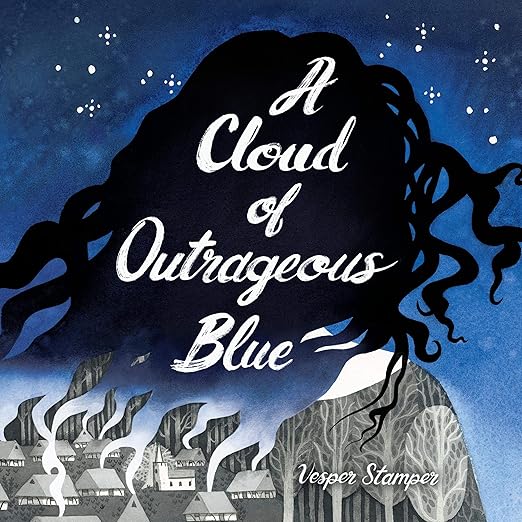
Vesper Stamper is an author-illustrator, and that compound is the single most important fact to hold in mind before buying this book as audio. A Cloud of Outrageous Blue runs eight hours and forty-eight minutes, follows a young woman named Edyth through the arrival of the Great Plague in 1348, and comes from a writer whose earlier book, What the Night Sings, won awards for its words and its pictures together. This audiobook keeps one of those halves. It is the better half for most listeners, and the listing never once mentions what became of the other.
What We Made of It
Edyth loses her family in what the description calls the blink of an eye, and is sent to live in a priory and work with ancient texts. A four-star response from October 2020 supplies the specifics the copy keeps vague: the story runs across 1348 and 1349, Edyth's parents die while another baby is expected, the family is shunned, and a brother who cannot keep her sends her to the priory to work rather than to take vows. That last distinction matters more than it appears to, because it makes Edyth staff and not novice inside her own refuge.
Synesthesia is the gift the publisher's copy declines to name. The blurb offers only the gifts she discovers in herself, while that same October response says it outright: when Edyth's synesthesia comes to light, the people around her read it as possibly divine. That is the actual engine of the novel, and burying it in a blurb does the book a disservice, because a fourteenth-century story about a girl whose senses cross and whose community decides this means God is a far more interesting proposition than a journey of self-discovery.
What Makes A Cloud of Outrageous Blue Worth Hearing
Only one response on this listing speaks about the recording at all, and it does so from an unusual position. A September 2020 reader keeps both the printed copy and the audio, the first because of a crowded schedule and the second in order to admire the colorful illustrations after hearing what that response calls the sonorous audio version, and it advises auditory learners to take the audio without hesitation. That is a specific and useful endorsement, and I will not stretch it past its length: one word about the sound is one word.
Nearly nine hours is generous for young adult historical fiction, and the length goes somewhere real. The novel builds its fourteenth century slowly, through the routines of a priory and the handling of ancient texts, before the plague turns those walls from shelter into a trap. Historical texture accumulates better in the ear than on the page, where the eye skims description to reach the dialogue, and a book about crossed senses gains something obvious from arriving through one of them.
Ell Potter carries the reading, and the material sets a demanding brief: an adolescent voice inside a medieval religious community, synesthetic description that has to sound like perception rather than like poetry, and a plague narrative that must not tip over into horror. Any one of those is manageable on its own. Holding all three steady across nearly nine hours is the actual job, and it is why casting matters more on a book like this than on a straightforward contemporary novel.
What Might Not Land
Reviews of an object you will not be buying account for two of the five entries on this page, and a third divides its attention between printed pages and the recording. The most explicit arrives from November 2023 under a heading calling the book imperfect but luminous, and consists almost entirely of one sentence about never having enjoyed the physical touch, weight, and illuminations of a book so much, followed by a parenthesis warning against reading it on a screen. A five-star rating attached to a remark about paper is not a judgment on this recording.
No line anywhere on the page warns you that the artwork does not survive the transfer. Stamper illustrated the book, the publisher's own copy calls the author an award-winning author-illustrator, and an audio edition necessarily leaves every image behind. That is not a fault in the production; it is a fact about the format, and a listing that sells an illustrated novel as audio without noting the loss leaves buyers to discover it for themselves. If the pictures matter to you, the sensible purchase is both editions instead of either one.
Content is worth flagging for parents weighing this up. The plague arrives, and a novel set in 1348 in which the plague arrives cannot be gentle about what that means; the story opens on a family's death and its immediate aftermath. The promise of falling in love sits alongside all of that and never replaces it. No age recommendation appears anywhere on the listing, so treat this as upper young adult and give the first hour a hearing before handing it to a younger listener.
Who Should Listen to A Cloud of Outrageous Blue
Teenagers who like historical fiction with real texture, and adults who read young adult fiction without apology, are the audience. An October 2020 response gets at what the book genuinely offers, describing being drawn into a world we never learn about in history class and praising the care taken to bring readers into what it calls the dark ages, so as to see that the period was not so long ago and the people not so different from us. That is precisely the effect, and it is why the book works in a classroom as readily as it works alone.
Readers who want a plague thriller, a romance with the romance out front, or a quick listen should go elsewhere, because the pace is deliberate and the interior life of one girl is the entire point. Anyone buying primarily for the art should take the printed edition and treat the recording as a companion to it. What remains is nine hours in a fourteenth-century priory with a girl whose senses refuse to behave, a stranger and better book than its own description makes it sound.
- Narrator: Ell Potter is credited with the reading, and the brief is an adolescent voice, synesthetic description, and a plague kept short of horror.
- Subjects: the Great Plague of 1348, synesthesia mistaken for divinity, life inside a priory, grief and self-possession
- Tone: Luminous, deliberate, quietly frightening
- Bottom line: A stranger and better novel than its blurb admits, though the audio edition costs you the artwork.
Does this audiobook come with any way to see Vesper Stamper's artwork?
The listing mentions no accompanying material of any kind, so assume the images do not travel with the recording. Buyers who want both will need the printed edition standing alongside it, which is an expensive answer to a question the product page should have answered plainly and does not.
Is this audiobook a sequel to What the Night Sings?
No. The two share an author and nothing else. The description invokes the earlier title purely as pedigree, since it won awards for its writing and its illustration together. You can start with either one, and the order makes no difference to how this story reads.