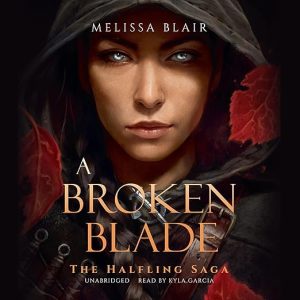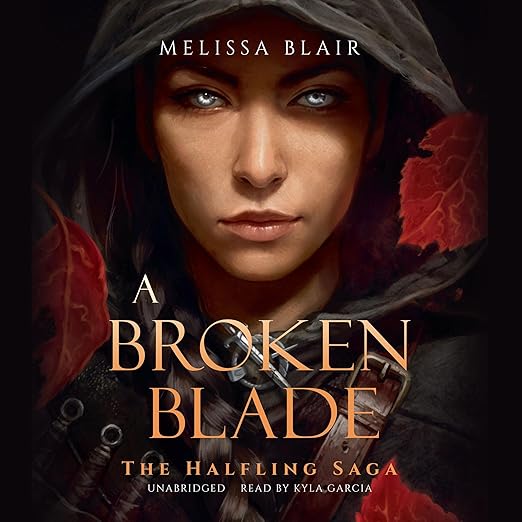
Keera opens this book by counting her scars and assigning blame for them, and the accounting is not generous to herself. My body is made of scars, some were done to me, but most I did to myself. Three lines, broken like verse, before any kingdom or plot arrives. Melissa Blair is setting the terms up front: this is a first-person account from somebody who has done real harm and will not be redeemed out of it by chapter four. Thirteen hours and twenty-one minutes of audiobook follow, opening The Halfling Saga with a royal assassin sent to hunt a rebel and discovering she may be standing on the wrong side of her own commission.
Broken is the word the title invites, and one four-star response rejects it outright, and the rejection is the most interesting critical argument attached to the listing. That response insists 'I wouldn't call her broken,' twice, on the grounds that Keera has been used her entire life to serve the crown's purposes, is quite literally scarred, and yet 'doesn't need anyone or anything else to fix her.' It credits the character with knowing her own power rather than discovering it. That is a meaningful distinction in a subgenre that usually routes its heroines through a fix-me arc, and it suggests Blair is writing damage as history rather than as a deficit awaiting repair.
Efficiency is the plot mechanism's chief virtue. Keera is the King's Blade, the most talented spy in the kingdom and its favored assassin, and when a figure called the Shadow moves against the Crown she is sent to hunt it. The hunt takes her into the magical lands of the Fae, where the description promises that neither Faeland nor the Shadow is what it appears, and the question reorganizes itself around which enemy is real: the king who destroyed her people, or the insurgent threatening the peace. Layered underneath is a promise Keera made long ago, which the copy flags as the thing that will test her most. Loyalty, in other words, is the actual subject.
Why It Works in Audio
Colonialism is the reading one response supplies that the description avoids, describing the book as a romantasy and noting how seamlessly the author 'wove in themes of colonialism and antiestablishmentarianism and sympathizing with those who had been taken advantage of or brutalized in some way.' The same response reports encountering the book through an Indigenous Reading Circles book club selection and thinking, more than once, 'I can tell a Native woman wrote this.' That framing reorients the whole premise. A halfling assassin serving the king who destroyed her own people is not a generic fantasy setup, and reading the Crown as a colonial apparatus makes Keera's compromised position considerably sharper than a loyalty dilemma alone would be.
Kyla Garcia takes on a demanding assignment. Those opening lines are typeset as broken verse, which means the line endings are timing instructions a reader either honors or flattens into prose. After that comes thirteen hours of sustained first person from a character who is deliberately withholding, since a spy's interiority has to feel guarded rather than confessional while still admitting the listener in. Fae names, invented ranks and a second world's vocabulary add a pronunciation layer on top. And the whole book turns on whether Keera reads as formidable or merely cold, a judgment a voice can tilt in either direction well before the plot has made its case.
Weak Spots in A Broken Blade
Every enthusiastic response concedes the same problem, which is unusual enough to take seriously. One five-star entry calls the beginning 'slow, almost painfully so,' then argues the buildup was necessary to understand Keera's pain and past, and that the payoff justified it retroactively. That is a real defense, but it is also a request for patience measured in hours rather than minutes on a thirteen-hour recording. The dissent comes from a three-star response that stayed the course and never got there: it wanted to care about Keera, 'couldn't,' and found her flat, while adoring the world and the magic and caring most about Riven and Nicolai instead. That response ends by declining to continue the series despite finding the ending intriguing, which is about as precise a warning as a prospective listener could ask for.
Chronology is where this listing comes apart. A response dated December 2021 sits roughly seven months ahead of this edition's August 2022 release, so whatever it describes, it is not this recording. That same response carries a decimal grade in its title which does not match the whole-star value recorded against it, so even its own verdict is reported two ways. The tags field, meanwhile, sits entirely empty on a book multiple responses call a romantasy, which means none of the descriptors a browsing listener would search on are attached to it at all. Read the average as a rough signal and the individual responses as the actual evidence.
Who Will Get the Most From It
Morally compromised protagonists rather than reluctant chosen ones: that is the clearest audience here. One five-star response describes Keera struggling with guilt over an assassin's career she was forced into as a child, with survivor's guilt over someone lost, and with the near impossibility of proving loyalty to a group that has every reason to distrust her, and calls the result 'impossible to put down' once it moves. Fae-politics listeners get a second world with its own stakes rather than a backdrop. And anyone drawn to fantasy that reads colonial history rather than decorating with it will find this doing genuine work under the romantasy label.
Listeners who need momentum from the opening chapter should be warned by the consensus rather than reassured by the average, because the slow start is not a minority complaint. Anyone who bounces off first-person narration will be stuck with Keera for the full thirteen hours with no relief. Readers hoping for a self-contained story should note this is volume one of a saga with threads left deliberately open. Star ratings are the least reliable thing on this page, and the individual responses are where the actual evidence sits.
Before You Listen
Is this audiobook a romantasy or a straight fantasy?
A hybrid, and the listing gives no tag at all to settle it. The description supplies a royal assassin, a rebel figure called the Shadow, and a journey into Fae lands, while the promise Keera made long ago drives the emotional line. Expect court intrigue and colonial themes carrying real weight.
Does A Broken Blade work as a standalone?
Not really. The series field marks it as volume one of The Halfling Saga, and the description sets up a kingdom-scale rescue that a single book cannot close. Keera's long-ago promise is explicitly flagged as the thing that will test her most, which points well past this installment.
How slow is the opening of this audiobook?
Slow enough that the pacing complaint appears in the enthusiastic responses as well as the critical one, which is unusual. Budget a few hours before judging, since the buildup is doing character groundwork rather than stalling. If your patience for that is limited, sample the first chapter before committing.
What should listeners be prepared for tonally?
The book announces itself with three lines about scars, most of them self-inflicted, so self-harm and guilt are present from the first page rather than introduced later. Keera is the king's favored assassin, and the narrative does not soften what that career involved or excuse her out of it.