Key Details
- Narration: Ritesh Jha brings warmth and clarity to Devdutt Pattanaik's meditative prose; his pace suits the short-chapter format without feeling rushed or artificially slow.
- Themes: Hindu mythology and symbolism, obstacles and transcendence, the ritual logic behind devotion
- Mood: Contemplative and quietly illuminating, like sitting with a patient teacher over several afternoons
- Verdict: A genuinely accessible entry point into Ganesha's symbolic universe that respects both the curious newcomer and the practicing devotee.
I spent a Sunday morning last spring trying to make sense of a temple I had walked past a dozen times in the Tamil neighborhood of a city I was visiting for a conference. Ganesha appeared everywhere: on doorframes, on shop signs, in small brass figures on restaurant counters. I had a general sense of the elephant-headed deity as a remover of obstacles, but the texture of that belief, the stories behind the symbols, the logic of the rituals, was opaque to me. I downloaded this audiobook on the train home and finished it in two sittings. By the end, what had been decorative became readable.
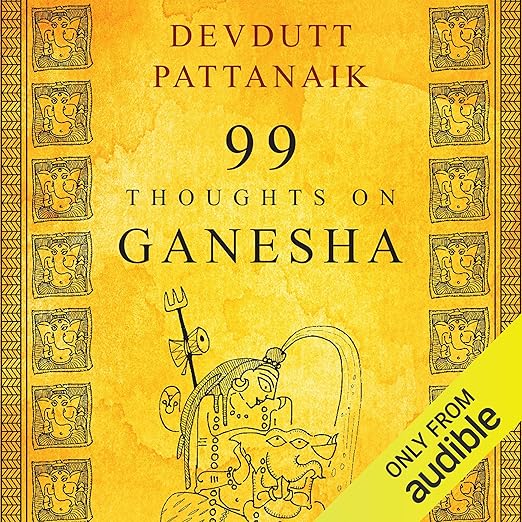
Devdutt Pattanaik's approach in 99 Thoughts on Ganesha is structured around brevity and accumulation. Each of the ninety-nine meditations is short, typically three to six minutes in audio form, and addresses a specific aspect of Ganesha's iconography, mythology, or ritual role. The conceit works better than it initially sounds. Rather than building a linear argument, Pattanaik circles his subject from different angles, the way you might walk around a statue to understand it fully. By the time you reach the final chapter, you have not been given a thesis. You have been given a way of looking.
The Verdict, Briefly
Pattanaik opens with the cricket metaphor that shapes the book's framing: the batsman who stands at ninety-nine runs, one away from a century, is in exactly the state that Ganesha governs. Fear, distraction, the gap between effort and achievement, all of these are Ganesha's domain, and the choice of ninety-nine as the book's number is not decorative but structural. It positions the listener perpetually at the threshold, never quite at the final answer but always approaching it. It is a clever choice that gives the otherwise loose collection of chapters a felt coherence.
The creation stories are where the book surprised me most. Multiple incompatible origin stories for Ganesha exist across different regional Hindu traditions, and Pattanaik presents them without hierarchy, without declaring one more authentic than the others. One reviewer described learning that "there are so many different creation stories of Ganesh" as revelatory, and I felt the same. This plurality is not a confusion in the text but a feature of it. Pattanaik is interested in what the existence of multiple stories tells us about the nature of divine symbolism itself: that meaning accumulates through variation, not through singular authority.
Why 99 Thoughts on Ganesha Works as an Audiobook
The elephant head, the broken tusk, the large belly, the mouse as vehicle, the modak sweet held in one hand: Pattanaik decodes each of these with a patience that never condescends. The large ears are for listening, the small mouth for speaking less. The broken tusk, used by Ganesha as a pen to transcribe the Mahabharata, represents the sacrifice required for knowledge. The mouse, often overlooked in Western encounters with Ganesha imagery, is explained as ego: the small destructive thing that Ganesha rides and controls rather than eliminates. That particular meditation stayed with me. The idea that the goal is not to destroy the ego but to redirect it is a more psychologically sophisticated position than most Western self-help traditions manage.
The book does not shy away from ritual context. Pattanaik explains why Ganesha is invoked first in any Hindu ceremony, what the significance of specific offerings is, and how regional variations in practice reflect different aspects of the deity's character. For a listener with no background in Hinduism, this is genuinely useful grounding material. For a listener who grew up with the traditions, reviewers suggest it serves as a structured reflection on things known but not always examined.
Points to Consider
The narration is clean and unhurried. Jha reads Pattanaik's prose with a quality I would describe as conversational gravity: he does not perform the material so much as present it, which is exactly what this kind of meditative text requires. The short chapters make the listening rhythm particularly comfortable for commutes or morning routines, and because each chapter stands alone, there is no anxiety about losing your place if you are interrupted mid-listen.
At two hours and twenty-seven minutes total, this is a short audiobook by any measure. Some reviewers who came to it hoping for scholarly depth found it too introductory. That critique has merit if you are already deeply familiar with Shaiva tradition. But Pattanaik is not writing for scholars. He is writing, as he always does, for the curious general reader who wants to understand why half a billion people revere a specific deity and what the accumulated symbolism actually carries. For that purpose, the brevity is an asset, not a limitation.
Who Should Listen to 99 Thoughts on Ganesha
If you are coming to Ganesha with no prior knowledge of Hindu mythology, this audiobook will orient you quickly and enjoyably without asking you to wade through academic apparatus. If you are a practicing Hindu looking for devotional content, it may feel more analytical than prayerful, but the meditation chapters toward the end have a quality of genuine reverence that bridges that gap.
If you want a single comprehensive text on Ganesha's place in Hindu philosophy, this is a starting point rather than a destination. Pattanaik is a popularizer in the best sense: he clears the path and points you toward something worth exploring further. The book that comes after this one, whatever you choose it to be, will be richer for having listened here first.
Frequently Asked Questions
Do you need any background knowledge of Hinduism to follow this audiobook?
None at all. Pattanaik is known for writing accessible mythology for general audiences, and each chapter is self-contained enough that you can follow the symbolism without any prior knowledge of Shaiva or Vaishnava traditions.
Is this a devotional audiobook or an analytical one?
Primarily analytical, in the sense that Pattanaik examines stories and symbols rather than leading the listener in prayer. However, the tone is respectful and the later chapters have a meditative quality that devotional listeners may find satisfying.
How does Ritesh Jha handle the Sanskrit terms and proper nouns in the narration?
Jha pronounces Sanskrit terms correctly and without self-consciousness, which matters for a text this dense with Ganesha's many names. Ganapati, Gajanana, Vinayaka, and Pillayar are all presented clearly and contextually so listeners can follow without a glossary.
At under two and a half hours, is this audiobook substantial enough to justify the time?
The brevity is intentional. Ninety-nine short meditations work better at this pace than they would expanded into longer chapters. You come away with a genuinely changed understanding of Ganesha's symbolism, which is the book's stated goal, and it accomplishes that efficiently.