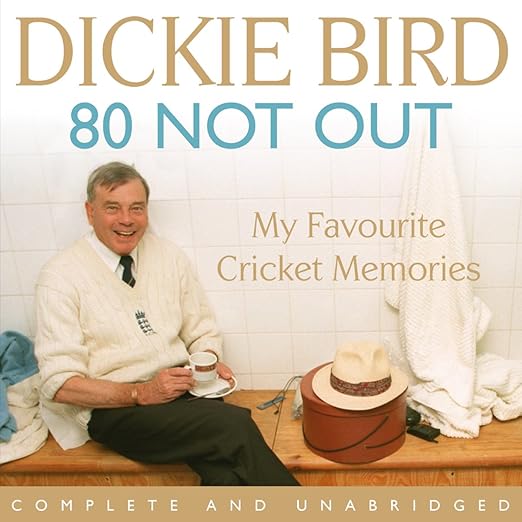
Before You Press Play
- Read by: Gareth Armstrong takes the first person for an umpire the copy calls a lovable eccentric, which is a casting job before it is a reading one.
- At its heart: Umpiring at the top level, Yorkshire cricket, six decades of anecdote, a game full of characters
- Vibe: Warm, chatty and deliberately unserious
- Short version: A delight for cricket followers who want stories, and thin for anyone after a career reckoning.
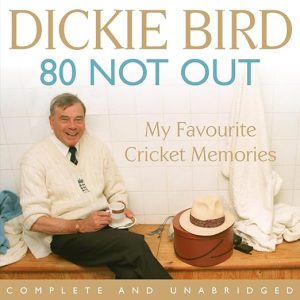
Half a century of cricket grounds, and Dickie Bird was at most of them. This audiobook gathers the memories he decided to set down as his eightieth birthday approached: a Yorkshire player who turned to umpiring, became the most famous umpire in the game, and went on turning up at county and Test matches long after he stopped standing in them. Seven hours and seven minutes of it, read by Gareth Armstrong.
Something on this page has been rewritten since the recording was made. The description opens by calling Bird the late, best-loved umpire in Britain, and says later that until his death he remained the most famous of them all, while the book inside was written by a man approaching eighty and looking forward to the next season. Hodder and Stoughton dated this audio edition April 18, 2013. The marketing copy has been updated for a death. The recording has not.
That gap is worth holding on to, because it changes how the whole thing reads. The book itself is present tense in spirit: hardly a week going by without a visit to a county or Test arena, old friends to reflect with, a career still being enjoyed from the boundary. The copy wrapped around it now reads as an obituary. A listener gets the cheerful version inside a frame built for mourning, and the mismatch is nobody's fault and still worth knowing about.
One response, filed from India in October 2025, supplies the missing information directly, recording that Bird died on 25 September 2025 at the age of ninety-two and dating the book itself to 2014, which does not match the April 2013 release stamped on this record. It also lays out the sequence a newcomer needs: Yorkshire county cricket first, then a move into umpiring, then a working lifetime of watching the game from the middle.
What Dickie Bird Gets Right
Cricket writing lives or dies on anecdote, and Bird had six decades of it gathered from a position nobody else occupies. An umpire stands closer to the players than any commentator, has no side to take, and hears everything said in the middle. The book is a collection of moments rather than an argument, which is precisely the promise the title makes and precisely what it delivers. I finished it with a dozen stories I wanted to repeat and no clear sense of what the man thought about anything, which is the deal on offer.
A response from May 2019 gets at the appeal better than the publisher does, describing the experience as being like listening to Bird talk over a pint in his local pub, and crediting him with a remarkable memory for detail across an era full of large characters. That is praise for the writing rather than for the recording, and it is the closest anything on this page comes to describing how the material sounds.
Casting a first-person memoir is a problem of its own, and this one is harder than most. The description calls Bird a lovable eccentric with a joyful sense of fun, and that has to arrive in the first person without tipping into impersonation of a man whose manner was part of his fame. The record credits Gareth Armstrong alone, and the charm of the book depends on that balance being struck correctly for seven hours.
Where Dickie Bird Loses Some Ground
The sharpest dissent here is a two-star from July 2013 calling the book a rag-bag of quotes, stories and other observations. It allows that some of the stories are quite funny, then argues that the general impression is of something thrown together, and the text cuts off mid-sentence at exactly the point where that criticism was about to be completed. The truncation belongs to the page rather than to the reviewer, and it leaves the one substantial objection on display half-stated.
The January 2021 five-star was bought for somebody else and describes a second-hand copy that turned up quickly in immaculate condition. Praise for the condition of a used book is praise for a parcel, and it tells a prospective listener nothing whatsoever, which is a recurring hazard on records where a single rating pool serves several formats at once.
Storefronts are stacked here as well. The written responses arrive from the United States, the United Kingdom and India, so one average carries opinion from three separate markets and, judging by the dates, several separate editions. The badge reads 4.3 across 196 ratings while the visible written sample sits noticeably below it. Even the title keeps its British spelling, a small sign that this is a UK product sitting in a catalog built for somewhere else.
Who Should Pick Up 80 Not Out: My Favourite Cricket Memories
Followers of the county game and the Test era Bird worked in will get the most from this. A July 2013 four-star sets the expectation accurately: not as full of facts as his other books, it says, but still a delight for the sheer number of cricketing anecdotes, closing on the thought that the game needs more characters like him. Anyone who wants the stories rather than the statistics is in the right place.
First-time cricket listeners should probably start somewhere with more explanation, since the book assumes you already know the grounds, the formats and roughly who everyone is. Anyone hoping for a considered late-career reckoning will find something warmer and looser instead: a man in his eightieth year enjoying himself, on a page that has since been rewritten to sound like a farewell.
Common Questions
Does the 80 Not Out audiobook cover Dickie Bird's entire career?
It covers the highlights he chose to revisit rather than working through everything in order. The framing is a man approaching eighty picking out the moments worth retelling, which means favourite memories in the literal sense, with plenty of the career left out by design rather than by oversight.
Who reads the 80 Not Out audiobook?
Gareth Armstrong, on a Hodder and Stoughton recording dated April 18, 2013 and running seven hours and seven minutes. The author is not the reader here, so the first-person voice belongs to an actor throughout rather than to the umpire whose memories fill the book.
How much cricket knowledge does this assume?
A fair amount. The book takes familiarity with grounds, formats and the players of the period as given, and it explains very little as it goes along. Somebody with a casual interest will still catch the humor, but the pleasure of recognition is doing most of the work here.