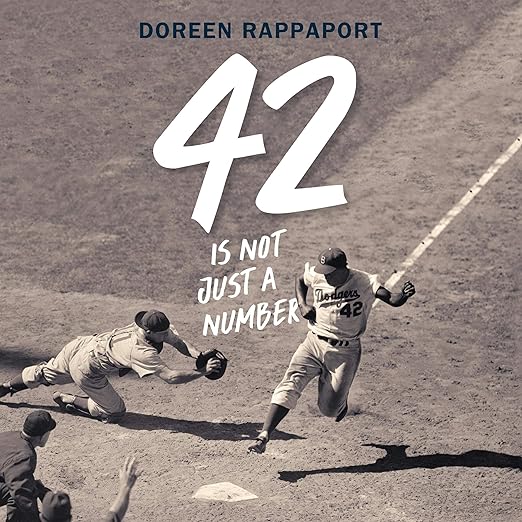
At a Glance
- Read by: JD Jackson brings controlled gravity to Robinson's story without theatricalizing it; his delivery trusts the material to carry its own weight and the result is one of the stronger performances in the young adult biography audiobook category.
- At its heart: racial segregation and athletic excellence, the cost of strategic dignity, the gap between individual achievement and structural justice
- Vibe: Measured and historically grounded, with genuine moral weight
- Short version: A disciplined young adult biography that earns its compact runtime through honest framing of Robinson's anger and Jackson's narration that treats the subject as history rather than simplified legend.
Writing Jackie Robinson's story for a young adult audience is a harder task than it appears. Robinson's life resists simplification: the grace under genuinely dangerous racial hostility, the private anger that Branch Rickey required him to suppress for years, the political activism of his later life that cost him the uncomplicated hero status his earlier years had earned. Doreen Rappaport's 42 Is Not Just a Number navigates that complexity with more honesty than most biographical treatments aimed at younger readers, and JD Jackson's narration of this audiobook brings both the subject's dignity and the structural injustice around him into full register.
First, the Big Picture
Rappaport frames Robinson's life around the specific cruelty of his situation in the 1930s and 1940s: his athletic talent was exceptional across multiple sports, but the systems that would have rewarded that talent were closed to him for no reason connected to ability. She does not soften the anger that must have accompanied that knowledge. Robinson chafed at the Negro Leagues not because the league was without value but because he understood, correctly, that the separation itself was the message. The book's approach to that anger is one of its most honest qualities: it does not convert Robinson's frustration into inspiration before acknowledging what the frustration was about.
Branch Rickey's role receives careful treatment. Rappaport neither reduces Rickey to a purely idealistic actor nor makes him a strategic opportunist. The decision to recruit Robinson was both principled and calculated, and the book allows both to coexist. Rickey's famous preparation of Robinson, 'I want a player with guts enough not to fight back', is presented with enough context that younger listeners understand what was being asked and why, without the moral weight of that demand being erased by triumph-of-the-human-spirit framing.
What Makes 42 Is Not Just a Number Worth Hearing
JD Jackson is one of the most accomplished voices working in audiobook narration today, and his performance here demonstrates precisely why biographical audio benefits from narrators of his caliber. He reads Robinson's story with the kind of controlled gravity that the subject demands, not somber, not celebratory, but present to the complexity. His voice carries historical weight without theatricalizing it. The moments of Robinson's public humiliation on the field, the spiking, the verbal abuse, the hotels that would not take him while his teammates stayed, are read with a precision that trusts the material to convey its own weight.
The book's two-hour-and-ten-minute runtime means Rappaport works efficiently. The biography covers Robinson's multi-sport collegiate career at UCLA, his military service and court martial for refusing to move to the back of a bus, his Negro Leagues tenure, the 1946 recruitment by Rickey, and the 1947 debut season with the Brooklyn Dodgers. Each phase receives proportional attention without being rushed. For a young adult biography, the compression is disciplined rather than reductive.
A Few Reservations
The book is structured for a middle-grade and young adult audience, which means the prose is accessible and the chapter architecture is more episodic than analytical. Adult listeners who want the full complexity of Robinson's later political activism, his relationship with Malcolm X and Dr. King, his criticism of baseball's failure to hire Black managers, his eventual break with the Republican Party, will find this account focuses primarily on the baseball integration period. Rappaport mentions Robinson's post-baseball life but the book's weight falls on the 1947-1956 playing career.
Reviewer Maria noted 'I needed it for school and I loved it so much', which reflects the book's primary audience and its success at reaching that audience. Reviewer danielle button found it a 'fast paced good read' for a seventeen-year-old. JD Jackson's narration elevates what could have been a routine educational text into something that functions as genuine biography rather than simplified history.
The book's treatment of Robinson's relationship with Branch Rickey is one of its most instructive sections for young adult readers encountering the history for the first time. Rappaport presents the dynamic with a degree of complexity unusual in the genre: Rickey is neither a simple hero of racial justice nor a cynical opportunist. He understood that the integration of Major League Baseball required a specific kind of player, one with athletic excellence, emotional discipline under provocation, and the capacity to be publicly humiliated without providing the opposition with the confrontation they sought. He found that combination in Robinson, and the arrangement was both principled and strategic. That complexity teaches something real about how social change happens, which is rarely through pure altruism alone.
JD Jackson's vocal presence adds particular value to the passages about Robinson's public composure under hostile conditions. Jackson reads those moments with gravity rather than performed outrage, which is the correct register for a biography aimed at young people who need to understand the actual difficulty of what Robinson accomplished rather than just the triumphant headline version. The restraint in the narration mirrors the restraint Robinson was required to demonstrate, and that formal correspondence between subject and narrator is one of the audiobook's more elegant qualities.
Who Should Listen to 42 Is Not Just a Number
The audiobook works for middle-grade listeners encountering Robinson's story for the first time and for adult listeners who want a concise, JD Jackson-narrated account of Robinson's integration of Major League Baseball. The two-hour runtime makes it practical for classroom use or for parent-and-child listening. It is also a strong choice for baseball fans of any age who want context for the retirement of Robinson's number across the entire league, an honor that the number 42 in the title directly references.
Adult readers who want the full biography of Robinson's life, particularly his post-baseball activism, his business career, and his evolving public politics, should supplement with Arnold Rampersad's comprehensive biography or David Falkner's account. What Rappaport delivers is a precise and honest introduction to the most consequential player in the sport's social history, and JD Jackson's narration gives that introduction the weight it deserves.
Questions Listeners Ask
Is the 42 Is Not Just a Number audiobook appropriate for adult listeners, or primarily for children?
The prose is written for a middle-grade and young adult audience, but the audiobook functions for adult listeners as well, particularly those who want a concise JD Jackson-narrated account. The two-hour runtime makes it an efficient companion to more comprehensive Robinson biographies.
Does this audiobook cover Jackie Robinson's life beyond his baseball career?
The book's primary focus is Robinson's integration of Major League Baseball and his 1947 debut season with the Brooklyn Dodgers. His post-baseball activism, political evolution, and business career receive brief mention but not sustained treatment. Adult listeners seeking full-life coverage should supplement with Rampersad's comprehensive biography.
Is this audiobook a good choice for middle school or high school classroom use?
Yes. The runtime of two hours and ten minutes is practical for classroom or homework listening. Rappaport's structure is episodic and follows a clear chronological arc. JD Jackson's narration is at the level that encourages rather than alienates younger listeners.