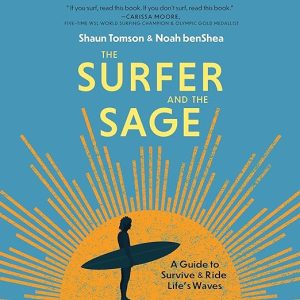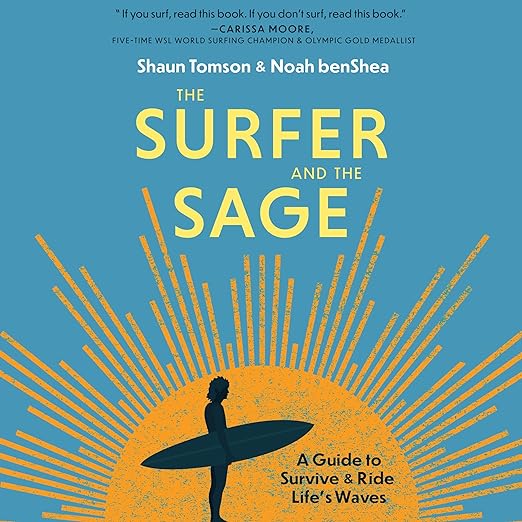
Shaun Tomson's name appears in the opening pages of The Surfer and the Sage, and if you know surfing history at all, that name carries weight. Tomson is a world champion surfer from the tube-riding generation of the 1970s who became something more unusual: a public philosopher of the ocean and of the particular kind of courage that confronting large waves demands. Noah benShea, his collaborator here, is an international bestselling poet-philosopher whose work intersects with Tomson's in the idea that physical experience and spiritual reflection can illuminate each other rather than existing in separate domains. This audiobook, narrated by benShea himself, brings their collaboration into an audio format that suits the material well.
The structure alternates between Tomson's experiential essays and benShea's philosophical commentary. Eighteen 'waves' of life are addressed, from loss and grief through aging, relationships, and depression, and each receives both the grounded personal testimony of a man who has lived through it and the reflective layering of a poet trying to articulate what that testimony means. The audiobook's organizing metaphor is not merely decorative: waves are genuinely ambivalent in Tomson's experience. They have taken things from him. They have also, he argues, given him access to something essential about the nature of difficulty and choice.
What We Made of It
BenShea narrating his own work brings a particular quality to the philosophical commentary sections. His voice is measured and slightly formal in a way that marks him as someone accustomed to public speaking and reading aloud; the cadence of his sentences is already shaped for oral delivery, which is partly why his aphoristic writing transfers well to audio. Reviewers describe the book as containing 'so much wisdom and positivity' and as 'phenomenal for anyone who is riding tough waves of life,' which is how the book positions itself: not as a clinical self-help resource but as companionship through difficulty.
The personal backstory that gives the book its emotional center is Tomson's loss of his son. That event is present throughout the audiobook as the specific loss against which the philosophical framework has been tested. Tomson does not sentimentalize it or use it as a credential for grief authority; he treats it as the fact that gives the book's argument about moving from darkness into light its evidential weight. For a book that addresses depression, grief, and loss alongside more navigable difficulties like aging and relationship strain, that anchoring in specific loss is what prevents the positive framing from feeling like a performance of optimism.
What Makes The Surfer and the Sage Worth Hearing
BenShea's philosophical commentary functions as the counterpoint to Tomson's experiential directness, and the alternating structure means neither voice dominates for long. The book does not demand sustained concentration in the way that a linear argument does; it is built from shorter pieces, each addressing a specific life challenge, which makes it well-suited to the kind of listening that happens in intervals rather than in a single extended session. The two-hour-fifteen-minute runtime means the full book fits comfortably in a single long session, but it also works in shorter pieces.
One reviewer described the discovery of the book by picking it up from a hotel coffee table and being immediately absorbed, which captures something about how the content is calibrated: it is immediately accessible rather than requiring situational framing or background knowledge. Another reviewer described it as appropriate for 'anyone who is riding tough waves of life (which is all of us),' and benShea's writing consistently holds that universality without becoming vague. The eighteen waves framework gives the book enough structure to feel organized without feeling like a self-help checklist.
What Might Not Land
The surfing metaphors are more than genre decoration. Tomson writes about specific moments in specific surf breaks, and the physical detail of those passages grounds the philosophical extensions that benShea builds from them. The point about choice, that even in the moment of being knocked down by a wave the choice of how to respond remains available, is not an abstraction for Tomson: it is something he learned by nearly drowning several times and still getting back in the water. That specificity carries into the discussions of depression and grief in ways that distinguish this book from more conventionally structured spiritual guidance.
BenShea's aphoristic style has a particular rhythm that becomes clearer across the audiobook. His commentary passages are shorter than Tomson's essays, and they work by compression rather than development. Some of those compressed observations are genuinely striking; others require a moment of sitting with them before they resolve. The audiobook rewards that sitting: benShea's lines are written to echo rather than to be processed on first contact, and hearing them read aloud gives them the pause they need.
The Right Listener for The Surfer and the Sage
This audiobook is for listeners navigating genuine difficulty, or who want a companion text for difficult periods without the clinical or therapeutic frame that most mental health adjacent content carries. It is explicitly spiritual without being narrowly doctrinal; the framework is open enough that readers from various faith traditions or no tradition will find points of entry. Listeners who want rigorous philosophical argument or empirically grounded self-help methodology should look elsewhere. Those who want the wisdom of specific, hard experience translated into language worth carrying with them will find the audiobook's two hours some of the most worth spending.
In Brief
- Narrator: BenShea self-narrates with the cadence of someone whose writing was already shaped for oral delivery, and the aphoristic sections particularly benefit from his voice.
- Subjects: Grief and resilience, the philosophy of difficulty, spiritual wisdom through physical experience
- Tone: Reflective, honest, and quietly luminous
- Bottom line: A short and substantive audiobook about navigating life's hardest passages, grounded in Tomson's specific losses and benShea's distilled philosophical insight.