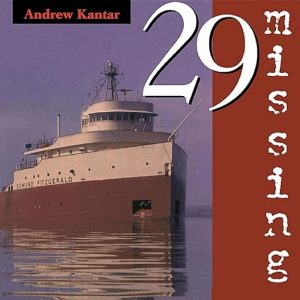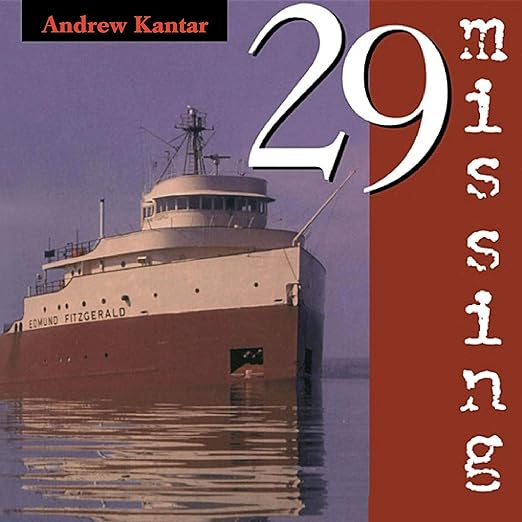
Can an hour and a quarter hold a shipwreck people have argued about for half a century? The SS Edmund Fitzgerald went down in Lake Superior on November 10, 1975 with all twenty-nine aboard, and the audiobook Andrew Kantar built from that night runs one hour and fifteen minutes. The brevity is a design decision rather than a shortfall: the book was written primarily for young adults, and Todd Curless reads it for University Press Audiobooks.
First, the Big Picture
Kantar's method gets described accurately by a March 2022 response, which credits the book with portraying what the ship's last night might have been like while keeping the many unknowns in plain view. That is the hard part of writing this particular wreck: nobody survived to say what happened, and every reconstruction is inference wearing the clothes of narrative. The same entry calls Kantar a Michigan author giving voice to Great Lakes shipwrecks so the ships and the men aboard them stay remembered, and then breaks off mid-word while discussing the book's length.
Radio traffic is the device that keeps the reconstruction defensible. The description says the account draws on government investigative reports and includes dialogue taken from actual transmissions between the Fitzgerald and the Arthur Anderson, the freighter following behind her. That distinction lands harder in audio than in print, because a transmission read aloud is the nearest a listener gets to the event itself, and it also marks precisely where documented speech ends and reconstruction begins.
What Makes 29 Missing Worth Hearing
Nine years before this recording existed, a September 2010 response left the most substantial appraisal on the page, calling the account brief yet captivating and recommending two other Kantar titles by name: Deadly Voyage on the loss of the Daniel J. Morrell in Lake Huron, and Black November on the Carl D. Bradley in Lake Michigan. It also gives itself a title quoting a line attributed to Captain Ernest M. McSorley on November 10, 1975. That entry belongs to readers who came to Kantar through print and then worked through the rest of the catalog, which is its own recommendation.
Documentary and dramatic are two different registers, and this recording has to move between them repeatedly inside seventy-five minutes. Todd Curless carries a factual reconstruction assembled from investigative reports, then has to deliver radio exchanges spoken by men who did not survive the night, without turning them into performance and without flattening them into data. The young-adult framing raises the difficulty further, since clarity has to win over atmosphere every time the two compete. Open on the radio-transmission passages rather than the christening chapters.
Length works as an advantage rather than a limitation here. A wreck story told across four hundred pages has to fill the gaps, and the gaps are exactly where this subject invites invention. The runtime covers the ship from her 1958 christening as the largest vessel on the Great Lakes through to the 1995 expedition that recovered her bell, and it leaves the competing explanations standing as explanations, which the description notes maritime experts continue to debate.
A Few Reservations
Fifty pages is the detail that gives the game away. An October 2021 response describes buying the book for a grandfather who finished it in three hours without putting it down, praises the print as very legible and readable, and reports the length as a very quick read of only fifty pages. Every one of those observations concerns a physical object. It is a warm, specific account of a printed edition sitting underneath a seventy-five-minute recording, and a buyer skimming the column for reassurance will absorb it without noticing the substitution.
Somewhere in the making of this listing, a word got replaced by a machine. The description opens with the phrase "A read Michigan Notable Book for young adults", which is not English, then reports that "the audiobook provides a dramatic hour-by-hour account" while a closing line still states that "The book is published by Michigan State University Press". The pattern fits an automated pass that swapped one noun for another across existing print copy and mangled a sentence on its way through.
Publisher information disagrees with itself too. The publisher field on this record reads University Press Audiobooks, while the description's own final line names Michigan State University Press. Both statements can be true at once, since a university press licenses its list to an audio house as a matter of routine, but a buyer reading the page has no way to tell whether one organization is involved or two, and nothing on the record explains the relationship.
Should You Listen to 29 Missing?
Teachers and school librarians are the natural buyers, and the record all but says so: written primarily for young adults, carrying notable-book recognition in Michigan, and short enough to fit a single class period with time left over to argue about causes. Great Lakes families will want it for entirely different reasons. Anyone who has heard of the wreck without ever meeting the documented account gets exactly that, in less time than a feature film takes.
Adults after the full forensic argument should look further, because a book written for young readers necessarily compresses the technical dispute, and the leading theories arrive summarized rather than adjudicated. Anybody hoping for a survivor's perspective will not find one, and the title explains why. Seventy-five minutes will not settle what happened out there, and the book is honest enough never to pretend otherwise.
Good to Know
Does this audiobook work in a classroom?
It was built for it. The record describes the book as written primarily for young adults while remaining enjoyable at any age, and it carries notable-book recognition in Michigan. The running time fits comfortably inside one period, and the subject is a documented disaster rather than a graphic one.
Does the audiobook include the actual radio transmissions?
The description says the account uses dialogue drawn from real radio exchanges between the two freighters, alongside government investigative reports. What the record does not specify is whether the production marks those passages with any change of treatment, so the preview is the place to check.
Who was the Arthur Anderson, and why does the account keep naming her?
She was the freighter following the Fitzgerald through the storm that night, and the exchanges between the two vessels form the documentary spine of the reconstruction. Because those transmissions were logged, they are among the few things about the final hours that nobody has to infer.
Is this audiobook a good starting point if I know nothing about Great Lakes shipping?
Yes, and that is close to its design brief. It establishes scale by noting the Fitzgerald was the largest ship on the lakes at her christening, then works outward from a single night. No background in maritime history or in freighter operations is assumed at any point.