In Brief
- Voice: A single credited reader, Amanda Dolan, on a 2020 Recorded Books production; nothing on the listing describes the casting beyond that credit.
- Big ideas: Ghetto resistance, adolescence under occupation, the arithmetic of impossible odds
- Atmosphere: Tense and plainspoken, with ordinary teenage life still audible under the catastrophe
- Worth it?: Serious Holocaust fiction that happens to be shelved as young adult; take the label as a note on Mira's age, not on how hard the book lands.
Mira is sixteen, and the work that keeps her family breathing is smuggling food past the wall of the Warsaw ghetto. That is the situation David Safier hands you in the first minutes of this audiobook, and it is worth noticing how little setup goes into it. No establishing lecture about 1942, no map of the district, no roll call of historical actors. A girl, a wall, a bag of food, and a family that eats if she gets back. Everything the novel later asks of her, and it asks a great deal, grows out of that one repeated errand.
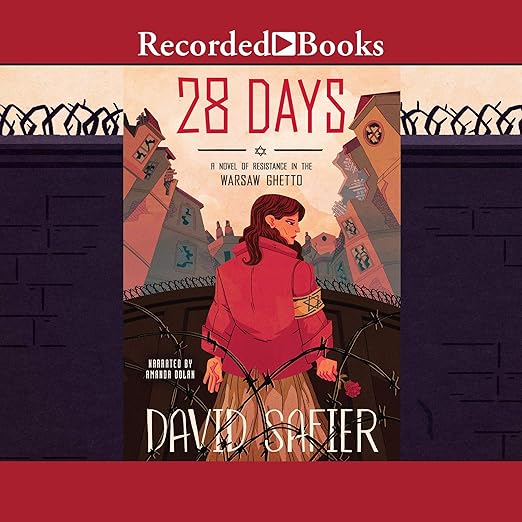
Note the title before you go searching. The listing calls this 28 Days; the publisher copy calls it 28 Days: A Novel of Resistance in the Warsaw Ghetto, which is the fuller and more accurate name, and anyone searching for that longer version will not find it in the title field here. Recorded Books issued the recording in April 2020 with Amanda Dolan credited as the sole voice across ten hours and fifty-four minutes. Forty-eight ratings sit behind the 4.7 average, though only four written responses are visible, and one of those is a grandparent relaying a thirteen-year-old's verdict instead of their own.
Where This One Lands
What Safier does with tone is the part that surprised me. A novel set inside the ghetto could reasonably run at one emotional pitch from beginning to end, and this one refuses to. A United Kingdom entry posted two months after release describes the book as running from love to hate and from laughs to tears, and credits it with giving a tangible sense of the environment the action sits in. That range is not decoration. Adolescence keeps happening inside the catastrophe: crushes, jokes, sibling irritation, vanity. Safier lets all of it persist instead of clearing it away, and the horror registers harder because ordinary life stays visible underneath.
The title is a countdown and the novel knows it. The group Mira falls in with holds out for twenty-eight days with almost nothing: improvised weapons, no relief coming, no realistic expectation of winning. The description is blunt that they lasted longer than anyone had thought possible, which is the only shape victory takes in this material. Safier builds the back half around that arithmetic, so you count alongside the fighters, and the counting does most of the tension work without any thriller machinery bolted on.
Why 28 Days Works as an Audiobook
A September 2023 response is the most useful thing in the pool for setting expectations. Its writer opens by admitting to having read few young adult novels, then says this one reads like adult historical fiction, and singles out the terror Mira carries as the element that keeps coming at you. I agree with the classification quibble. The teen and young adult shelving reflects the age of the protagonist and the plainness of the prose, not the difficulty of the content, and the History and Culture tag on the same record is the more honest signal of what you are buying.
At ten hours and fifty-four minutes this is a full-length listen, not a school-length one, and Amanda Dolan is credited as the only voice on it, with no second cast member and no dramatization. That single-reader format suits a novel told from inside one girl's head, where you have no access to information Mira does not have. The claustrophobia is structural. You learn what she learns, when she learns it, which is why the deportation sequences land the way they do instead of arriving as historical summary.
What Gives Us Pause
Nothing about this is softened for the age bracket. Starvation, deportation, and killing are all on the page, and the novel declines the protective distance that some Holocaust fiction for young readers builds in. A September 2025 entry, five stars, goes further and reads the book against present-day events, arguing that eighty years of distance has not made the material safely historical. Whether or not you follow that particular application, it tells you something true about the experience of listening: this does not feel like a period piece while you are inside it.
Two things are worth knowing before you start. Mira is invented and the uprising is not, and the novel moves between the two without flagging the seam, so listeners who want to separate documented event from dramatic license will have to do that work afterward. And the romantic thread that develops among the fighters sits oddly against the surrounding devastation for some readers. My own view is that it belongs, because young people did not stop being young, but it is a genuine tonal risk and better met knowingly than by surprise.
Who Should Pick Up 28 Days
The September 2020 entry reporting a thirteen-year-old's reaction is the closest thing here to age guidance from an actual household, and it is positive, if secondhand. I would put the floor around that age and add that an adult in the vicinity helps, less because the book is graphic than because it resolves nothing on the listener's behalf. Teachers and parents looking for a companion to classroom Holocaust reading will find this sits alongside primary testimony instead of competing with it: a novel about deciding whether to comply, flee, or fight, told by someone with no good options available.
Skip it if you want historical fiction that keeps a comfortable distance from what it describes, or if you need a narrative that arrives somewhere consoling. Adults who avoid the young adult shelf on principle should reconsider for this one, since the label is about Mira's age and very little else about the book is calibrated for a young audience. The full runtime is a real commitment for material this heavy, and I would not run it end to end. Broken across a week, with room between sessions, it does what the best of this genre does: it turns something you have read about into something someone Mira's age had to decide.
Does the audiobook use the full title 28 Days: A Novel of Resistance in the Warsaw Ghetto?
The publisher copy does; the title field on this listing does not, showing only 28 Days. Anyone searching the longer name may miss the record entirely, and the subtitle is the part that tells a browser what the novel is about. The recording carries the unabridged text either way.
Is Mira a real person from the Warsaw Ghetto?
The description presents the novel as inspired by true events and Mira as its protagonist, without claiming she existed. The ghetto liquidation and the twenty-eight-day holdout are historical. Her family, her smuggling route, and the fighters she joins are the novelist's construction built around them.
How much of the audiobook is the uprising and how much is life before it?
The setup occupies a substantial stretch: smuggling runs, family arguments, the slow arrival of the liquidation news. The armed resistance is the final movement, and its length is fixed by the title. Listeners expecting a war novel from the first hour will be waiting a while.
Is anyone besides Amanda Dolan on the recording?
No. Dolan is the sole reader named. Recorded Books lists no second performer, no full-cast treatment, and no author introduction, so the whole novel arrives in one voice. Nothing on the listing points to an abridged or dramatized alternative, and the runtime is consistent with a complete text.