Quick Take
- Big ideas: Impermanence and presence, the gap between knowing and understanding, everyday enlightenment
- Atmosphere: Quietly meditative, best absorbed in small doses rather than all at once
- Worth it?: A short and unpretentious collection that works as a daily practice companion, with individual stories compact enough to carry you through an afternoon with a single idea.
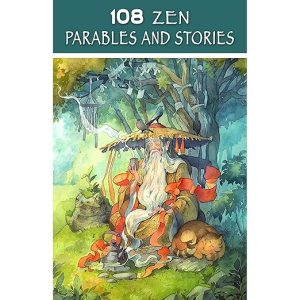
Zen literature has a particular problem in audio: its power depends on silence, on what is not said, on the space a story creates rather than fills. Olga Gutsol's 108 Zen Parables and Stories is a 2-hour collection of traditional koans and parables from the Sacred Wisdom Stories series, rendered as an audiobook through AI narration. At its best, the format transforms these fragments into a listening experience closer to a meditation companion than a conventional audiobook. The collection's 108 stories, matching the sacred Buddhist count of human desires, range from brief koans designed to short-circuit rational thought to longer parables woven through with local legend and folk narrative. The number itself carries meaning: in Buddhist tradition, 108 represents the full cycle of human attachment, and a collection that takes the number seriously is making a structural claim about the scale of what it hopes to address.
The context for this collection matters. Koans were originally oral forms, public sayings of great masters presented to students to test their understanding of Zen. They were never meant to be resolved the way a riddle is resolved; they were meant to create an experiential gap between the question and the available answers. Gutsol's framing describes the goal as allowing our true Buddha nature to free up from any obstructed perceptions of a fragmented mind and to flow in unison with the river of the universe, which is more poetic than precise but captures the spirit of the koan tradition accurately. These are not stories you are meant to understand on first hearing. They are stories you are meant to carry with you through the day and find returning unexpectedly.
The most useful framing for this audiobook came from reviewer K.D., who compared the experience to eating peanuts: you read one, then you have to read another, and before long you have finished the bag. That addictive quality is not accidental. Koan collections are designed for accumulation, for the way meaning accretes across multiple encounters with seemingly simple material. In audio, this translates to a collection that works well when listened to in short sessions of five or ten minutes, allowing each story to settle before the next one begins. Two hours of sustained listening is technically possible, but probably not the wisest approach to material this concentrated. The format works best as a practice rather than a performance.
K.D. also noted one small inconsistency in the text itself: stories that occasionally begin with the word "One" where "A" or "An" would be grammatically correct. This is worth knowing in advance. The collection has the texture of translated material where idiomatic smoothness was not the primary concern, and the AI narration does not correct for these moments. For listeners who find such roughness distracting, it surfaces occasionally enough to be a minor but real irritant. For listeners accustomed to Zen literature in translation, where a certain quality of foreignness in the language is part of the tradition's resistance to over-familiarity, the roughness reads as characteristic rather than careless.
Five or Ten Minutes at a Time
The case for this audiobook is partly about format and partly about intention. At just over 2 hours, it is genuinely not a commitment. Individual stories run from a minute or two to perhaps five minutes, which means you can dip in before sleep, during a break, or at any moment when you want a brief reorientation of perspective. Reviewer Thanh Nguyen described these as invaluable lessons for life, and while that is generous, the best stories in this collection do carry the quality that makes koan literature endure across centuries: they refuse easy answers and leave a question where the conclusion should be, and you find yourself returning to them the way you return to a stone in your pocket.
The Sacred Wisdom Stories series positioning places this squarely within the tradition of accessible Zen anthologies aimed at Western readers who may not have prior familiarity with koan practice. Gutsol's editorial approach is to present stories in a form that preserves their paradoxical quality without requiring extensive doctrinal knowledge. That democratizing intention works more often than it fails. The stories that work best are the ones where the parable and the local legend genuinely intertwine, creating something richer than a simple moral lesson about impermanence or non-attachment.
Virtual Voice Narration Misses the Zen Pause
The AI narration is the primary limitation here. Virtual Voice technology has improved considerably, but it struggles with the precise tonal qualities that koan delivery requires: the pause, the slight flattening of affect that makes a Zen teacher's response feel both ordinary and devastating, the way a short silence after a punchline is part of the teaching itself. What you get instead is competent but undifferentiated reading that treats all 108 stories with the same measured pace. For some listeners this neutrality works; it can become almost meditative in itself. For others, the absence of a human narrator's interpretive presence will feel like a significant absence in material this dependent on tone and timing.
There is also the question of whether 108 stories at roughly one minute each create cumulative depth or mere accumulation. Not all 108 are equally strong. Some feel like repetition of a theme rather than a new angle on it. The collection rewards selective return and personal favorites built over time more than it rewards a single linear listen-through from beginning to end. Treating it as a source to draw from rather than a book to complete changes the experience considerably.
Skip It If You Want Systematic Zen Doctrine
This audiobook suits listeners who already have some interest in Zen or Buddhist thought and want a brief, accessible collection to revisit regularly rather than consume once and set aside. It works as a daily practice companion, as something you return to before or after meditation, or as a low-stakes entry point into koan literature for people who find longer treatments intimidating. Skip it if you want a systematic introduction to Zen doctrine or a historically contextualized account of the koan tradition. This is a collection for personal use, not scholarly inquiry, and it is most valuable when treated as a living resource rather than a book to be finished.
Frequently Asked Questions
Does the audiobook format work well for Zen parables, given that koans depend on silence and reflection?
It works best when listened to in small doses rather than as a single sitting. At just over 2 hours total, the collection lends itself to brief daily sessions where individual stories have room to settle. The format trades the physical pause of turning a page for the pause you impose yourself as a listener, which is part of the practice.
Is the AI narration in the 108 Zen Parables and Stories audiobook a significant drawback?
It is a limitation worth knowing about in advance. Virtual Voice narration delivers the text competently but cannot replicate the tonal precision that a skilled human narrator would bring to koan delivery. The pauses and subtle affect that make a Zen teacher's response feel both ordinary and devastating are absent. For some listeners the neutrality works; for others it will feel like a missing instrument.
Do you need background knowledge of Zen or Buddhism to follow this audiobook?
No prior knowledge is required. Gutsol's editorial approach makes the collection accessible to readers with no familiarity with koan practice. The stories function as parables even without doctrinal context, and the audiobook does not assume existing knowledge of Buddhist thought.
Are all 108 stories in the audiobook equally strong, or does the quality vary significantly across the collection?
Quality varies. Some stories in the collection feel like repetitions of a theme rather than distinct angles on it, and the AI narration does not differentiate between them tonally. The collection rewards selective return and building your own list of favorites more than it rewards a single linear listen-through.