Quick Take
- Narration: Gisela Chipe brings controlled energy and genuine authority to this history, letting the archival material breathe without overperforming the drama.
- Themes: women in athletics, immigrant ambition, 1920s celebrity and its cost
- Mood: Propulsive and quietly moving
- Verdict: A sports history that earns its place alongside the best narrative nonfiction about athletes who broke barriers before the language existed to describe what they were doing.
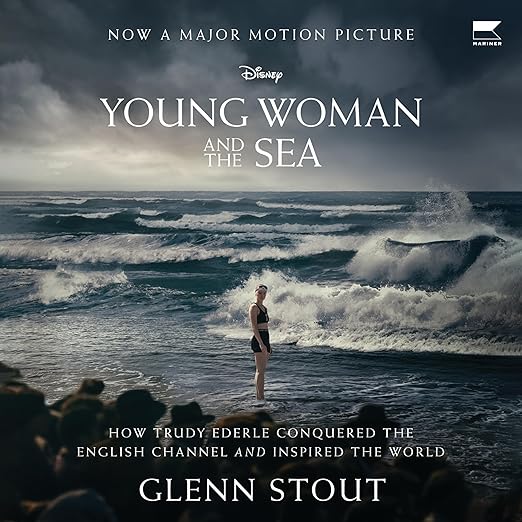
I was somewhere over the Atlantic when I first listened to the opening chapters of Young Woman and the Sea, and I remember thinking that Glenn Stout had done something genuinely difficult: he had written a sports book that felt like it was actually about something. The English Channel crossing is the event, but the book is really about who gets to be called an athlete, who gets to fail publicly and try again, and what happens to a woman when the world decides she is the most famous person in it.
Trudy Ederle’s story is one of those cases where the facts are so extraordinary that the writer’s main challenge is not finding drama but organizing it. By age twenty, she had already set multiple world records and won Olympic gold. The Channel crossing in 1926 was her second attempt, after a disputed first try the year before where her trainer controversially pulled her from the water against her will. Stout reconstructs both attempts with the kind of archival patience that makes the climactic fourteen-hour swim feel genuinely uncertain even when you know the outcome.
Our Take on Young Woman and the Sea
What separates this from a straightforward celebration is Stout’s willingness to document the cost of fame as carefully as he documents the achievement. Ederle returned from the Channel to a ticker-tape parade in New York, a deal with Paramount, and a level of celebrity that the infrastructure of 1926 had no real way of managing. Stout follows this arc without editorializing, which is the right call. The sadness accumulates on its own.
The book’s first third, which covers the broader history of Channel swimming and the development of women’s competitive swimming in America, is where some listeners have reported losing the thread. One reader described having to reframe the early chapters as a series of interconnected stories before the narrative fully cohered. That is fair criticism. Stout is building context that pays off substantially in the second and third acts, but the patience required in the opening section is real. For listeners who stick with it, the payoff is a protagonist whose achievement feels fully situated in the world that made it possible and remarkable.
Why Listen to Young Woman and the Sea
Gisela Chipe’s narration is well-suited to the material. She does not sentimentalize. Sports history benefits from a narrator who trusts the facts to carry emotional weight, and Chipe does exactly that. The pacing during the Channel crossing itself is particularly effective, maintaining forward momentum across what is, in real time, a very long swim through a gale. The 15-hour runtime feels appropriately proportioned to the scope of the story being told.
Stout’s detail about Trudy’s sister Meg, who helped engineer both the two-piece swimsuit and the leak-proof goggles that made the crossing possible, is one of those facts that sounds small but illuminates everything. The crossing was a collective achievement wearing one person’s name.
What to Watch For in Young Woman and the Sea
Readers familiar with the 2024 Disney film of the same name will find the book substantially richer in detail, particularly around the contested first attempt and the complicated relationship between Trudy and her various coaches and managers. The film has its own value, but the audiobook is the more complete account.
One reviewer noted that fewer people today have swum the English Channel than have climbed Everest, a fact Stout includes that quietly reframes the entire enterprise. The Channel crossing is not a quaint historical footnote. It remains one of the most demanding athletic feats on the planet, which retroactively sharpens the contempt directed at women who attempted it in the 1920s.
Who Should Listen to Young Woman and the Sea
Essential listening for anyone interested in sports history, women’s athletic history, or the Jazz Age as a cultural moment. Also recommended for listeners who followed the 2024 film and want the fuller account. The early chapters ask for patience, but the reward is proportionate. Those expecting a straight-line biography may need to adjust to Stout’s contextual approach in the opening section.
Frequently Asked Questions
Do I need to watch the 2024 Disney film before listening to this audiobook?
Not at all. The book stands completely on its own and is considerably more detailed about the contested first Channel attempt and the political dynamics around women’s athletics in the 1920s. The film is a reasonable companion piece but not a prerequisite.
Is the audiobook’s opening section hard to follow?
Some listeners find the early chapters, which establish the broader history of Channel swimming and women’s athletics, slower going before Trudy becomes the clear central focus. Think of it as an extended prologue that pays off substantially once the main narrative kicks in around the midpoint of the first third.
How does Gisela Chipe handle the drama of the Channel crossing itself?
With real restraint, which is exactly right. She maintains steady pacing through the fourteen-hour swim, neither rushing nor overdramatizing. The narration during the gale sequence has genuine tension without manufactured urgency.
Does the book cover what happened to Trudy Ederle after the crossing?
Yes, and it is one of the more sobering parts of the story. Stout documents the parade, the Paramount deal, and the way her celebrity became unmanageable, without turning it into a cautionary tale. He follows the evidence and lets readers draw their own conclusions about fame’s cost.