Quick Take
- Narration: Danny Montooth keeps Grant’s desperation credible and the riddle sequences kinetic, though his register stays fairly uniform throughout.
- Themes: Abduction and coercion, marriage under pressure, the logic of obsession
- Mood: Breathless and propulsive, with a slightly deflating final stretch
- Verdict: A fast, genuinely suspenseful thriller that works best if you surrender to the pace and do not push too hard on the puzzle mechanics.
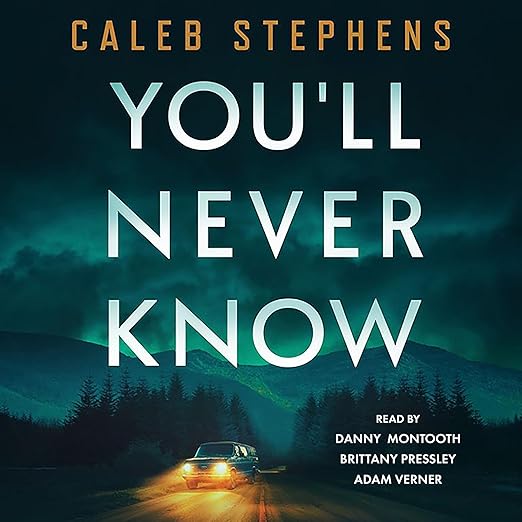
I was washing dishes when I started You’ll Never Know and I did not finish the dishes. By chapter three, Grant Wilson’s wife Avery had been taken, the first riddle had arrived, and I had abandoned all domestic responsibilities in favor of following this increasingly unhinged treasure hunt through a landscape of mounting dread. The novel is blurbed by Freida McFadden, who calls it full of clever twists and says she shed a tear or two, which is exactly the kind of endorsement that makes thriller readers nervous and eager in equal measure.
The premise is stripped to its bones in the most effective way. Grant Wilson is happy, country home, pregnant wife, everything intact. Then two masked men take Avery in broad daylight and the instructions begin arriving: solve the riddles or she dies. No negotiation. No police. Just Grant, the clock, and a series of puzzles that escalate from bizarre to outrageous. Each piece of the puzzle is more complex than the last, and Caleb Stephens has designed the riddle architecture with enough internal logic that the listener can follow Grant’s reasoning without the whole structure collapsing under scrutiny.
Our Take on You’ll Never Know
What Stephens does well is pace. The novel rarely allows a breath, and the riddle structure gives each chapter a built-in propulsive hook: you solve one, you get another. That mechanical forward motion is also the novel’s main vulnerability. When the twists land, they land hard. When they do not, the rickety scaffolding of the puzzle logic becomes visible. One reviewer noted that some timeline details felt implausible; another said the main twist was visible from a distance. Both reactions are fair. The novel is operating at a register where plausibility is secondary to propulsion, and if you cannot make that trade, the seams will show.
The comparison to Adrian McKinty’s The Chain in the marketing is apt in terms of structure but not in terms of depth. The Chain built a sociological portrait of coercion and complicity inside its thriller mechanics. You’ll Never Know is more focused and more breathless, which is both its strength and its ceiling. If you go in expecting McKinty-level interiority, you will be disappointed. If you go in expecting nine hours of relentless forward motion, you will finish it in a sitting and find the experience largely satisfying.
Why Listen to You’ll Never Know
Danny Montooth’s narration suits the material. Grant Wilson is a man acting on instinct and adrenaline, and Montooth keeps the performance in that register without overcooking the desperation. The riddle sequences, where Grant must decode increasingly elaborate instructions under time pressure, benefit from audio delivery because Montooth’s pacing creates genuine countdown tension. Reading on the page, you might rush ahead. Listening, you are locked into his tempo and the urgency has nowhere to go but into the story itself.
What to Watch For in You’ll Never Know
The final act is where opinions divide most sharply. Several listeners wanted more closure between the two main characters after everything they have endured together, and the novel leaves that space more open than most thrillers of this type would. This is worth flagging if you are a reader who needs emotional resolution alongside plot resolution. The book earns its tension. It does not entirely earn its goodbye, and that gap is real. Whether it bothers you will depend on how invested you became in Grant and Avery as people rather than as plot functions.
Who Should Listen to You’ll Never Know
Listeners who want a kinetic, puzzle-driven thriller and can tolerate some implausibility in the mechanics will enjoy this one considerably. It is a debut, and it reads like one in the best sense, the author has not yet learned to hedge. For a first novel, the control over pace is impressively sustained. Skip it if you need your thrillers psychologically complex or if an emotionally incomplete ending will sour an otherwise strong experience.
Frequently Asked Questions
How similar is You’ll Never Know to Adrian McKinty’s The Chain, which it is compared to in the marketing?
The structural similarity is real: both involve a protagonist forced to solve escalating tasks to save a family member. McKinty’s novel has more sociological depth and a more complex moral trap. Stephens leans harder into pure pace, think of it as a tighter, faster version of that premise without the same layered critique.
Does the twist land in audio, or does it work better on the page where you can go back?
Most listeners seem to find the twist works in audio, though Montooth does not signal its arrival with any particular shift in performance. Listeners who suspected it coming say the audio still delivers the emotional beat effectively.
Is Grant a compelling protagonist for almost ten hours, or does the single-goal structure make him feel thin?
Reviewers are split on this. The relentless pace prevents deep characterization, but Montooth keeps Grant sympathetic. Listeners who need layered protagonists may find him functional rather than fully realized.
Does the ending provide closure, or does it feel cut off?
Multiple reviewers flagged wanting more closure between the two central characters. The plot resolves; the emotional aftermath is left more open than many listeners wanted. Approach it as a sprint, not a character study.