Quick Take
- Narration: Elizabeth Knowelden manages three distinct female voices across nine-plus hours of escalating tension without losing grip on any of them, which is the baseline requirement for this kind of multi-POV thriller.
- Themes: Female friendship as performance and resentment, secrets and social veneer, suburban violence
- Mood: Taut, petty, and deliberately uncomfortable
- Verdict: A twisty, character-driven domestic thriller that earns its bonfire finale, with the caveat that the first quarter requires patience and none of the women are written to be liked.
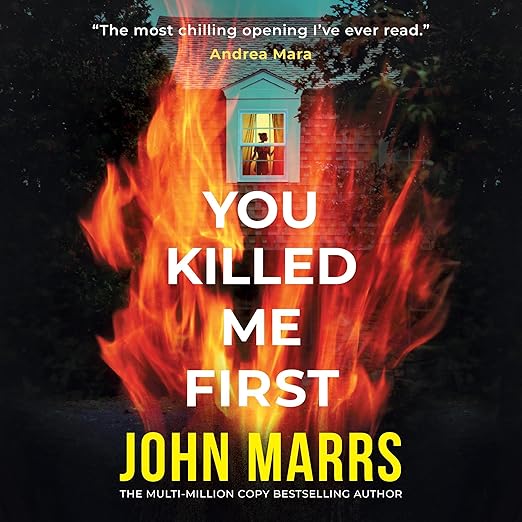
I was halfway through my commute on a Tuesday morning when the bonfire scene that opens You Killed Me First clicked into place. John Marrs drops you there first: a woman, bound and gagged, trapped inside a towering bonfire on the fifth of November, smoke thickening, flames approaching. Then he rewinds eleven months and gives you the three women whose entangled secrets produced that moment. It’s a structural choice that would be a gimmick in lesser hands. In Marrs’s, it becomes the organizing principle of a novel that is fundamentally about the gap between how women present themselves and what they are actually capable of.
Margot, the faded TV star, and Anna, her long-suffering friend, are the established residents watching as Liv and her flawless family arrive on their street. The friendship that forms between the three women is, from the first chapter, explicitly fabricated. They know they’re performing for each other. Liv senses something wrong beneath the polished surface almost immediately. And each of them is carrying a secret heavy enough that the discovery of the others’ secrets sets off a chain reaction that ends in fire. What Marrs does well is sustain the reader’s investment in that chain reaction without allowing any of the three women to become simply a villain or simply a victim.
Our Take on You Killed Me First
The comparison invoked by the blurb endorsements, Freida McFadden called it “electrifying and page-turning,” Sarah Pinborough gave it five stars, Andrea Mara called it “trademark John Marrs and then some” is accurate in the sense that this is a book that operates with professional confidence in a specific thriller mode. Marrs knows how to construct a mystery that rewards both the reader who tries to stay ahead of it and the reader who surrenders to being led. The twist in the middle of the book that completely reconfigures what came before is the kind of structural move that separates writers who understand construction from writers who just understand suspense.
The decision to make all three central characters difficult to root for is deliberate and, I think, correct. Reviewers who note that they “hated all of the characters” are usually making that observation as a critique, but in Marrs’s framework it’s actually the point. You Killed Me First is interested in what happens when the ordinary social performances women are required to maintain, of niceness, of support, of the appearance of comfortable suburban contentment, become untenable. The women in this novel are not likeable, but they are believable in their specific unlikeability, and that’s a harder thing to achieve.
Why Listen to You Killed Me First
Elizabeth Knowelden’s narration is the right choice for this material. Three women, three distinct backgrounds and social registers, and a timeline that moves nonlinearly through the eleven months preceding the bonfire: that’s a complex audio challenge, and Knowelden handles it with clean character differentiation. She doesn’t dramatize the women’s awfulness; she lets the writing do that, which is the correct instinct. A more theatrical narration would tip the book into camp, and Marrs isn’t writing camp. He’s writing something that wants to feel as though it could be happening in a real suburb.
The audio format suits the book’s pacing structure better than a print read might, because Knowelden’s voice maintains the forward momentum through the sections that several reviewers found slow, particularly the opening quarter. The momentum of audio narration compensates for the deliberate scene-setting pace of the first act in a way that print can’t.
What to Watch For in You Killed Me First
The first quarter of the book is slow, and multiple reviewers noted it independently. Marrs is doing necessary work, establishing the women’s histories, their relationship dynamics, and the specific texture of their deceptions, but the payoff is backend-loaded. Listeners who find the early chapters too deliberate should commit to at least the midpoint before making a judgment: the twist that lands there reshapes everything that came before it.
The three-POV structure with additional secondary characters is a lot to track across nearly ten hours. One reviewer described it as “borderline confusing” and noted the timeline as “drawn out,” which is a legitimate criticism for listeners who want their multi-POV thrillers tighter. The writing style in the prose is also described by at least one reader as “flowery,” with sentence structures that occasionally require rereading. In audio, Knowelden smooths some of that over, but the underlying stylistic tic is present.
Who Should Listen to You Killed Me First
This is for domestic thriller listeners who enjoy the specific pressure of stories built around female social performance and the violence that lies underneath it. If you’ve read Liane Moriarty’s Big Little Lies or Sarah Pekkanen and Greer Hendricks’s work and want something darker and less redemptive in tone, Marrs’s novel is in that territory but pushier with its secrets and more willing to let its characters remain morally compromised.
Skip it if you need at least one character to root for, or if multi-POV thrillers that require you to hold several contradictory accounts of events simultaneously tend to frustrate you. The book is demanding in that specific way, and listeners who find that kind of unreliability more tiring than enjoyable will have a harder time with the nine-plus hour runtime.
Frequently Asked Questions
Is the Bonfire Night setting and structure gimmicky, or does it earn its place in the narrative?
It earns its place. The opening bonfire scene is not just atmosphere: it’s the destination the whole eleven-month rewind is building toward, and the structure creates a specific dramatic irony where you know what’s coming but not who or why, which sustains tension across the full runtime.
How does Elizabeth Knowelden differentiate between the three women in her narration?
Through vocal register and temperament rather than accent work. Margot, Anna, and Liv come across as distinct personalities in Knowelden’s reading, which is essential for a book that depends on readers understanding each woman’s perspective as genuinely hers, not as a variation on a single narrator.
Does You Killed Me First have a satisfying resolution, or does it end on ambiguity?
The ending provides answers and closure on the central mystery, but the moral resolution is messier than a conventional thriller would offer. Marrs doesn’t deliver tidy justice, which is consistent with the book’s overall refusal to make things comfortable.
How does this compare to John Marrs’s other thrillers in terms of darkness and pacing?
Reviewers who know his work describe it as ‘trademark John Marrs and then some,’ suggesting it sits at or slightly beyond the darker end of his usual range. If you’ve read The One or What Lies Between Us and found those comfortable, this will feel familiar but more compressed in its social malice.