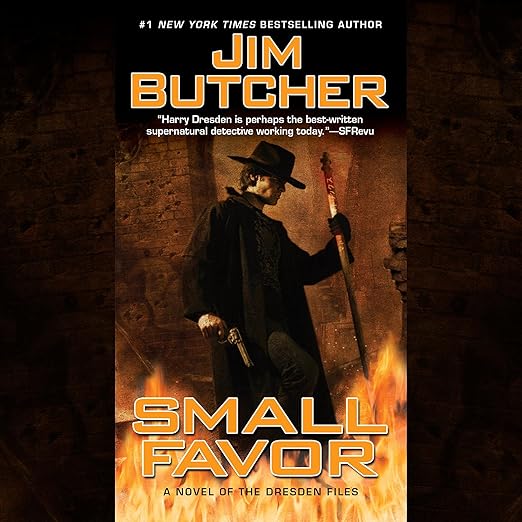
Quick Take
- Narration: James Marsters is definitively Harry Dresden, his sardonic timing and gritty Chicago cadence have been building for ten books and it shows.
- Themes: Faerie debt and obligation, loyalty under impossible pressure, the cost of power
- Mood: Relentless and propulsive, with flashes of dark humor
- Verdict: Book ten of the Dresden Files delivers the series’ biggest structural shifts yet, and Marsters makes every gut punch land.
I had been listening to the Dresden Files for weeks straight when I reached Small Favor, and by that point James Marsters had become so inseparable from Harry Dresden that the idea of any other narrator felt almost absurd. I queued up this one on a cold Tuesday commute, about halfway through a January that had been exactly as grim as the Chicago winter Butcher conjures in the opening chapters. By the time Mab showed up to collect her favor, I had missed my stop.
Small Favor is the tenth book in the series, and Jim Butcher treats that milestone as permission to start pulling threads he has been laying since book one. This is not a standalone adventure. If you have not lived through Dresden’s earlier entanglements with the Winter Court, the weight of Mab’s request will not land the way it should. But if you have put in the hours, this installment rewards that investment in ways that feel genuinely earned rather than plotted.
Our Take on Small Favor
The premise is deceptively contained: Mab wants Harry to rescue mob kingpin Johnny Marcone, who has been snatched by parties with enough supernatural firepower to level a fortified safe house. What opens as a mob rescue quickly expands into something that involves the Denarians, fallen angels housed in ancient coins, and a set of confrontations that reviewer Nicholas King accurately described as the first moment where major shakeups begin in the Dresden universe. That description is earned. Butcher has been content for nine books to let his world run on familiar rhythms. Here, he starts breaking things.
The pacing is characteristically relentless. Butcher has always written action sequences that translate beautifully to audio, and Marsters has the physicality of Harry’s voice down to something almost instinctive, the way exhaustion creeps into the narration during extended fights, the particular register he uses when Harry is running on stubbornness alone. The Lake Michigan section that reviewer D. Mikels highlights is genuinely surprising geography for a series rooted in Chicago street-level grit, and Marsters handles the tonal shift with ease.
Why Listen to Small Favor
The argument for the audiobook over the print edition of the Dresden Files has always been Marsters, and that argument only sharpens here. He has spent ten books calibrating the voices of characters like Thomas, Murphy, and Michael Carpenter, and the relationships between them have accumulated enough history that a simple exchange of dialogue can carry real emotional freight. Reviewer Karen Joan put it well: both Jim and Harry keep growing. Butcher’s plotting is more confident here than in the early installments, and Marsters matches him, finding gradations in Harry’s voice that the text alone cannot fully convey.
The Thomas and Harry scenes in particular benefit from audio delivery. These brothers have a dynamic that lives in subtext, in what is not said, and Marsters is careful not to over-explain it. That restraint is the work of a narrator who understands the material deeply.
What to Watch For in Small Favor
One reviewer who gave the book four stars noted that Harry spends a fair amount of time processing grief and that it gets wearing. That is a fair observation. Dresden’s emotional life has always been a tension point in the series, Butcher wants his protagonist to feel things, but Harry’s particular brand of self-flagellation can tip into repetition across a long listen. If you are coming in fresh from the previous book, you may feel the weight more acutely than someone spacing out their listens. The audiobook at 13 hours and 49 minutes is long enough that pacing variations matter.
Reviewer Charles Green also noted that the book leaves more loose ends than previous installments. This is true, and intentional. Butcher is clearly building toward something larger, and Small Favor functions partly as a structural pivot. Some threads are opened here that will not resolve for several more books. If you need clean endings, this entry will frustrate you. If you are in it for the long arc, it will make you immediately queue up Turn Coat.
Who Should Listen to Small Favor
Series listeners who have reached book ten already know whether they are in or out, this review is really for anyone who has been holding off on the Dresden Files entirely and wondering where the ceiling is. The answer is that the series keeps raising it, and Small Favor is convincing evidence. Do not start here. Start with Storm Front, let Marsters grow into the character over a few books, and by the time you reach this one the payoffs will hit as intended. Readers who came up on noir fiction, urban fantasy with genuine consequence, and serialized storytelling in the tradition of Raymond Chandler will find a lot to respect. Those who need their audiobooks self-contained should look elsewhere in Butcher’s catalog.
Frequently Asked Questions
Do I need to have listened to all nine previous Dresden Files books before starting Small Favor?
You do not need to have heard every prior book, but you will lose significant emotional weight if you skip the earlier Mab and Denarian storylines. At minimum, books three through nine will give you the context this installment assumes. Starting here blind will work as a thriller but not as a Dresden Files experience.
Is James Marsters still the narrator for Small Favor, and does his performance hold up at book ten?
Yes, Marsters narrates the entire Dresden Files series including Small Favor. Most listeners would argue his performance actually improves as the series progresses, by book ten he has refined the supporting cast voices and his physical characterization of Harry has real depth that earlier entries were still developing.
How does Small Favor compare to Dead Beat and White Night in terms of action and scale?
Small Favor escalates further than either of those. The Denarian storyline raises the supernatural stakes considerably, and the structural changes Butcher introduces here affect the series long-term in ways that Dead Beat and White Night, though both excellent, do not quite match.
Is the mob figure Johnny Marcone worth knowing before this book?
Marcone appears throughout the series and his role here is much richer if you have watched his relationship with Harry develop. He functions as a morally complex foil whose interests occasionally align with Harry’s, and Small Favor puts that dynamic under real pressure. His earlier appearances in books one, four, and six are particularly relevant.