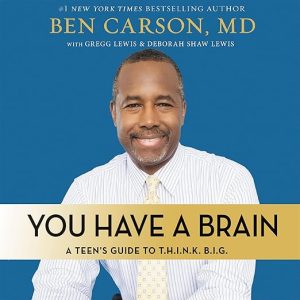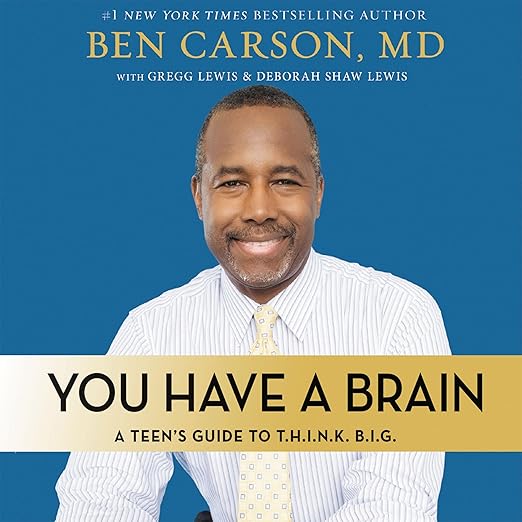
You Have a Brain arrived in my listening queue through a route I did not anticipate: a conversation with a high school teacher who runs an audiobook-based study group for students who are struggling academically and emotionally. She recommended it without reservation for that specific audience, and I trusted her enough to listen before passing judgment. What I found was something more substantial than the motivational self-help packaging suggests.
Ben Carson is a figure who inspires strong and divergent reactions in American public life, and I want to be direct about that before proceeding. You Have a Brain was written and recorded when Carson was a neurosurgeon and Presidential candidate, before his tenure as Secretary of Housing and Urban Development. The biography it draws on, growing up in poverty in Detroit, an absent father, early academic struggles so severe that his teachers considered him intellectually limited, the dramatic reversal that led to Yale and then to the Johns Hopkins neurosurgery program, is one of the more genuinely remarkable American success stories in recent decades. That story is the book's foundation, and it is a strong one.
The Verdict, Briefly
Carson structures his advice around an acronym: Talent, Honesty, Insight, Nice (strong people skills), Knowledge, Books, In-Depth Learning, and God. The T.H.I.N.K. B.I.G. framework is unapologetically mnemonic and unapologetically practical; it is designed to be remembered and applied by teenagers in the specific circumstances of early life decision-making rather than to offer philosophical sophistication. On those terms, it largely succeeds.
The individual chapters use Carson's own experiences, and those of other people he presents as exemplars of each principle, to give concrete content to what might otherwise be slogans. The chapter on Books, for instance, is not merely an endorsement of reading but an account of how his mother, Sonya Carson, forced her sons to read two library books a week and report on them despite being barely literate herself. That detail does more work than any number of generalizations about the importance of education. It grounds the advice in a specific human circumstance and demonstrates that the principle operates even under conditions of significant constraint. The framework earns its letters through stories like this one.
Why Listen to You Have a Brain
The G in T.H.I.N.K. B.I.G. stands for God, and Carson's Christianity is woven throughout the book at a level that cannot be sidestepped. Several reviewers have noted this as a feature rather than an obstacle, and for the audience the book targets, young Christians and their families seeking inspiration rooted in faith, this is entirely coherent. For secular listeners or those of different religious traditions, the question is whether the faith content functions as an obstacle to the book's practical and biographical value.
My assessment is that it does not, provided you approach it with the interpretive generosity you would bring to any memoir that integrates a worldview different from your own. Carson's faith is not polemical; it is personal, expressed through the specific experiences of his own life rather than as theological argument. The principles themselves, honesty, insight, in-depth learning, strong interpersonal skills, are not contingent on the faith framework. The G in the acronym can be read as the source of Carson's own motivation without requiring the same source in the listener.
Points to Consider
Narrating young adult self-help requires a specific calibration. Too authoritative and you lose the teenagers who most need to hear the message; too casual and the material loses its weight. Dan Miller strikes a balance that serves Carson's voice well. He reads with directness and without the overenthusiastic uplift that would make this unlistenable for anyone over seventeen. The biographical passages benefit from his restraint; the framework chapters have an appropriate firmness that gives each letter of the acronym its own weight.
At just over six hours, the runtime is appropriate for the audience. The discussion questions included at the end of the audiobook, which Miller reads with specific care for pacing, suggest this was designed partly for group listening rather than solo consumption. The teacher who recommended it to me uses it exactly that way, pausing after each chapter for discussion and returning to specific passages that resonate differently for different students. The discussion questions frame genuine conversation rather than simple comprehension checks, which is a design choice worth noting.
Who Should Pick Up You Have a Brain
Young adults facing significant obstacles, students in educational contexts where this can be discussed and contextualized, and parents or educators seeking motivational material with genuine biographical depth will find this valuable. Carson's story is real and the principles, however packaged, are substantive. One reviewer who bought it for grandchildren found it unexpectedly engaging for adults as well, noting that anyone looking for their place in the world could find the book useful beyond its stated teenage audience.
Listeners who find Carson's public political positions disqualifying as a biographical subject will struggle to separate those from this earlier work. The audiobook predates his most controversial public roles and was written entirely within a medical and inspirational context, but the listener's relationship with the narrator-subject is their own to calibrate. Secular listeners willing to engage generously with faith-rooted content will find more of value here than the genre packaging might suggest. The biographical core of the book, a boy from inner-city Detroit who became one of the most celebrated neurosurgeons in American history, is compelling entirely on its own terms and does not require religious investment to appreciate fully.
A Few Questions About You Have a Brain
How prominent is the religious content, and does it affect the book's usefulness for secular listeners?
Carson's Christian faith is integrated throughout, most explicitly in the G (God) component of his T.H.I.N.K. B.I.G. framework. It is personal and experiential rather than theological or prescriptive. Secular listeners willing to engage with the material generously will find the practical and biographical content fully accessible, though the faith dimension cannot be separated from the whole.
Does Dan Miller's narration work for the teenage target audience?
Yes. Miller avoids the excessive uplift that plagues some motivational audiobooks, reading instead with a directness that respects the intelligence of the audience. The discussion questions at the end, which he reads with careful pacing, are clearly designed for group use rather than solo consumption.
Given Carson's political career after this book was published, should that context affect how listeners approach it?
That is a judgment each listener makes individually. The audiobook was produced when Carson was a neurosurgeon and Presidential candidate, and the content is entirely within that biographical frame. Listeners who find his subsequent political positions disqualifying may struggle to separate them; those able to engage with the earlier biographical material on its own terms will encounter a story with genuine substance.