Quick Take
- Narration: Davis Aurini’s reading matches the book’s deliberately blunt register, though the tone edges toward lecturing.
- Themes: college major economics, ROI of higher education, STEM versus liberal arts
- Mood: Confrontational and persuasive, somewhere between a stern advisor and an ideological brief
- Verdict: A pointed economic argument for choosing marketable degrees that readers should engage with critically, not as the final word.
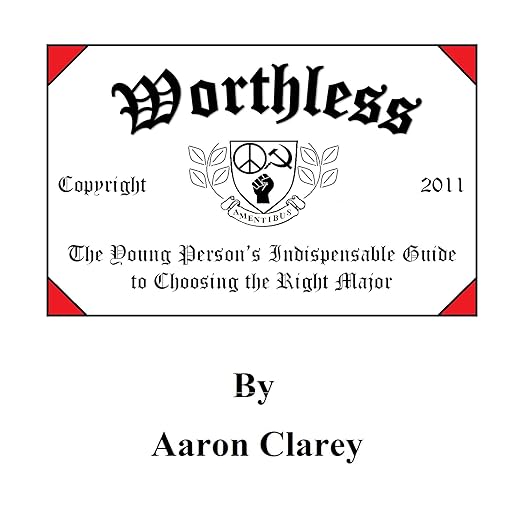
I first encountered Aaron Clarey’s work through the broader manosphere-adjacent corner of financial independence writing, which gave me a reasonable sense of what to expect from Worthless before I listened to it. The book is exactly what it claims to be: a blunt economic assessment of college majors, delivered with the rhetorical style of someone who has decided that diplomatic framing produces worse outcomes than honest brutality. Published in 2013 and narrated by Davis Aurini, it has accumulated 570 ratings on Audible at a 4.6 average, which is a real signal of sustained reader engagement with the core argument.
The argument itself is straightforward: degrees in fields without strong labor market demand are poor financial investments, and the people who tell you to follow your passion without accounting for economic reality are doing you harm. Clarey uses the term fatherly love to describe his approach, which captures the register accurately if not entirely flatteringly.
Our Take on Worthless
The economic core of the argument has real substance. Labor market data consistently shows earnings premiums for STEM, healthcare, finance, and skilled trades relative to many liberal arts and social sciences fields. Clarey is not making those numbers up, and the reviewers who confirm it from professional experience, including a PhD biochemist who has worked in biomedical research, speak to something real. One reviewer’s account of using Clarey’s advice as a reference point for their daughter’s double major in chemistry is a practical success story, even if the wider political framing around it is more contested.
Where the book earns its criticism is in the ideological packaging around the economic core. Clarey does not simply analyze degree market value; he moralizes about it in ways that are not always separable from broader culture-war positions. Reviewer Tripleog2010, for instance, describes learning about evolution in college as complete bullshit in a five-star review, which is not an endorsement that signals strong epistemic standards. Clarey’s audience skews toward readers who already share his cultural politics, and that shapes what the book counts as evidence and what it dismisses.
Why Listen to Worthless
Davis Aurini narrates with a clipped authority that suits the material. The runtime at three hours and twenty-five minutes is short enough to absorb in a single sitting, which matches Clarey’s approach: he is not building a complex argument that requires careful unpacking so much as hammering a simple point repeatedly until it lands. For a listener who wants to internalize the basic ROI framework before choosing a major, the compression is a feature.
The economic data Clarey cites was accurate for 2013, and reviewer Florian Ulrich notes that numbers can be extrapolated to today, though the reviewer from 2023 notes that things are worse now. That is a reasonable update: student debt loads have increased significantly since the book was written, which, if anything, strengthens the core argument even if specific figures need refreshing.
What to Watch For in Worthless
The book does not engage seriously with the non-economic functions of a liberal arts education: its role in developing critical thinking, civic literacy, or adaptability across careers that do not exist at graduation time. It also does not account for the wide variation in outcomes within degree categories. A philosophy degree from a highly selective institution with strong networking produces very different outcomes than the same degree from an open-enrollment school, but Clarey treats the category as homogeneous.
Parents and high school counselors who use this as a conversation starter should supplement it with more nuanced analysis from labor economists, higher education researchers, or career services professionals who work with actual outcome data rather than rhetorical examples.
Who Should Listen to Worthless
High school seniors and college freshmen who have not yet committed to a major and who need a direct economic argument to counterbalance well-meaning but practically vague advice about pursuing passion will find the core argument useful. The political packaging is separable from the financial logic if a listener knows to separate them. Anyone who wants a comprehensive analysis of higher education’s value, including its non-monetary dimensions, should look beyond this book. Read it as one strong and deliberately provocative data point, not as the complete picture.
Frequently Asked Questions
Are Aaron Clarey’s economic statistics in Worthless still accurate given it was published in 2013?
The specific figures are dated, but the directional argument has largely held up. Student debt has increased and labor market premiums for STEM fields remain significant. Readers should treat the data as illustrative rather than current and verify figures against recent Bureau of Labor Statistics or NCES data.
Is Worthless ideologically slanted, and how much does that affect its usefulness as career guidance?
Yes, the book carries a strong conservative-libertarian ideological framing that goes beyond economic analysis. The core ROI argument for marketable degrees is separable from the cultural politics, but Clarey does not always keep them separate. Listeners should be aware of this framing and read critically.
How does Davis Aurini’s narration affect the listening experience?
Aurini’s delivery matches the book’s blunt, confident register. It reinforces the tone of authoritative argument rather than inviting reflection. Some listeners will find this energizing; others may find it one-note across the full runtime.
Does Worthless account for degree quality, for example, that a liberal arts degree from a top university might have very different outcomes than one from a less selective school?
No. Clarey treats degree categories as largely homogeneous for the purposes of his argument, which is one of its significant analytical limitations. Outcomes vary substantially by institution, networking, and individual initiative in ways the book does not account for.