Quick Take
- Narration: Jeff Harding is one of the best English-language Reacher narrators – his performance captures the character’s laconic menace precisely, earning praise from The Sunday Times.
- Themes: Rural tyranny and community fear, justice outside institutional structures, the ethics of intervention
- Mood: Cold, tense, and propulsive – Nebraska winter rendered as a slow-building threat
- Verdict: A strong entry in the Reacher series that works well as a standalone, even if it does not quite match the peak entries in the sequence.
I have a specific relationship with the Reacher novels that I suspect many listeners share: I do not read them consecutively, but I keep coming back. There is something about the rhythm of a Lee Child thriller, the way Reacher’s particular moral geometry organizes an otherwise chaotic situation, that I find genuinely restorative in a way that more prestigious fiction rarely is. I came to Worth Dying For, the fifteenth installment, on a midweek evening when I needed a book that would not require me to hold complexity in suspension and could simply move.
The setup is characteristically efficient. Reacher is heading somewhere, or rather heading nowhere in particular, which is his natural state of motion, and he stops in rural Nebraska. The Duncans, a local clan with the whole county under their thumb, are the obstacle. And somewhere beneath the surface of the community’s fear is the unsolved disappearance of an eight-year-old girl that Reacher cannot walk away from. That last element is the moral center of the book, the thing that holds it to a higher stake than another exercise in Reacher dismantling bad men.
Our Take on Worth Dying For
Jeff Harding’s narration is one of the better things about the Reacher audio experience. The Sunday Times described it as capturing Reacher’s character perfectly, and the description is accurate. Harding does not overperform. Reacher’s voice in print is spare, declarative, almost affectless, and a narrator who brings too much color to those sentences breaks the spell. Harding understands this. The result is a listening experience that feels genuinely calibrated to the prose rather than imposing a separate layer of interpretation on it.
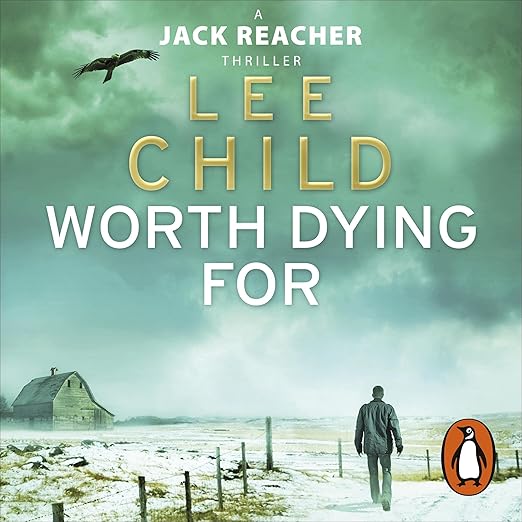
The Nebraska winter setting gives the book a particular atmosphere. Cold as a backdrop works well for this kind of thriller. It slows the peripheral world down and tightens the dramatic geography. The Duncans are effective antagonists, their control of a small county rendered in credible, incremental detail. Child is good at the sociology of local tyranny, at showing how communities absorb and accommodate a corrupting power until confronting it seems literally unimaginable.
Why Listen to Worth Dying For
The book follows directly from 61 Hours, and Child recommends reading them in sequence. Worth Dying For opens by resolving the cliffhanger ending of its predecessor, so listeners who have not heard 61 Hours will encounter a brief disorientation at the opening. That said, the book is perfectly functional as a standalone once the first chapter resolves. The series is explicitly designed to be read in any order, and the core dramatic question here requires no prior context.
One reviewer described Reacher as the personification of a certain kind of movie-heroic masculine archetype, and that characterization helps explain both the series’ appeal and its limits. For listeners who find that archetype satisfying, Child delivers it at the highest level of craft. The plotting is clean, the violence is credible rather than cartoonish, and Reacher’s decision-making follows an internal logic that rewards attention.
What to Watch For in Worth Dying For
The consensus among reviewers who have followed the series closely is that this installment sits slightly below the peak entries in the sequence. One measured assessment described it as a solid tale that falls somewhat short of the one just prior, which is a fair appraisal. The missing girl subplot adds emotional weight but is not as fully developed as the setup promises. The Duncans, while effective, lack the complexity of some of Child’s stronger antagonists.
None of that makes this a weak book. Within the range of a long-running thriller series, consistency is underrated, and Child delivers a structurally sound, entertaining listen that will satisfy anyone who has enjoyed the series. The standard is high enough that “slightly below peak” still means a very good audiobook.
Who Should Listen to Worth Dying For
Existing Reacher fans will not need the recommendation. For newcomers, this is a reasonable entry point though not the strongest one in the sequence. Those who prefer thrillers with more emotional or psychological complexity may find the formula limiting, but for listeners who value clean plotting, a convincing protagonist, and efficient pacing, Child and Harding deliver exactly what the genre promises.
Frequently Asked Questions
Do I need to have read 61 Hours before listening to Worth Dying For?
Child notes that the Reacher novels can be read in any order, but Worth Dying For follows directly from 61 Hours and opens by resolving that book’s cliffhanger. Listeners who start here without the prior installment will encounter a brief disorientation but will be fully oriented within the first chapter.
How does Jeff Harding’s narration compare to other Reacher narrators?
Harding is widely regarded as one of the better fit for the character. He keeps the delivery spare and controlled, which matches Reacher’s prose voice precisely. The Sunday Times specifically praised his narration for capturing Reacher’s character perfectly.
Is the missing girl subplot satisfyingly resolved?
Reviewers generally feel it adds meaningful emotional weight to the book, though some find it less fully developed than the setup promises. It does reach a resolution and gives the novel more moral gravity than a purely action-focused entry would have.
Where does Worth Dying For sit in the overall Reacher series ranking?
Among fans who follow the series closely, it is viewed as a solid but not peak entry – stronger than many standalone thrillers but slightly below the highest-regarded books in the sequence such as Gone Tomorrow or Killing Floor.