Quick Take
- Narration: Jeff Harding is the definitive Reacher voice for British audiences, controlled, dry, and completely at home in the procedural stretches that other narrators fumble.
- Themes: Outsider competence, Secret Service security culture, brotherhood and grief
- Mood: Tightly wound and methodical, with bursts of violence that feel earned rather than gratuitous
- Verdict: One of the stronger entries in the Reacher series and an ideal place to start if you want to understand why this character has such enduring pull.
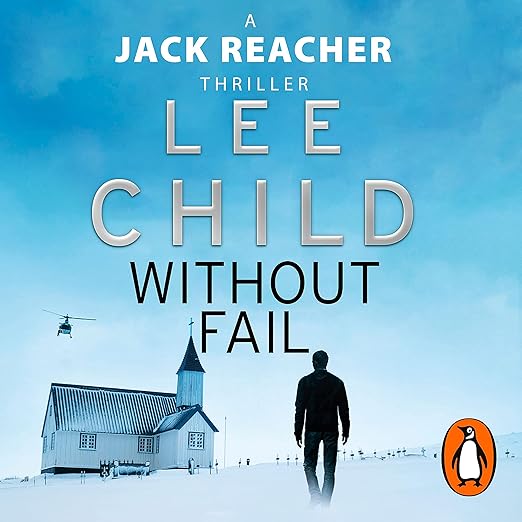
I was halfway through the fifth Reacher novel when a colleague mentioned that Without Fail was the one that actually made him care about Jack beyond the action sequences. I bumped it to the top of the queue and started it on a Tuesday evening commute, finishing the last two hours the following morning while folding laundry. Lee Child’s plotting in book six is leaner than in some of the surrounding entries, and the premise carries a genuine conceptual hook: what if someone hired Reacher not to protect the Vice President, but to find every hole in the protection before an assassin does?
Jeff Harding narrates, and The Sunday Times quote on the cover is accurate. His delivery captures Reacher’s flat, observational quality without turning it into caricature. Where some narrators overplay the laconic toughness until it sounds like self-parody, Harding understands that Reacher’s power comes from what he does not say as much as from what he does. The fourteen-hour runtime flies.
Our Take on Without Fail
What makes this installment interesting structurally is that Reacher begins the book as a security consultant rather than a freelance avenger. He is brought in by a Secret Service agent named M.E. Froelich, whose connection to Reacher through his brother Joe becomes one of the emotional pillars of the story. The book uses that relationship to give us more of Reacher’s background than usual: his family history, his relationship with his brother, the particular shape of his grief. Reviewers who called out the Joe and Jack material as valuable were responding to something real. Child does not often let Reacher sit with loss, and here he has to.
The procedural mechanics of the VP protection plot are unusually detailed and, for the most part, convincingly handled. Child’s research into Secret Service protocols shows without becoming a lecture, and the tension around the assassination attempts works because Reacher is solving a puzzle that has real rules rather than improvising through chaos. When the Secret Service and FBI fail and Reacher succeeds, it does not feel arbitrary. His advantage is specific and logical.
Why Listen to Without Fail
The gun detail that one reviewer found overwhelming is worth contextualizing: Child’s firearms descriptions serve a thematic function in this book, establishing Reacher’s credibility as someone who can see what trained agents miss. In audio, Harding handles these passages with the same measured authority he brings to everything else, and they read as character-defining rather than hobbyist. Those who care nothing about weaponry will not be lost; those who do will find the specificity satisfying.
Neagley appears in this book and makes an immediate impression, as the reviewer who named her specifically was right to flag. She is one of Child’s best recurring characters, and Without Fail is where the dynamic between her and Reacher is established. Listeners who have not met her before will understand after this book why readers and viewers follow her wherever she goes.
What to Watch For in Without Fail
The chase sequence in the third act divided some readers, with one reviewer noting it went over their head in terms of logistics. In audio, this is a genuine challenge: the geography of a pursuit is harder to track without a map, and Child does not always pause to reorient the listener. The sequence is exciting but occasionally disorienting, and following it requires some patience.
The emotional weight of the ending, which involves significant loss for Reacher personally, is handled with characteristic Child restraint. Some readers found this satisfying; others wanted more space for Reacher to process what has happened. Given that this is a character who processes almost everything by moving to the next town and the next problem, the restraint is in keeping with the series, but it is worth going in with managed expectations for catharsis.
Who Should Listen to Without Fail
Without Fail is an excellent entry point for readers who have heard about Reacher but have not started the series. Child’s note that the novels can be listened to in any order is accurate, and book six happens to be one of the most structurally complete installments, offering a full understanding of who Reacher is without relying on accumulated series knowledge. Existing fans who have skipped around the series and not yet reached this one should prioritize it.
Listeners who prefer their thrillers with more emotional complexity or morally ambiguous protagonists may find Reacher’s competence-as-identity formula limiting. But if you want a thriller that is intelligent about its own genre constraints, efficiently plotted, and brought to life by one of the series’ best narrators, this one delivers.
Frequently Asked Questions
Is Without Fail a good starting point if I’ve never read a Jack Reacher novel?
Yes. Child designed the series so any book can serve as an entry point, and Without Fail happens to include more backstory on Reacher’s family and early history than most entries, which makes it especially useful for new listeners. You won’t be lost without prior knowledge.
How does Jeff Harding’s narration compare to other Reacher audiobook narrators?
Harding narrates the UK editions of the Reacher series and is widely regarded among fans as one of the strongest voices for the character. His controlled, understated delivery suits Reacher’s internal monologue better than more theatrical approaches. The Sunday Times called his work on this title specifically excellent.
Does the book explain who Neagley is, or do I need to have read other Reacher novels first?
Without Fail establishes Neagley’s character and her history with Reacher’s unit. No prior knowledge of her is needed, and this is actually the ideal introduction to her. Her dynamic with Reacher is fully developed within this book.
Is the violence in Without Fail appropriate for readers who prefer thrillers over action novels?
The violence is present but purposeful and not gratuitous by thriller standards. One reviewer described the bloodshed as significant but meaningful to the plot. It is not horror-adjacent violence, and readers comfortable with standard crime fiction will find nothing here that pushes into uncomfortable territory.