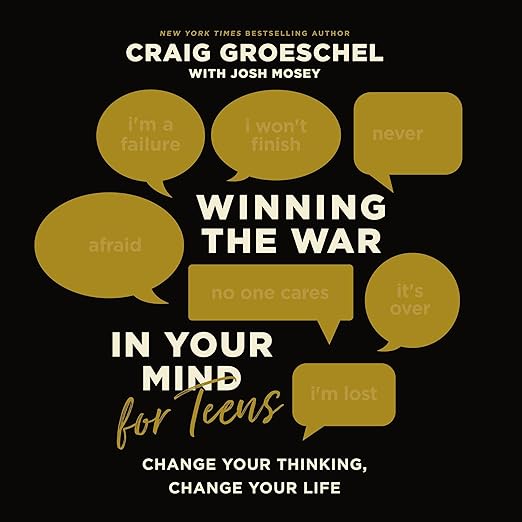
Quick Take
- Narration: Van Tracy reads with energy and directness that suits teenage listeners, keeping the tone accessible without being condescending.
- Themes: Rewiring negative thought patterns, faith as a mental framework, the neuroscience of the teenage brain
- Mood: Encouraging and practical, grounded in both Scripture and brain science
- Verdict: A genuinely useful adaptation that takes its teenage audience seriously, blending Christian faith with cognitive tools in a way that parents and teens report finding immediately applicable.
I will be honest about the context in which I came to this one. I do not typically review Christian self-help, and teenage-targeted books are not my usual beat. But this showed up with a 4.8 rating built on a substantial number of reviews, and the question of how to help adolescents manage the particular chaos of their inner lives is one I find genuinely interesting regardless of the framework being offered. So I listened. And I came away thinking Craig Groeschel has done something harder than it looks: he has adapted an adult bestseller for teenagers without talking down to them.
The original Winning the War in Your Mind was aimed at adults struggling with negative thought patterns and self-doubt. This teen edition takes that same framework, Scripture plus brain science, and rewires it specifically for the teenage mind. Not just younger language. Not just shorter chapters. Actual engagement with how the adolescent brain is wired differently, with what kinds of cognitive traps are particularly common at 15 versus 35, and with the specific social pressures that make mental wellness harder to maintain in high school than almost anywhere else.
Our Take on Winning the War in Your Mind for Teens
Groeschel’s central argument is that thinking can be retrained. The framework draws on neuroplasticity research while staying consistently within a Christian worldview. The idea that prayer and praise transform the mind is not presented as a substitute for practical strategy but as complementary to it. For listeners within that faith tradition, the integration feels coherent rather than forced. For secular listeners, the practical cognitive strategies are useful enough to extract even if the theological scaffolding is not one they share.
What makes this adaptation genuinely effective is the honesty about the battle the book describes. Groeschel does not pretend that teenagers should be able to simply decide to think better. He acknowledges the neurological reality that the teenage brain is still developing the prefrontal cortex that handles impulse regulation and long-term thinking. That acknowledgment gives the practical strategies that follow a credibility that more aspirational approaches lack.
Why Listen to Winning the War in Your Mind for Teens
Van Tracy’s narration is calibrated correctly for the audience. He reads with momentum and warmth, does not slow down to over-explain simple concepts, and handles the Scripture passages with the same energy as the brain science sections rather than shifting into a more solemn register. That tonal consistency matters for teenage listeners who might otherwise tune out when the book shifts from accessible to devotional.
The companion PDF, which includes exercises and an appendix, is available as a download alongside the audiobook. Parents and teens who report the highest engagement with this book seem to be using the exercises rather than treating it as passive listening. That interactive element is part of what makes the 4.8 rating coherent. The book is designed to produce behavioral output, and the companion materials support that. At under five hours, it is also one of the few books in this genre that does not ask for a prohibitive time investment.
What to Watch For in Winning the War in Your Mind for Teens
This is explicitly a Christian book. The framework is theological, Scripture is woven throughout, and the resolution Groeschel points toward is a transformed mind through relationship with God rather than purely secular cognitive practice. Listeners who are comfortable within that worldview, or who are the parents of teenagers in that tradition, will find the integration meaningful. Listeners who want a secular cognitive-behavioral approach for adolescents will want something else entirely.
The book is also adapted from an adult text, and while the teen-specific material is substantial, certain readers who have encountered the original may find some familiar territory in the core arguments. The new-to-this-topic listener, which most teenage listeners will be, will not notice. But if you are a parent who read the adult version and is wondering whether to give this to a teenager, the adaptation is meaningful enough to justify the overlap.
Who Should Listen to Winning the War in Your Mind for Teens
Teenagers and parents within a Christian faith tradition will find this the most complete and resonant. Youth group leaders and school counselors operating in faith-based contexts may find it a useful recommendation. Secular listeners seeking cognitive tools for teenage mental wellness should look elsewhere. The short runtime and practical companion exercises make it accessible as a starting point for conversations between parents and teenagers about thought patterns, self-doubt, and mental health.
Frequently Asked Questions
Is Winning the War in Your Mind for Teens appropriate for adults or only teenagers?
Groeschel designed it specifically for a teenage audience, with all-new stories and material addressing the unique wiring of the adolescent brain. Adults who have not read the original may find it useful, but adult listeners familiar with the parent book will find significant overlap in the core arguments.
Does the audiobook include the exercises mentioned in the print description?
Yes. The exercises and appendix are included in a companion PDF available as a download with the audiobook. Reviewers who used the exercises alongside listening report higher engagement and more practical takeaway from the content.
How does Van Tracy’s narration suit teenage listeners?
Tracy reads with energy and directness that avoids the condescending slow-down that sometimes characterizes narrators for younger audiences. He handles both the brain science passages and the Scripture sections with consistent momentum, which reviewers note keeps the content accessible without feeling dumbed down.
Does the book require a Christian faith background to be useful?
The framework is explicitly Christian and theological throughout. Secular listeners can extract the cognitive strategies, but the book is built around Scripture and the premise of a relationship with God. Listeners outside that tradition will find it less integrated than works written from a secular psychology standpoint.