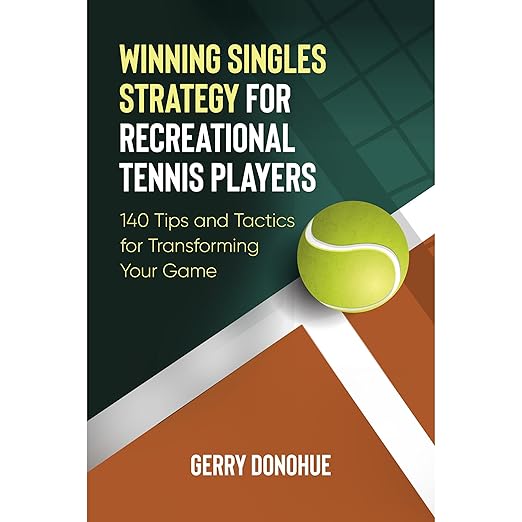
Quick Take
- Narration: Virtual Voice handles the strategic content clearly, but the absence of a human narrator flattens what is essentially conversational coaching advice, the material would benefit from a voice with some personality.
- Themes: Strategic thinking over stroke mechanics, reducing unforced errors, exploiting opponent tendencies
- Mood: Clear-headed and practical, a sensible, no-flattery approach to recreational competition
- Verdict: A genuinely useful strategic framework for recreational players who have plateaued on stroke improvement, short, direct, and immediately applicable on court.
I played tennis seriously through university and still get on court whenever my schedule allows, which means I arrive at a book like this with a specific kind of skepticism. Most tennis instruction focuses on mechanics, grip, stance, swing path, and is therefore most useful to players who have not yet built their strokes, which by recreational standards means beginners and lower intermediates. Winning Singles Strategy for Recreational Tennis Players is explicitly doing something different: it is coaching the player who already knows how to hit the ball but has not thought carefully about where, when, and why.
That distinction matters. I listened to this one early on a Saturday before a match, which is probably the ideal use case, and found myself thinking about specific points from Gerry Donohue’s framework while I was actually playing. That kind of immediate transferability, content that changes something in the way you approach the game rather than just informing you in the abstract, is not something most sports instructional books achieve.
Our Take on Winning Singles Strategy for Recreational Tennis Players
Donohue’s central observation is arresting in its bluntness: approximately 80% of points in a recreational match end with an unforced error. That means when most of us win a match, we have not really won, we have lost less. The strategic framework he builds from that fact is about reducing your own error rate systematically, which is a less glamorous ambition than the one most recreational players carry onto the court (the desire to hit like the pros we watch on television), but a substantially more achievable one.
The section on adapting strategy to different opponent types is where the book becomes a genuine tactical resource rather than just a philosophical reframing. Donohue gives specific approaches to players who push, players who serve-and-volley, and players who hit big but inconsistently, the kind of targeted tactical thinking that transforms a general understanding into something you can apply against a specific person across the net from you this Sunday afternoon.
Why Listen to Winning Singles Strategy for Recreational Tennis Players
The audiobook is under two hours, which is a significant feature for this kind of content. A book about tennis strategy does not need to be long; it needs to be clear and specific, and Donohue is both. The format suits the material: this is coaching advice, delivered in a coaching register, and listening to it on the way to the court gives it an immediacy that reading it on the sofa the night before would not.
The Virtual Voice narration is functional but limited. Donohue’s writing has a conversational quality, he addresses recreational players directly, with occasional self-deprecating humor about the gap between our aspirations and our abilities, and a human narrator would have carried that tone more naturally. The synthetic voice handles the content clearly enough, but the warmth of the original coaching voice does not fully come through.
What to Watch For in Winning Singles Strategy for Recreational Tennis Players
One reviewer flags the lack of graphics in the physical book, which is a format-specific concern but relevant here as context: Donohue’s strategic advice is primarily verbal and conceptual rather than diagram-dependent, which is why it works in audio where visual aids are unavailable. The book’s approach is fundamentally about decision-making and pattern recognition rather than technical instruction that requires visual demonstration.
Donohue is explicit that listeners should adopt only the strategies that suit their game. This is good pedagogy rather than a hedge: he is offering a toolkit, not a prescription, and the framework is designed to be adapted rather than followed wholesale. Players who approach the material that way will get more from it than those who try to implement every suggestion simultaneously.
Who Should Listen to Winning Singles Strategy for Recreational Tennis Players
Recreational singles players who have been working on their strokes for years and feel like they have hit a plateau will find this the most directly applicable content available at this length. The framework is specifically built for players who can already hit the ball reasonably well and want to compete more effectively without rebuilding their technique from scratch. At a 3.0 to 4.0 NTRP level, the strategy-first approach Donohue advocates is particularly well-suited to the actual conditions of recreational play.
Complete beginners will find it premature, the book assumes you can rally and serve, and focuses on what you do with that capability rather than how to develop it. Advanced players who are already thinking strategically will find the material too introductory. And players who specifically want diagram-based tactical breakdowns with court geometry will find this too verbal for their preference. Within its intended audience, though, it delivers exactly what it promises: a practical strategic framework for the recreational player who wants to win more by losing less.
Frequently Asked Questions
Does Winning Singles Strategy also apply to doubles, or is it strictly singles-focused?
It is strictly singles-focused. Donohue addresses the specific geometric and tactical conditions of singles play, court positioning, cross-court versus down-the-line percentage decisions, managing the center mark, which are sufficiently different from doubles that the framework does not transfer directly. He has written a separate book on doubles strategy, which reviewers mention ordering after enjoying this one.
Is this audiobook useful for match preparation specifically, or is it a more general philosophy of play?
Both, with the balance tilting toward match preparation. The framework Donohue builds around error reduction and opponent-specific tactical adjustment is designed to be applied in actual match conditions rather than on the practice court. Reviewers describe listening to it before matches as a particularly useful use case, which suggests the material is concrete enough to influence decision-making in real time.
Does the Virtual Voice narration handle the tactical terminology clearly, or does it stumble on tennis-specific language?
The Virtual Voice narration handles the tennis terminology, unforced errors, net approach, cross-court percentage, serve placement, without significant stumbling. The limitation is tonal rather than technical: Donohue’s coaching voice has warmth and directness that the synthetic narration cannot fully replicate. The content comes through; the personality of the coaching style is partially lost.
At under two hours, is there enough content in this audiobook to justify the time, or does the brevity signal superficiality?
The brevity reflects precision rather than superficiality. Donohue has made deliberate decisions about scope, this is a strategic framework, not a comprehensive tennis manual, and the result is a book that says what it needs to say and stops. Reviewers consistently describe it as substantive despite its length. The short runtime is actually an asset for a book about court strategy: you can listen to it before a session and carry the framework onto the court the same day.