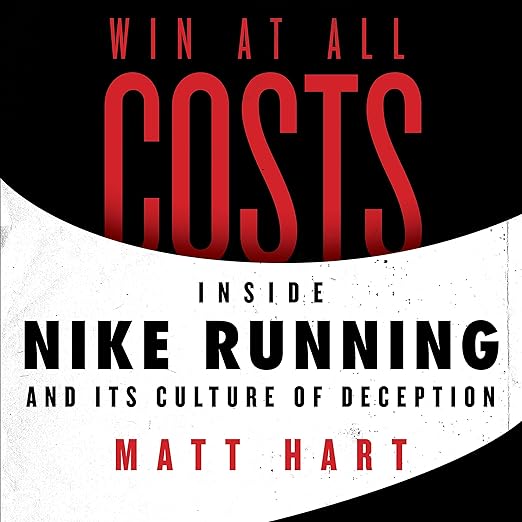
Quick Take
- Narration: Josh Bloomberg reads with the right kind of urgency for investigative journalism, clear and paced for sustained attention without editorializing.
- Themes: Corporate corruption, athletic pressure, the ethics of performance
- Mood: Indignant and propulsive, reads like a true crime investigation
- Verdict: A thoroughly researched and genuinely revelatory listen for anyone interested in elite running, Nike’s culture, or the broader ethics of performance sports.
I was midway through a run, a very ordinary one, nothing approaching Olympic ambition, when I started listening to Win at All Costs. By the time I finished for the day, I had stopped thinking about my own pace entirely and was thinking instead about what it would feel like to be told, by a coach you trusted at the highest level of your sport, that your body needed to be managed in ways that broke the rules. Matt Hart’s book put that question in my head and kept it there for the full thirteen hours.
In May 2017, Hart received a USB drive with a single PDF on it: a stolen USADA report on Alberto Salazar, the Nike Oregon Project coach, and Dr. Jeffrey Brown. What followed was three years of reporting, nearly one hundred sources, fact-checking by both the New Yorker and the Atlantic, and the book that resulted. The level of documentation is evident throughout, which is what allows Hart to write about deeply contested events with the confidence of someone who has done the work.
Our Take on Win at All Costs
Josh Bloomberg narrates, and his performance is a good match for the material. Investigative journalism in audio form requires a narrator who can sustain tension without theatrical flourish, the facts themselves are doing the dramatic heavy lifting, and Bloomberg understands that. He reads with the kind of measured urgency that keeps you pressing forward through the denser sections of corporate history and anti-doping regulation.
One reviewer who has followed competitive running for fifty years described learning things from this book they had not known despite their experience in the sport, which is a meaningful endorsement for the depth of Hart’s reporting. Another described it as reading like a suspense novel, not in the sense of fabricated drama, but in the structural sense that Hart has ordered his material so that information is revealed in ways that build genuine dread about what comes next.
Why Listen to Win at All Costs
The book is not simply about doping. It is about the culture that makes doping seem like the logical conclusion of everything surrounding it. Hart’s portrait of Nike as a corporation that has lost the counter-cultural identity it once traded on is sympathetically drawn for readers who remember that original spirit, and damning for anyone who wants to understand how institutional win-at-all-costs mentality filters down to individual athletes who are already deeply vulnerable to pressure from coaches and sponsors.
Steve Magness, Salazar’s former assistant who broke the silence, is the book’s quiet hero. So are Adam and Kara Goucher, Olympians who risked their careers and their livelihoods to become whistleblowers on the program. Hart gives their decisions the weight they deserve without turning them into uncomplicated heroes, they were part of the system before they moved against it, and the book is honest about that complexity.
What to Watch For in Win at All Costs
One reviewer noted there are few genuinely sympathetic characters across the whole story. Salazar is the clear antagonist, but the athletes around him are described as largely insecure and self-absorbed, shaped by an environment that cultivated those qualities. Some listeners may find that moral landscape frustrating if they are hoping for clear heroes beyond the whistleblowers. The book does not offer easy resolution, the sport’s anti-doping apparatus allowed the situation to persist for years, and Hart is clear-eyed about the systemic failures that made Salazar possible.
Who Should Listen to Win at All Costs
This is essential listening for anyone with genuine interest in elite running, the business of Olympic sport, or the ethics of performance enhancement. It is also a strong choice for listeners who enjoyed books like Game of Shadows or Shoe Dog, the former for its investigative rigor, the latter for its portrait of Nike at a very different moment in its history. Casual sports fans who want a single deeply reported story rather than a broad survey of the doping problem will find this structured appropriately for them.
Frequently Asked Questions
Do I need to be a runner or follow competitive athletics to engage with this book?
No. Hart writes for a general audience and provides the context needed to understand the competitive stakes. The corporate and ethical dimensions of the story are accessible to anyone interested in institutional corruption.
What happened to Alberto Salazar and the Nike Oregon Project as a result of the investigation?
Salazar received a four-year ban from the USADA in 2019, and the Nike Oregon Project was subsequently disbanded. The book covers the events leading to that outcome in detail.
Is Josh Bloomberg familiar with the running world, and does that affect his narration?
The narration is praised for clarity and sustained tension. Bloomberg handles the athletic and technical terminology smoothly, though his particular familiarity with the subject is not detailed in available materials.
How does this book compare to the original reporting Hart did for the New Yorker and the Atlantic?
The book draws on that reporting but significantly expands it, incorporating three years of additional interviews and documentation. Listeners who followed the magazine coverage will encounter substantially more material here.