Quick Take
- Narration: Avi Roque leads a full cast whose diversity matches the anthology’s scope, creating a listening experience that feels like a genuine community of voices rather than a single narrator doing impressions.
- Themes: Latinx identity and diaspora, intersectionality and anti-Blackness, grief and belonging
- Mood: Rich and varied, moving between sorrow and celebration within a single session
- Verdict: An AudioFile Earphones Award winner that earns the recognition, delivering fifteen distinct perspectives on what it means to be Latinx in America.
I came to this one on a Saturday morning in late autumn with no particular plan beyond sitting with something that felt urgent. I had been reading a lot of monolithic narratives that week, books where a single consciousness shapes everything, and I was craving the opposite: a space where multiple voices argued with each other, overlapped, contradicted, and ultimately built something larger than any one of them could alone. Wild Tongues Can’t Be Tamed delivered exactly that.
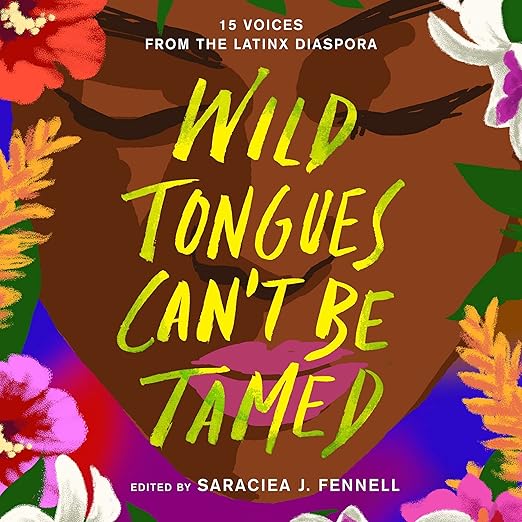
Edited by Saraciea J. Fennell, founder of The Bronx Is Reading, this anthology brings together fifteen original pieces from some of the most significant Latinx voices working in young adult literature today. Elizabeth Acevedo, Meg Medina, Ibi Zoboi, Mark Oshiro, Naima Coster: the contributor list reads like a syllabus for a course someone should already be teaching. The material ranges from ghost stories and superhero narratives to kitchen memories, addiction, anti-Blackness within Latinx communities, and the specific grief of loving someone while losing a language. No two pieces feel alike.
Our Take on Wild Tongues Can’t Be Tamed
What distinguishes this anthology from similar collections is its willingness to sit with contradiction. The book does not position the Latinx diaspora as a unified bloc with shared experiences and tidy conclusions. It shows community fractured by race, class, sexuality, national origin, and generational distance from the countries families left behind. The piece addressing anti-Blackness inside Latinx communities is particularly uncomfortable in the best possible way, raising questions the anthology does not rush to resolve. A listener named Natasha Wade described it as a beautiful kaleidoscope, noting that it unearths questions we should be asking ourselves about identity. That is an accurate description of what the best essays and stories here accomplish.
Why Listen to Wild Tongues Can’t Be Tamed
The full cast production is the right choice for this material. Avi Roque anchors the listening experience without overwhelming it, and the individual contributors who perform their own work bring an intimacy that no single narrator could fake. When Elizabeth Acevedo reads her own prose, you hear the rhythm she intended. That rhythmic specificity matters when the writing is as carefully constructed as hers is. AudioFile awarded this the Earphones Award, noting it would help listeners discover that the Latinx diaspora is far more diverse than they realized. Kirkus called it tremendously thought-provoking, and both assessments hold up under listening.
What to Watch For in Wild Tongues Can’t Be Tamed
Anthology listening is a different experience from sustained narrative. Some pieces will grab you immediately; others will need a few minutes to find their footing with a new voice. The range in tone is intentional, but it can feel jarring when a quietly devastating memory gives way to a piece in an entirely different register. This is not a criticism of the editing so much as a fair warning about pacing expectations. At just over seven hours, it is also not a short commitment for an anthology, though the investment is justified.
It is also worth noting the cultural moment this anthology arrives into. The Latinx community is frequently treated as a single political and cultural bloc in American media, a flattening that erases enormous variation in national origin, racial identity, class, and immigration history. Wild Tongues pushes back against that reduction with every piece it includes. The range of perspectives gathered here, from the explicitly political to the intimately personal, is itself an argument about the complexity that goes unmarked when a community is reduced to a demographic category.
Who Should Listen to Wild Tongues Can’t Be Tamed
Readers who already love one or two of the contributors and want to discover the others will find this an efficient and deeply satisfying way to expand their reading. Educators looking for diverse voices to bring into a classroom context will also find it strong, particularly because the pieces generate genuine discussion around identity, community, and belonging. Anyone who approaches the Latinx diaspora as a monolith will find their assumptions challenged in productive ways. Listeners who prefer sustained single-narrator stories may find the shifting voices harder to settle into, but that is precisely the point the anthology is making.
Frequently Asked Questions
Do I need to know the contributors already to enjoy this anthology?
Not at all, though fans of Elizabeth Acevedo, Meg Medina, or Ibi Zoboi will find familiar pleasures. Each piece introduces itself on its own terms, and the full cast performance helps orient you quickly.
How does the full cast format affect the listening experience compared to a single narrator?
It strengthens it considerably. Each voice is matched to its material, and contributors who perform their own work bring a specificity of rhythm and emphasis that a single narrator cannot replicate.
Is Wild Tongues Can’t Be Tamed appropriate for classroom use with high school students?
Yes, and it is arguably ideal for that context. The pieces address identity, anti-Blackness, grief, and belonging in ways that generate genuine discussion, and the Kirkus review specifically notes its thought-provoking reconstruction of Latinx experiences.
Does the anthology address conflict within the Latinx community, or does it present a unified experience?
It actively resists a unified narrative. Several pieces engage with anti-Blackness inside Latinx communities, generational fractures, and the tensions between national and diaspora identities, which is what makes it honest rather than celebratory in a shallow way.