Quick Take
- Narration: Katy Bowman narrates her own work with the clarity of someone who has taught this material many times, precise, accessible, occasionally evangelical.
- Themes: Biomechanics and shoe design, foot strength and rehabilitation, the gap between natural movement and modern footwear
- Mood: Practical and persuasive, with an underlying urgency about movement as medicine
- Verdict: A well-organized case for rethinking your footwear that is useful whether you are already curious about minimalist shoes or actively dealing with foot and knee pain.
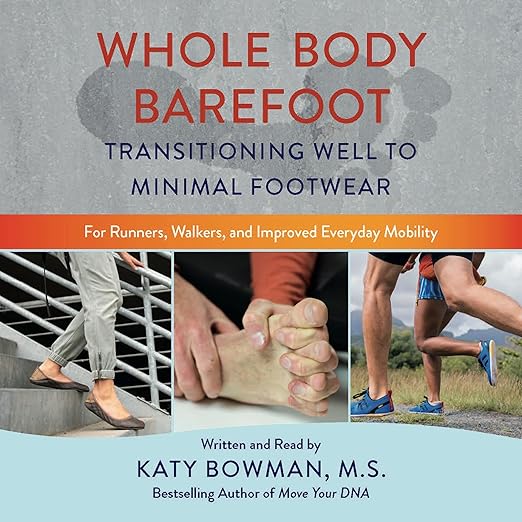
I have had intermittent plantar fasciitis for two years. My podiatrist’s solution was orthotics; my physiotherapist’s solution was stretching; my own solution was buying progressively more supportive shoes that somehow made the problem worse without anyone being able to explain why. Katy Bowman’s Whole Body Barefoot is the explanation I had been missing, not a miracle cure, but a coherent account of how I had been thinking about my feet entirely wrong.
Bowman narrates her own audiobook, and the effect is that of a very knowledgeable friend explaining a subject she has spent decades studying. Her voice is direct and confident without being hectoring. She knows her material so well that she can anticipate the listener’s objections, particularly the reasonable concern that going barefoot caused injuries in studies, and address them before they become reasons to stop listening.
Our Take on Whole Body Barefoot
The book’s core argument is deceptively simple: modern shoes, by elevating the heel and cushioning the sole, change how our feet function in ways that weaken the muscles and connective tissue that our feet need to work properly. The conventional response to weak, painful feet, more support, can deepen the problem by further reducing the load-bearing work those structures need to remain functional. Bowman frames this as a mechanical rather than a moral issue, which keeps the argument from tipping into lifestyle polemic.
What makes the book genuinely useful rather than merely interesting is the 25-exercise program Bowman includes for strengthening feet, ankles, and arches before and during a transition to minimal footwear. She is explicit that simply taking off your shoes and walking is not a safe approach, the research on injury rates in new barefoot runners supports this, and the exercises are designed to bridge the gap between where most sedentary-footed modern people are and where they need to be. The accompanying PDF, available in the Audible library, includes visual guides to the exercises that make the audio more functional than it would be on its own.
Why Listen to Whole Body Barefoot
Because the biomechanical reasoning Bowman provides is useful regardless of whether you intend to transition to minimal footwear. Understanding the mechanical relationship between heel height, ankle flexion, calf shortening, and knee loading gives you a new vocabulary for thinking about your own movement patterns. One reviewer described the book as essential even for people who had no interest in barefoot shoes going in, because the anatomy of the foot and its relationship to the rest of the body was explained in ways they had never encountered from medical professionals. That rings true.
The section on what Bowman calls Vitamin Texture, the sensory and proprioceptive benefits of walking on natural, irregular surfaces as opposed to flat artificial ones, is a particularly good example of how she expands the conversation beyond footwear. The book argues not just for different shoes but for different relationships with the ground, which is a more interesting claim than the marketing around minimalist footwear typically makes.
What to Watch For in Whole Body Barefoot
The book is short, running just over two hours, which means some of the exercise guidance benefits from the PDF more than the audio alone. A few reviewers noted that the concepts are not overwhelming but that having visual reference for the exercises made them easier to execute correctly. The audiobook is worth treating as a companion to the PDF rather than a standalone resource for the practical sections.
Bowman is a persuasive writer, and the book has an evangelical quality that occasionally gets ahead of the evidence. She is careful with most of her claims, but listeners with pre-existing foot conditions, plantar fasciitis, bunions, tendonitis, should treat the exercise program as a starting point for conversation with a physical therapist rather than a self-directed rehabilitation protocol.
Who Should Listen to Whole Body Barefoot
Anyone dealing with persistent foot, ankle, or knee pain who suspects their footwear choices might be contributing. Runners considering a transition to lower-drop shoes will find the gradual approach described here more rigorously thought through than most online advice. Health practitioners working with patients on foot pain and mobility will find the biomechanical framework a useful supplement to clinical knowledge. Listeners seeking a thorough academic treatment of podiatric biomechanics will want something more technically dense, but for an accessible, evidence-aware introduction to the subject, this delivers clearly.
Frequently Asked Questions
Is the PDF supplement necessary to get full value from the audiobook?
The audio is coherent on its own, but the exercises described in the latter half of the book are significantly easier to perform correctly with the PDF’s visual guides. Bowman recommends accessing it, and it is available free in your Audible library.
Does Bowman address transition timelines for people with existing foot pain versus healthy feet?
Yes. She distinguishes between listeners who are pain-free and those managing existing conditions, and she recommends a more cautious, exercise-first approach for anyone with current foot problems before reducing shoe support.
The book was originally published in 2015. Is the advice still current?
The biomechanical principles Bowman explains are not time-sensitive, and the research on barefoot movement she references has been broadly supported by subsequent work. The core exercise program remains valid, though listeners may want to supplement with more recent research on minimalist footwear transition injuries.
How does this compare to Bowman’s other books, like Simple Steps to Foot Pain Relief?
Whole Body Barefoot is more specifically focused on the footwear-to-barefoot transition and includes a stronger emphasis on exercises for that purpose. Simple Steps to Foot Pain Relief covers a broader range of foot problems. Many readers find both complementary rather than redundant.