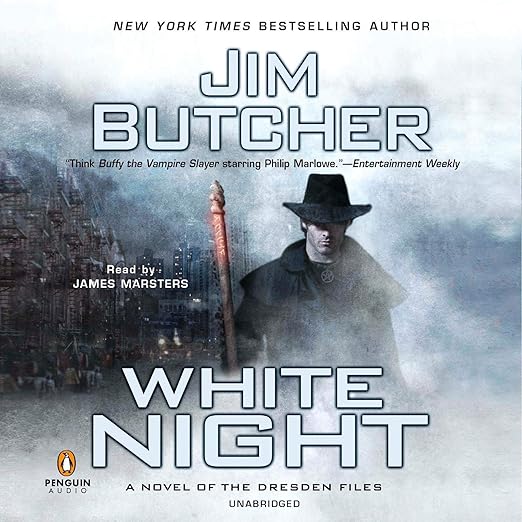
Quick Take
- Narration: James Marsters is the definitive Harry Dresden voice, bringing a wry, bone-tired charisma that has made this the gold standard for long urban fantasy series narration.
- Themes: Complicity versus intervention, family loyalty under impossible circumstances, the political economy of supernatural power
- Mood: Sharp, fast, and darkly comedic with genuine emotional weight in the back half
- Verdict: The ninth entry in the Dresden Files remains one of the series’ stronger installments, with Marsters in particular form and Butcher working through a case that hits closer to home than most.
I came to White Night the way a lot of people come to entry points into long fantasy series: sideways. A friend who had been listening to the Dresden Files for years insisted I start somewhere in the middle because, as she put it, the early books are functional but Butcher hits his stride around book seven. So I listened to books seven and eight first and then White Night, the ninth entry, which covers the case of apparent suicides targeting women who practice low-level magic in Chicago. By hour three I understood why this series has the kind of dedicated readership that generates decade-long reread threads online.
White Night opens with the Chicago Special Investigations Unit calling in wizard PI Harry Dresden to look at what appear to be suicides. Dresden’s magical assessment reveals they are not. The emotional manipulation required to drive someone to self-harm points toward the White Court of Vampires, and the trail leads toward Dresden’s half-brother Thomas, whose name should not plausibly appear on the suspect list but does.
Our Take on White Night
Butcher is working at a level of personal stakes here that the earlier books in the series build toward. Dresden’s relationship with Thomas has been developing across multiple entries, and White Night uses it to create a case where the investigation is also, unavoidably, a confrontation with Dresden’s own history and family. One reviewer who had followed the series from the beginning noted that this book addressed what they called Dresden’s sexist nature, his habitual overprotectiveness of women, with more directness than previous entries, allowing the character to be called on it and to grow without the text simply making jokes at his expense. That growth is real and it changes the texture of this particular case.
The plot is busy in the way Butcher’s books tend to be. The apparent suicides, the White Court vampires, the personal family complication, and the structural politics of the supernatural community are all active simultaneously. What White Night manages that some earlier entries did not is that none of the simultaneous threads feel excessive or cramped. The case architecture holds its shape under pressure.
Why Listen to White Night
James Marsters is the single most important reason to listen to this series in audio rather than in print. His performance as Dresden has been described by longtime fans as essentially inseparable from their experience of the character, which is high praise for a narration that began in 2005 and has accumulated consistency across thousands of hours of content. His Dresden voice carries wry exhaustion, genuine danger, and occasional flashes of the particular pleasure Dresden takes in being right about things. At fourteen hours and twelve minutes, this is a long listen, and Marsters sustains the energy of it without the performance ever feeling effortful.
The humor in Butcher’s writing translates particularly well to audio in Marsters’ delivery. The regular repetition that one reviewer flagged, the consistent description of Mac’s bar and certain recurring character verbal habits, lands differently when you hear Marsters deliver it with exactly the right timing. It becomes a feature of the world-building rhythm rather than a writing tic.
What to Watch For in White Night
White Night is not entry-point friendly. Butcher does not summarize prior events for new listeners, which is a deliberate choice that serves readers who are investing in the full series arc but creates friction for anyone dipping in at book nine. The supernatural politics, the family history, and Dresden’s relationship with the regular supporting cast including Karrin Murphy and Thomas all carry weight that accumulates over the preceding entries. Newcomers will follow the plot but will miss the emotional stakes that make the resolution land.
The series has repetition baked in by design. If you are listening across multiple books consecutively, you will encounter the same location descriptions and certain character verbal habits multiple times. For listeners who pace themselves between entries this is background texture. For binge listeners it becomes more noticeable.
Who Should Listen to White Night
Squarely aimed at Dresden Files readers who are progressing through the series in order and who are invested in the Thomas relationship arc that this book brings to a head. Also valuable for urban fantasy listeners who want to join the series at a point where Butcher’s craft is fully developed, with the caveat that prior books are genuinely necessary context. Marsters alone makes a compelling argument for choosing the audio version over print at any point in the series.
Frequently Asked Questions
Is White Night accessible as a starting point for the Dresden Files, or is series order necessary?
Butcher structures each entry around a self-contained case, so the mystery of White Night resolves within the book. However, the emotional weight of the Thomas storyline, Dresden’s complicated relationship with the White Court, and the character dynamics with Murphy and others all depend on accumulated context. Starting at book one is strongly recommended.
How does James Marsters handle the humor in Butcher’s writing?
Marsters is as responsible as Butcher for the comic texture of the series in audio. His timing on Dresden’s sardonic internal commentary, the precise delivery of the recurring jokes and observations that appear across the books, makes them land as character voice rather than authorial habit. It is a performance that has clearly been refined across nine consecutive entries.
Does White Night address the criticism that Dresden is sometimes condescending toward women?
One reviewer flagged this specifically, noting that this entry is more direct than previous books about the paternalism in Dresden’s protective instincts, allowing him to be called on it without the text simply laughing it off. It is addressed within the plot rather than as a meta-comment, which makes it more effective as character development.
At 14 hours and 12 minutes, does the pacing hold across the full runtime?
Marsters sustains the energy effectively, and Butcher’s plotting keeps multiple threads active enough that the runtime rarely feels padded. Listeners who noted repetition in the series descriptions are correct that some passages recur, but within a single entry the pacing is tight and the case architecture holds its shape.