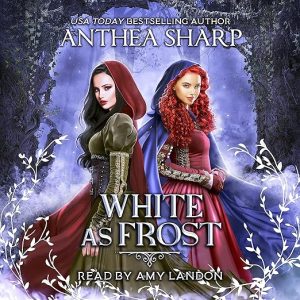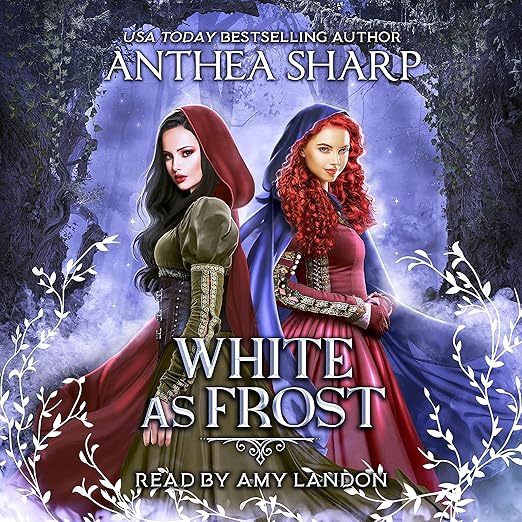
Anthea Sharp's White as Frost draws from the Grimm fairy tale of Snow White and Rose Red rather than the better-known Snow White, a distinction that matters more than it initially sounds. The source tale is about two sisters, not one, and their relationship with a bear who is actually an enchanted prince. Sharp transplants this architecture into a fae-inflected secondary world, layering the stepsister dynamic with a court politics narrative and a first-person narration from Rose, the non-magical half of the pair. Amy Landon narrates this opening volume of the Darkwood Trilogy, and the audiobook experience is shaped by her voice from the first chapter.
Rose is not a passive heroine, but she is a disadvantaged one. She has moved into a castle beside a forest called the Darkwood after her mother's marriage to the king. Her stepsister Neeve has magic, has the affection of a guardian named Thorne who protects and tutors her in the forest's powers, and has the succession advantage of being the actual heir. Rose has none of these things. What she does have, and what the first-person narration makes vivid, is an acute awareness of her own displacement and a stubborn refusal to accept it as her permanent condition. This is good material for a YA fantasy protagonist, and Sharp writes it with enough specificity that the familiar setup does not feel like placeholder.
First, the Big Picture
The craft question in a book like this is how to make the magical power differential feel genuinely consequential rather than just a plot mechanism for the heroine to overcome. Sharp handles it well by making Neeve a fully realized character rather than an obstacle. One reviewer noted that "Rose and Neeve did bond over that time but nothing significant at least seemed to happen." This is a fair observation about pacing, but it undersells the accumulative quality of the relationship-building. What looks like inaction in synopsis is, in the experience of the audiobook, the patient construction of a relationship that will matter to the series.
Another reviewer with fairy tale knowledge noted that the book is "a lovely retelling of Grimm's Snow White and Rose Red meshed with fae lore in the author's unique fantasy world" and confirmed it can be read without the preceding prequel. Sharp has built a world with enough internal coherence that the Darkwood Trilogy functions as its own entry point, even within a larger series context. The mythology of the Darkwood, what it wants, what Thorne's guardianship means, why Neeve's power takes the form it does, is parceled out carefully rather than dumped in exposition, which is the right structural instinct for an opening volume.
What Makes White as Frost Worth Hearing
Amy Landon is one of the more reliable YA fantasy narrators working, and her performance here reflects the sustained care she brings to first-person young adult material. Rose's voice is specific, impulsive where Neeve is controlled, warm where Neeve is contained, confused where Neeve is certain. Landon maintains these contrasts without caricaturing either character, which is important in a novel whose central dynamic is the relationship between two very different young women discovering unexpected common ground.
The Darkwood itself is the audiobook's most effective element. Sharp's forest has a texture and a menace that accumulate slowly through Rose's observations, glimpses of what happens to those who enter without protection, what Thorne's role actually costs him, what Neeve's visits to the forest do to her over time. At 11 hours and 35 minutes, the book has room to build this atmosphere without rushing, and Landon's pacing gives the forest scenes the unhurried weight they need.
A Few Reservations
The middle section of the audiobook is explicitly acknowledged by one reviewer as lagging, "it did kind of lag and didn't seem like much happened over the passing of time." This is the honest assessment. The time-passes sequences in the middle of the book prioritize relationship and world-building over plot momentum, and listeners who need consistent narrative drive will feel the deceleration. Sharp is building toward a revelation, but the patience required to reach it is real.
The romance with Thorne is clearly central to the series arc and present enough in this first volume to be felt, but it is handled with restraint. Rose's attraction is acknowledged and then deliberately held at a distance by both the character and the narrative. Readers expecting a full romantic payoff in this volume will need to calibrate, this is an opening chapter of a longer story, and the romantic elements function as promise rather than resolution.
Who Should Listen to White as Frost
Listeners who appreciate fairy tale retellings with dark atmospheric backing, readers of Sarah J. Maas's early work or Holly Black's fae novels, will find White as Frost's pacing and tone congenial. The YA pitch is genuine: the protagonist is a teenager, the magical-world-building is central, and the coming-of-age elements around identity and belonging are never far from the surface. But the Darkwood's menace and the castle's cold court dynamics give the book a slightly darker register than some YA fantasy.
Skip it if you need fast-moving plots or quick romantic resolution. The Darkwood Trilogy is built for sustained investment, and the first volume is primarily a foundation rather than a payoff. Listeners willing to sit with a slow-building atmospheric fantasy and let Amy Landon's narration draw them into the Darkwood's particular dread will find a series beginning that rewards the patience it asks for.
Good to Know
Does the White as Frost audiobook require reading the prequel first, or is it accessible as a series opener?
It works as a standalone opener. One reviewer specifically noted they had not read the prequel and found it accessible without that context. Sharp provides enough world-building within the first volume that new readers can follow the mythology and character dynamics without prior series knowledge.
How does Amy Landon's narration handle the contrast between Rose and Neeve in the audiobook?
Landon maintains distinct vocal registers for the two sisters without overplaying the contrast. Rose's impulsiveness and warmth are audible in her delivery, while Neeve's contained quality comes through in Landon's more measured performance of her dialogue. The relationship's gradual development tracks clearly in audio.
Is the White as Frost audiobook appropriate for younger teen readers, or is the dark fantasy content aimed at older YA?
The fae and forest content includes darker elements, menace from the Darkwood, consequences for those who enter without protection, but the book is written for a broad YA audience. The romantic content is restrained in this first volume. It is appropriate for teens across the YA age range.
Does the White as Frost audiobook end at a satisfying stopping point, or does it end on a cliffhanger that requires the next volume?
The main story arc of the first volume reaches a meaningful resolution, though the series mythology and the romantic thread are clearly ongoing. It ends with enough closure to be satisfying while leaving clear reasons to continue to the second Darkwood Trilogy book.