Quick Take
- Narration: Virtual Voice handles the journal-entry prose competently but lacks the warmth a human narrator would bring to the trail’s emotional highs and lows.
- Themes: Endurance and solitude, human connection along the trail, the transformative power of sustained physical challenge
- Mood: Meditative and uplifting, with honest stretches of hardship
- Verdict: A genuinely immersive thru-hike journal that earns its emotional climax at Mount Katahdin, though listeners who prioritize narration performance should note the AI voice.
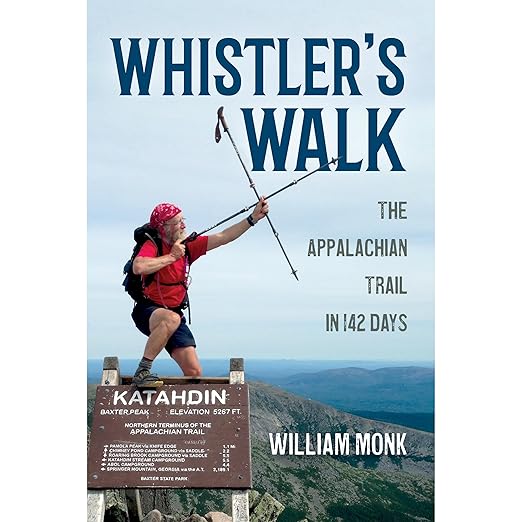
I came to Whistler’s Walk on a drizzly Tuesday afternoon when my own plans for a weekend hike had just been rained out. There is something quietly consoling about settling into someone else’s outdoor adventure when yours has been cancelled, and Bill Monk’s account of walking all 2,189 miles of the Appalachian Trail in 142 days turned out to be exactly the kind of company I needed. What started as background listening while I made dinner stretched into three hours on the couch, trail maps pulled up on my phone, trying to follow Monk’s progress north. I had not planned to care this much about a stranger’s blisters and elevation gains, but that is what the best trail memoirs do: they make the physical specific enough that you cannot maintain comfortable distance from it.
The book began life as a daily journal, and that origin is both its greatest strength and its most distinctive quality. Monk does not reconstruct or editorialize with the benefit of hindsight. You get the trail as he lived it: sore knees on day eleven, the particular misery of a wet sleeping bag, the genuine delight when a town stop delivers a hot meal and a real bed. Readers who came expecting a polished narrative memoir with a tidy thematic arc may need to adjust expectations here. This is a documentary record, not a shaped story. But that rawness is precisely what makes it valuable, and what separates it from the versions of outdoor adventure writing that have had the difficulty edited out in favor of the inspirational.
What a Daily Journal Format Actually Delivers
Reviewer John Hughes captured the rhythm perfectly: he joined Monk at breakfast each morning, read what the day would bring, and experienced the trail as a kind of shared ritual. That is not an accident of reading style. Monk writes with the specificity of someone who knows the day’s details matter. You learn the names of shelter registers, the relative mercy of the terrain in Virginia versus the brutality of Maine, and the particular personality of the hiker community Monk fell into. His trail name, Whistler, feels earned by the time you are a few weeks in. The journal format means sections are short and portable, which one reviewer noted makes it easy to pick up and put down. I found the opposite problem: the chapters are short enough that you tell yourself one more, and suddenly it is midnight and Monk is somewhere in New Hampshire and you cannot leave him there.
The Relationship with Scooby
More than one reader flagged the evolving friendship with a fellow hiker named Scooby as the emotional spine of the book. Steve Holyfield, one of the reviewers who compared Whistler’s Walk favorably against AWOL, wished Monk had gone deeper into those human connections. I share that wish in part. The trail friendships are real and affecting, and there are moments where you can feel Monk consciously choosing restraint when the material might have supported more. Whether that is a deliberate choice or a consequence of the journal format, I cannot say. What I can say is that when Scooby appears, the writing perceptibly lifts. The relationship gives the book an emotional through-line that the daily format alone cannot quite provide, and the moments where their paths diverge and reconnect along the trail give the second half of the book a weight it might not otherwise have earned.
The Narration Question
This audiobook uses a Virtual Voice narrator, which Audible deploys for titles without a human recording. For a journal-format memoir, the choice matters more than it would for fiction. Monk’s writing has a gentlemanly quality, as Brian Gladstone’s review puts it, a certain quiet authority that comes from someone who is not performing adventure but simply recording it honestly. A skilled human narrator could have brought texture to that voice, the slight fatigue of day ninety, the particular elation of a summit morning, the way exhaustion changes how you write a sentence. The Virtual Voice performs the text clearly and without stumbling, but it cannot replicate the naturalistic cadence that Monk’s prose seems to want. If you are the kind of listener for whom narration is the primary pleasure, this limitation will register. If you are primarily interested in the content of the account, the trail, the mileage, the people, the weather, the impossible beauty of a mountain morning after a hard week, you will get on fine.
The Kind of Reader This Book Was Made For
Linda H’s review, written by a 67-year-old woman who has dreamed of hiking the AT for years without ever getting the chance, identifies the book’s widest audience: people who want to walk the trail vicariously without sanitizing the experience. The daily format means you absorb the commitment of a thru-hike in a way that highlights-reel trail memoirs do not always provide. Beth Young noted the hybrid structure, journal entry meets constructed narrative, and that is accurate. Monk shapes the raw entries enough that they cohere as chapters without losing the immediacy of field notes. Listeners who prefer a more literary wilderness memoir, think Cheryl Strayed’s Wild or Bill Bryson’s A Walk in the Woods, will find this rougher-edged but in some ways more honest about the accumulation of ordinary days that makes a thru-hike what it is. This free audiobook earns its 4.6 rating across nearly 800 reviews from a readership that recognizes the difference. Come to it if you want to know what 142 days on the Appalachian Trail actually feels like from the inside, one coffee-and-breakfast morning at a time.
Frequently Asked Questions
Is Whistler’s Walk suitable for listeners who have never hiked the Appalachian Trail?
Yes. The journal format and Monk’s accessible writing style make the trail legible to complete non-hikers. He explains enough context that the AT’s culture and geography make sense without prior knowledge.
How does the Virtual Voice narration affect the listening experience compared to a human narrator?
It is functional but impersonal. The prose is read clearly, but the warmth and variation that Monk’s gentlemanly writing style seems to call for are absent. Listeners focused on content over performance will adapt quickly.
How does this compare to other AT memoirs like AWOL’s guide or Bill Bryson’s A Walk in the Woods?
Whistler’s Walk is closer in spirit to AWOL than Bryson. It prioritizes daily authenticity over comic narrative. Reviewers who have read both tend to describe Monk’s book as more intimate and less polished, which is either an asset or a limitation depending on what you want.
Does the book cover preparation and gear, or is it purely a trail narrative?
The synopsis describes intense necessary preparation at the start, and reviewers confirm that Monk’s practical knowledge surfaces throughout. It is not a gear guide, but the preparation section gives context that makes the later trail hardships more legible.