Quick Take
- Narration: The multicast production brings Birdie, Linzie, and Mary-Beth into distinct vocal life, a format decision that earns its ambition given how much the book depends on competing perspectives.
- Themes: The long aftermath of childhood sexual abuse, who controls a story and why that control matters, the gap between legal justice and lived justice
- Mood: Tense and literary, more interior than thriller-paced, closer to Toni Morrison than Gillian Flynn despite the genre billing
- Verdict: A literary debut that is more ambitious and more disturbing than its packaging suggests, readers who want a conventional whodunit will be surprised; readers ready for something harder and more considered will find it extraordinary.
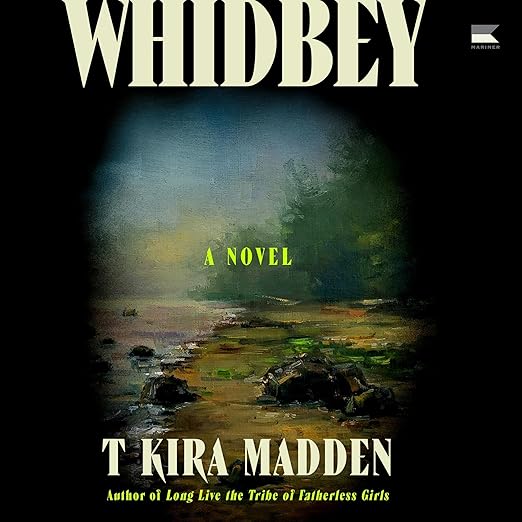
I started Whidbey on what I thought was going to be a thriller afternoon. By the end of the first hour I had adjusted my understanding of what kind of book I was in. T Kira Madden, whose memoir Long Live the Tribe of Fatherless Girls established her as one of the more formally adventurous writers working in nonfiction, has written a debut novel that borrows the architecture of a whodunit and uses it to examine something that conventional crime fiction almost never addresses with this degree of care: the lives of people who survive childhood abuse, and the question of who gets to tell their story.
Calvin Boyer is dead. Three women are connected to him: Birdie Chang, who he abused at age nine; Linzie King, who he abused at thirteen and who later wrote a bestselling memoir about it; and Mary-Beth, Calvin’s mother, who loved her son and has to receive the news of his murder. The book moves between these three perspectives, building a whodunit from the inside out.
Our Take on Whidbey
The Adam Johnson blurb on the cover calls it part thriller, part mystery, part conversation with the classics regarding the human condition, and he’s not wrong. Madden is interested in questions that genre fiction usually elides: who has the right to tell a story about violence done to them, and what happens when multiple survivors of the same perpetrator develop competing narratives about what happened and what justice looks like? Linzie’s memoir has made her famous in a way that Birdie, who chose silence, hasn’t processed. Birdie arriving on Whidbey Island and cracking open Linzie’s book, only to find too much she recognizes in its pages, is the novel’s central emotional engine, and it’s extraordinarily well-executed. The mother’s perspective, Mary-Beth, provides a more uncomfortable angle: genuine maternal love for a man who did terrible things, rendered without sentimentality and without simplification. One reviewer called it disturbing in ways that haunt you long after finishing, which is accurate.
Why Listen to Whidbey
The multicast production is the right format decision for this material. The book is fundamentally about competing perspectives and the way three different women understand a shared history through irreconcilably different lenses. Having distinct voices for Birdie, Linzie, and Mary-Beth, with Eunice Wong anchoring the production, makes those perspectives audibly separate in ways that single-narrator readings of multi-POV fiction often fail to achieve. At nearly fourteen hours, the listening experience is substantial. The pacing is literary rather than thriller-propulsive, which is the adjustment most readers will need to make: you’re not going to be racing through chapters trying to catch a killer. You’re going to be sitting with three women and their very different relationships to a very similar wound.
What to Watch For in Whidbey
Several reviewers came expecting a conventional mystery and found something more difficult and more literary than anticipated. The thriller and mystery elements are real, there is a whodunit at the center, but they function as structure for the exploration of abuse, narrative power, and the failures of rehabilitation and incarceration systems, not as the primary reason to listen. Content warnings are genuinely warranted: the book deals explicitly with childhood sexual abuse and its long-term effects. One reviewer described it as disturbing at times, raising questions about justice systems and rehabilitation methods. Another said the content felt vindicating in a strange way, that for many women, the terrain Madden maps is familiar even if the specific experience isn’t. Listeners who pick this up expecting a thriller-paced mystery may find the first half slower than the genre marketing suggests.
Who Should Listen to Whidbey
Readers who have followed Madden’s nonfiction career will find this a natural extension of her preoccupations, the memoir drew on similar territory, and the fiction allows her to explore that territory from multiple angles simultaneously. Listeners drawn to the literary crime fiction of writers like Attica Locke or Celeste Ng, where the crime is a structural device for examining something larger, will find Whidbey in that tradition. The book carries genuine content weight around childhood sexual abuse, and readers should go in prepared for that. Those who need their mysteries resolved with conventional clarity about motive and justice may find Madden’s ending more ambivalent than satisfying. Those who find ambivalence more honest than tidy resolution will find this one of the more serious literary debuts in recent years.
Frequently Asked Questions
Is Whidbey primarily a thriller or literary fiction, what should I actually expect from the experience?
Literary fiction that uses thriller architecture. The mystery of who killed Calvin Boyer provides structure, but the book’s actual interest is in the three women connected to him and the question of who controls narrative around abuse. Readers expecting the pace of a conventional thriller will need to adjust their expectations significantly.
How does the multicast format work, and does it serve the story?
The three main perspectives, Birdie, Linzie, and Mary-Beth, are given distinct voices, with Eunice Wong coordinating the production. This format serves the novel’s central concern about competing perspectives exceptionally well, making the women’s different experiences of the same history audibly distinct rather than just stylistically differentiated on the page.
How explicitly does Whidbey address childhood sexual abuse?
With considerable directness. This is the book’s central subject, not a backstory element. Reviewers note it can be disturbing and recommend going in prepared. That said, Madden handles the material with literary care rather than gratuitousness, the focus is on the aftermath and the women’s lives rather than on the abuse itself.
Is the mystery of Calvin’s death resolved conventionally by the end?
In a technical sense yes, though Madden is more interested in the question of justice as a concept than in the procedural satisfaction of identifying a killer. The ending is more morally complex than conventionally satisfying, which divides readers, those who want clean resolution may find it frustrating; those who find that moral complexity more honest will likely find it the book’s strongest section.