Quick Take
- Narration: Emily Chappell reads her own work with clarity and emotional precision; she neither sentimentalizes the racing nor the grief, and the restraint is consistently the right call.
- Themes: Ultra-endurance as philosophy, the paradox of competitive friendship, grief without resolution
- Mood: Physically vivid and emotionally honest, with a quiet devastating undertow that surfaces gradually
- Verdict: Where There’s a Will uses the Transcontinental Race as a lens for exploring endurance, loss, and what it means to push past the person you thought you were; it rewards listeners willing to follow a tonal shift in the second half.
I am not a cyclist. I want to be honest about that upfront, because I went into Where There’s a Will prepared to admire it from a distance, the way you admire a discipline that is clearly not yours. What I didn’t expect was to be genuinely undone by the second half of the book. Emily Chappell earns the grief she eventually leads you to; she builds toward it so carefully that when it arrives you feel you’ve been riding alongside her through the dark hours of the night stages, and the loss lands accordingly.
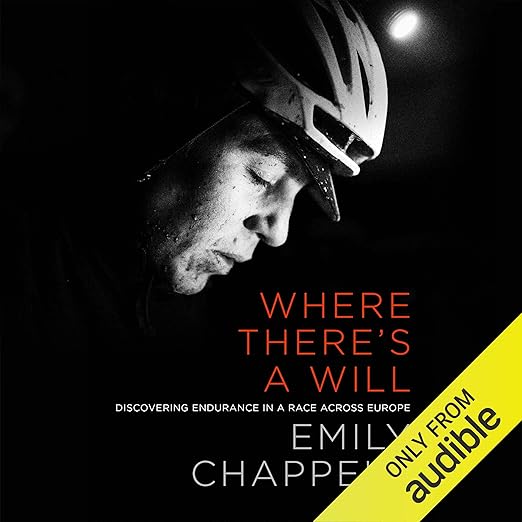
Chappell was a London cycle courier when she entered the Transcontinental Race: a self-supported crossing of Europe in the shortest time possible, no route prescribed, no assistance allowed. On her second attempt she won the women’s category, covering nearly 4,000 miles in thirteen days and ten hours, sleeping in brief bursts wherever her body gave out. This is already an extraordinary story. But the book isn’t primarily about that win. It’s about what the win meant and didn’t mean, and about her friendship with Mike Hall, the race’s founder, who was killed by a vehicle on a race course in Australia not long after.
The Race That Doesn’t Give You Answers
Chappell is excellent on the interior experience of ultra-endurance sport. She describes sleep deprivation, pain management, the strange psychological territories you enter after seventy-two sleepless hours, and the way that extreme physical stress strips away ordinary self-concept until you’re left with something more fundamental. Her account of the second Transcontinental attempt is specific about the logistics and the suffering without being tediously technical, and her prose rises to something close to poetry in passages about the experience of riding through the night across Eastern Europe on roads no support vehicle will follow.
One reviewer called the writing “poetic clarity with a deft and honest touch,” and that’s accurate. Chappell doesn’t write like a sports journalist; she writes like a novelist who happens to be describing something that actually happened to her. The book is published as sports memoir but it reads closer to literary nonfiction, and that’s where its value lies and its real audience lives.
Where the Book Shifts Beneath You
A fair number of readers found the second half of the book less engaging than the first, and I understand that response even if I don’t fully share it. The first half is driven by narrative momentum: the race, the physical drama, the competition. The second half is slower and more reflective, centered on Chappell’s work with Mike Hall and the emotional aftermath of his death. That shift in register is jarring if you came primarily for the race reporting, and one reviewer noted they found themselves skipping ahead through the later chapters.
For listeners willing to follow Chappell into that slower, more uncertain territory, the second half is where the book’s real intelligence lives. She is honest about ambivalence, about a race win that troubled as much as pleased her, and about the particular difficulty of grief that arrives before you’re finished being grateful for what the lost person gave you. Hall’s death is handled with neither melodrama nor false resolution. Chappell sits with the discomfort, and she writes from inside it rather than at a safe interpretive distance.
An Author Reading Herself
Chappell’s narration of her own work is, as one reviewer noted, “equally well read” to the writing itself. She has the particular gift of reading aloud as if she is speaking rather than performing, which suits a memoir of this kind exactly. The physical descriptions land with authority: she’s not reconstructing an experience she read about; she’s reporting from muscle memory, and you can hear that in the specificity of the delivery. The emotional passages are read without self-consciousness, and the combination of physical specificity and emotional openness is what makes the audiobook version particularly effective.
At eight hours and ten minutes, the runtime feels right. The book would be weaker both shorter and longer. Chappell knows when she has said what needed saying, and the running time respects that economy.
For Riders, and for Everyone Else
Where There’s a Will is ideal for listeners who have ever pushed themselves physically past what seemed possible, regardless of the sport or activity involved. It’s also for readers interested in grief literature that refuses easy comfort, or in questions about what motivates people to attempt extreme things. Cyclists and adventure athletes will find specific pleasures here, but the book’s actual subject, what endurance reveals about character and what loss leaves in its place, requires no specialist knowledge. Available as a free audiobook on Audible, it is well worth the eight hours regardless of whether you’ve ever clipped into a pedal. Books about ultra-endurance sport are, at their best, books about consciousness under pressure, about what happens to the self when the body has run out of resources and the mind must decide what to do next. Chappell understands this and writes from inside it. That makes Where There’s a Will more useful as a document of human experience than the genre label alone would suggest. It belongs in the same conversation as Rebecca Solnit’s writing on walking or Robert Macfarlane on mountain landscapes: books that use physical experience to approach philosophical territory without announcing the philosophy at every turn. Chappell earns that comparison by staying inside her own experience rather than gesturing toward larger meanings she hasn’t yet earned. The result is a book that trusts its reader to draw their own conclusions from what she has seen and suffered and survived, which is a form of respect that the best memoir writers extend and others don’t.
Frequently Asked Questions
Do you need to know anything about cycling or the Transcontinental Race to follow the book?
No. Chappell explains the essential context clearly, and the book is written for a general literary audience rather than a cycling specialist readership. The racing scenes are vivid without being technically demanding.
How much of the book focuses on Mike Hall’s death, and how graphic is that treatment?
Hall’s death forms a significant emotional anchor for the book’s second half, but Chappell handles it with restraint. She writes about grief and absence rather than the accident itself, and the tone is reflective rather than distressing.
Is the second half as strong as the first half, or does the book lose momentum after the race?
This is genuinely contested territory among readers. The second half is slower and more introspective; some listeners find it less engaging, others find it where the book’s real depth lives. If you came purely for race drama, adjust expectations accordingly. If you’re open to a tonal shift toward memoir and elegy, the second half rewards patience.
Has Emily Chappell written other books, and how does this compare?
Chappell’s earlier book What I Carry documents a different long-distance ride and her experiences as a cycle courier. Where There’s a Will is generally considered her more fully realized work; it is more emotionally complex and more carefully written throughout.