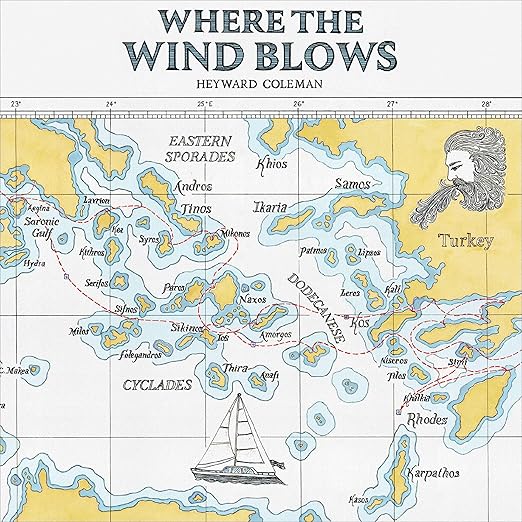
Heyward Coleman's decision arrives with more drama than most midlife pivots. Squeezed out of his company in mid-career, he looks at the uncertainty ahead and chooses something that sounds, on paper, like an obvious mistake: pull his children out of school, sell the house, buy a boat in Greece, and spend a year sailing the Mediterranean. Where the Wind Blows, the audiobook narrated by Timothy G Little, is the record of what happened next, and Coleman tells it with the self-aware humor of someone who knows the whole thing was slightly insane and entirely worth it. This is the first book in The Voyages of Skimmer series, with Coleman's subsequent circumnavigation documented in a later volume.
The timing compounds the adventure. The Gulf War was underway as the Colemans set sail, which introduces a layer of external uncertainty that gives the trip its first real pressure beyond the ordinary challenges of a family learning to live aboard a boat. The family, Heyward and Charlotte and their children including daughter Margot and son Alex, navigates both the literal waters of the Aegean, Mediterranean, Adriatic, and eventually the Atlantic, and the more unpredictable waters of family dynamics under stress. Coleman writes honestly about both, and the relationship between himself and Charlotte, as they work out how to crew together effectively, is one of the memoir's most sustained and interesting threads.
Our Take on Where the Wind Blows
Timothy G Little's narration suits the material precisely because it does not try to make Coleman sound like a professional storyteller. The delivery has the quality of a good dinner-party account, someone who was there and is recounting it with pleasure but without theatrical embellishment. That register is right for a memoir that earns its appeal through specificity and honesty rather than dramatic construction. Coleman is not a great prose stylist, and Little does not try to perform the text as if he were. The result is an audiobook that feels authentic to its subject in a way that more polished narration would actually undermine.
The memoir is strongest when it stays at the level of the specific: a particular anchorage in the Cyclades, a difficult night on the Corinth Canal, the social life aboard neighboring boats at various ports, the learning curve of two people working out how to crew together in difficult conditions. Reviewer M Everett, who clearly had some cruising background, noted the story's appeal is how the author navigates both literal and relational waters across the year. That dual navigation, physical and interpersonal, is what separates this from a simple ports-and-weather log and gives the memoir its human texture.
Why Listen to Where the Wind Blows
At 14 hours and 37 minutes, this is a substantive listen for its genre. Sailing memoirs tend to run long because the experience they describe is longitudinal, months of daily decisions rather than a single dramatic event, and Coleman uses the runtime to convey the cumulative effect of the year rather than a highlight reel. The itinerary itself is genuinely interesting: the Cyclades, Turkey's Aegean coast, Rhodes, the boot of Italy and Sicily, Malta, Tunisia, the Balearic Islands, Gibraltar, and the Atlantic coast of Portugal and Spain into the Netherlands. Each region has its own character and Coleman gives each enough space to feel distinct.
For aspiring cruisers, the book functions as something between memoir and practical guide. Coleman is detailed about planning, provisioning, decision-making under uncertainty, and the logistics of making a major voyage work with a family aboard. Reviewer B Stassen, who had sailed a similar Mediterranean route and came to the audiobook partly to compare notes, found the account vivid and recognizable. A reviewer who had bought the book based on its cover alone and was preparing a Greek Islands cruise described it as a great read on many levels. The practical credibility is a genuine selling point.
What to Watch For in Where the Wind Blows
The sailing content is fairly technical in places, and listeners without any background in sailing may find some passages slow. Coleman uses nautical terminology throughout without always pausing to define it, which is appropriate for the intended audience but can create distance for those coming to the subject entirely fresh. Reviewer Pablo noted that much of the most interesting action happens at various ports and parties on other boats rather than at sea, which is an accurate characterization of where the memoir's human energy concentrates.
The memoir ends with a note pointing forward to Coleman's next book, covering the circumnavigation he and Charlotte undertook ten years later. Listeners who want to know what happened to the family and to the boat have a clear path to the next volume. The first book stands alone as a complete account, but the suggestion that more is available will land differently for readers who have spent 14 hours with the Colemans and are reluctant to leave.
Who Should Listen to Where the Wind Blows
Sailors, aspiring cruisers, and armchair adventurers who want the texture of a year-long Mediterranean voyage without the salt spray will find Coleman's account consistently satisfying. The memoir also speaks to anyone considering a serious career interruption; the family dynamic of a year-long unconventional adventure has genuine resonance beyond the maritime context. Listeners who prefer dramatic narratives with clear crisis arcs may find the episodic structure too diffuse. This is a book of accumulated pleasures and observations, not a single sustained climax. The reward is proportionate to the patience the episodic structure asks for.
Quick Take
- Voice: Timothy G Little reads Coleman's memoir with the affable warmth of the author's own voice coming through clearly. The tone is conversational and suits the armchair-sailor register of the writing.
- Big ideas: Midlife reinvention at sea, family resilience under pressure, the logistics and pleasures of Mediterranean cruising
- Atmosphere: Easygoing and sun-warmed, with enough Gulf War-era tension and navigational mishap to keep the stakes real
- Worth it?: For sailors who want to feel the Mediterranean under their feet without leaving their armchair, and for anyone curious about the practical realities of pulling your family out of ordinary life for a year at sea, this memoir delivers.
Common Questions
Does the Where the Wind Blows audiobook require prior sailing knowledge to enjoy?
Basic sailing interest helps. Coleman uses nautical terminology throughout, and some technical passages may feel slow to listeners with no exposure to sailing. That said, the memoir's core appeal, family, midlife reinvention, Mediterranean travel, does not require sailing expertise.
Is this audiobook the first in a series, and does it stand alone?
Yes, this is the first book in The Voyages of Skimmer series. It stands fully alone; Coleman's Mediterranean voyage has a complete arc within this volume. A later book covers a circumnavigation and can be treated as a separate work.
How does Timothy G Little's narration handle the technical sailing passages?
Little reads the technical material at an even pace without trying to make it more dramatic than it is, which suits Coleman's plain-spoken style. The narration is consistent with the memoir's register throughout: affable, clear, and unembellished.
At nearly 15 hours, does this audiobook maintain momentum across the full runtime?
The episodic structure means the pacing is uneven by design. The early chapters, covering the decision to leave and preparations, move faster than the port-to-port middle chapters. The final stretch, into the Atlantic and north toward the Netherlands, picks up momentum again. The audiobook rewards commitment but does not sustain constant intensity.