Quick Take
- Narration: Eva Kaminsky captures Tylene’s quiet determination without over-dramatizing; her pacing suits the novel’s focus on community friction rather than individual heroics.
- Themes: Women’s authority in male-dominated spaces, WWII home front, small-town social dynamics
- Mood: Warm and quietly defiant, with moments of genuine tension
- Verdict: A true story handled with restraint and heart; the audiobook works particularly well for listeners who want their historical fiction character-led rather than plot-driven.
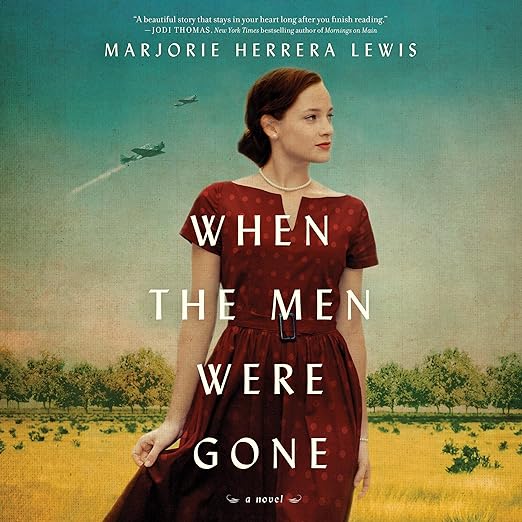
I listened to When the Men Were Gone over two evenings in late autumn, and I found myself thinking about it the next morning in the way that specific kinds of historical fiction stick – not because of dramatic plot machinery but because of the precision of its social observation. Marjorie Herrera Lewis built this novel around a documented event: Tylene Wilson became a high school football coach in Brownwood, Texas during World War II when the men who would normally fill that role had gone to war. The story is true. The novel is careful about that truth in ways that matter.
Lewis is a sports journalist by background, and that training is visible in how she handles the football sequences: with technical specificity that earns rather than borrows the sport’s emotional weight. But the book is not really about football. It is about what happens to a small Texas town when the organizing assumption of who holds authority is suddenly removed by force of external circumstances, and what it costs one woman to step into a space she was not supposed to occupy.
Our Take on When the Men Were Gone
The opposition Tylene faces is specific and detailed. Rival coaches refuse to take the field against her. Referees question her credentials before games. The community’s support is conditional and never fully settled. Players arrive skeptical. Even Tylene’s own confidence wavers in ways the book does not conceal. Lewis resists the narrative convenience of having Tylene’s competence immediately silence all critics, which makes the eventual rallying of the team feel earned rather than inevitable.
Eva Kaminsky’s narration handles this material with appropriate care. One reviewer specifically praised the characterization of Tylene as a tenacious, courageous woman, and Kaminsky’s voice work maintains that characterization consistently without slipping into hagiography. The humor the book contains – and it does have genuine humor – comes through clearly in Kaminsky’s timing. The emotional beats, particularly the town scenes where Tylene’s position is being actively contested, land with quiet force.
Why the WWII Home Front Setting Matters
The novel’s 1944 setting is not incidental. The home front context does two things simultaneously: it makes Tylene’s appointment plausible in ways it would not have been under normal circumstances, and it underscores the fragility of the opening. Everyone understands that this arrangement is temporary, contingent on the men being gone. The question of what happens to Tylene’s authority – and to the town’s understanding of itself – when the war ends hovers over the whole story, even in scenes where it is not explicitly addressed. Lewis uses this tension intelligently without resolving it too cleanly.
One reviewer noted that the ending arrived a little quickly – that the final section felt compressed compared to the sustained development of the book’s middle. That is a fair observation. The novel is relatively short at five hours and forty-two minutes, and some readers will want more time in the denouement. But the economy also prevents the story from overstaying its welcome, and the pace that some reviewers find too fast others will find bracingly focused.
What to Watch For in the Social Resistance
The most interesting material in this novel is not the football but the community politics around the football. Lewis maps the range of responses Tylene encounters – from the principal who gives her cautious support, to the local press that cannot decide whether she is a curiosity or a menace, to the rival programs that use her gender as a tactical weapon – with sociological accuracy that suggests genuine research into how small Texas towns operated in the 1940s. The players’ arc from skepticism to investment is handled with more nuance than a standard sports narrative would require; Lewis is interested in the specific reasons each player resists or comes around, rather than treating the team as a single unit with a single trajectory.
One reviewer who encountered the book in a middle-grade context suggested it would work particularly well for younger readers. That is true: the novel’s language is accessible, the conflict is clear, and Tylene is a protagonist whose courage is legible to younger audiences. But it would be a mistake to file this as only a younger-reader book. The historical detail and the social observation are adult-register material that rewards adult attention.
Who Should Listen to When the Men Were Gone
Listeners who enjoy character-driven historical fiction about the WWII home front, particularly stories centered on women navigating institutional resistance, will find this precisely calibrated to their interests. Sports fiction readers who want social texture alongside the game sequences will not be disappointed. Those who want fast-moving plot mechanics or a larger cast of developed characters may find the scope modest. At under six hours, this is also an excellent choice for listeners who want a complete, satisfying arc without a major time commitment – the kind of audiobook that works beautifully on a long drive.
Frequently Asked Questions
Is this based on a true story, and how closely does the novel follow the historical events?
Yes, Tylene Wilson was a real person who coached a Texas high school football team during World War II. Lewis conducted research into the historical events and built the novel from documented circumstances, though as fiction it includes invented dialogue and scenes. The core facts – including the opposition Tylene faced from the press, rival coaches, and the community – are grounded in the historical record.
Do you need to know football to enjoy this audiobook?
No. Lewis’s journalism background gives the football sequences technical authenticity, but the emotional and social dynamics of the story are fully accessible to listeners with no interest in the sport. The football games function as occasions for community politics rather than as the primary subject of the novel.
Is Eva Kaminsky’s narration a good fit for this material?
Reviewers found Kaminsky’s performance well-suited to Tylene’s character – steady and quietly determined rather than theatrical. Her pacing through the community opposition sequences and the football scenes maintains the novel’s balance between sports narrative and social observation.
How long is the audiobook, and is it suitable for younger listeners?
The audiobook runs five hours and forty-two minutes. One reviewer specifically described it as particularly suitable for middle-grade students, and the accessible language and clear moral framework do work for younger audiences. Adult listeners will find the historical detail and social observation equally engaging. The content is suitable for all ages.