Quick Take
- Narration: Tim Morgan handles this dense sports history with steady authority, his pacing suits the book’s measured prose and gives the archival material room to breathe.
- Themes: Basketball as civic identity, New York in the 1970s, sports as cultural mirror
- Mood: Nostalgic but unsentimental, the kind of sports history that remembers loss as clearly as triumph
- Verdict: The definitive account of the championship Knicks era doubles as a portrait of a city, and Tim Morgan’s narration does justice to both.
I was halfway through my Tuesday evening commute when the chapter on Willis Reed’s limping onto the Garden floor stopped me cold. I know the story. Most sports fans know the story. But Harvey Araton tells it in a way that reconnects it to the specific weight of New York City in 1970, the garbage strikes, the fiscal crisis building on the horizon, the particular exhaustion and resilience of a city that needed something to believe in. By the time Tim Morgan read the crowd’s reaction, I had missed my stop.
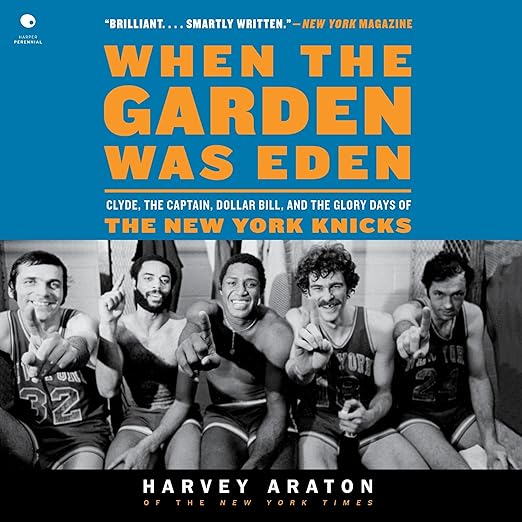
When the Garden Was Eden was originally published in 2011 and brought to audio with a new release through Harper Paperbacks. Running nearly eleven hours, this is not a quick sports biography, it is a fully committed piece of sports journalism that treats the late 1960s and early 1970s Knicks as an entry point into a larger story about race, politics, civic identity, and the nature of team sports done right.
Our Take on When the Garden Was Eden
Araton has covered the Knicks for decades, first as a teenage fan, then as a reporter for the New York Post, and eventually as a columnist for the New York Times. That long arc of observation gives the book a depth of access that most sports histories cannot match. He interviewed the principal players, Walt Frazier, Willis Reed, Bill Bradley, Dave DeBusschere, Phil Jackson, at length, and the player profiles that emerge are genuinely dimensional. These are not hero sketches. DeBusschere’s working-class origins, Bradley’s unusual intellectual life, Jackson’s early coaching philosophy, Araton treats each figure as a full person navigating a specific historical moment.
Reviewer Peter Hillman, who attended those games as a teenager, wrote of getting goosebumps again, forty years after being at these games, coming of age. That quality, the ability to restore the emotional texture of events that have since been mythologized into smoothness, is the book’s greatest achievement. The 1970 and 1973 championships are remembered now as inevitable legends, but Araton reconstructs them as contingent, hard-fought, and contextually specific.
Why Listen to When the Garden Was Eden
Tim Morgan’s narration is well-suited to the material. Araton’s prose is measured and precise, the New York Times column voice, disciplined and never indulgent, and Morgan respects that. He does not dramatize or editorialize; he reads the text the way it was written, which is the right call for a book this substantive. The effect is something like having the book read to you by a knowledgeable friend rather than performed for you by an actor.
The sociopolitical context is handled with genuine care. The book examines the racial politics of the era, the NBA was integrating rapidly, and the Knicks were a particularly multiracial team for their time, without reducing the players to symbols of the moment. Reviewer Jarrett Tedesco praised the profiles of players’ upbringings and unique struggles amidst the times’ racial and political landscapes. This is history writing that earns its claims.
What to Watch For in When the Garden Was Eden
Reviewer Jarrett Tedesco noted the book’s final chapters shift tone, moving from the championship era into subsequent Knicks history and the present-day shadow the old team casts. Some readers found this less satisfying than the main narrative. The later material does not have the same density of reported access, and the shift from historical reconstruction to contemporary observation is noticeable. It does not undermine the book’s overall achievement, but listeners expecting the final hours to match the first eight may feel a slight deflation.
This is also a book that rewards some prior knowledge of the era. Listeners who are unfamiliar with the broader context of New York City in the early 1970s, the near-bankruptcy, the crime surge, the particular political atmosphere, will get the sports history clearly, but may miss some of the resonance that makes the book more than a basketball chronicle.
Who Should Listen to When the Garden Was Eden
Essential for any serious Knicks fan and for listeners who appreciate sports writing that reaches beyond box scores and championships. It is also a strong recommendation for anyone interested in New York history, race and sports in America, or the NBA’s early evolution. Casual basketball fans who want a quick biography may find the depth and length demanding, but those willing to commit will find one of the more serious and rewarding sports audiobooks available.
Frequently Asked Questions
Do you need to be a Knicks fan to enjoy When the Garden Was Eden, or does it work as general sports history?
It works as general sports history and as New York City history of the early 1970s. The players are treated as dimensional human beings navigating a specific historical moment, so the book has value well beyond basketball fandom.
How does Harvey Araton handle the racial politics of the era, does it feel integrated into the narrative or tacked on?
It is genuinely integrated. Araton examines race throughout, from individual player backgrounds to the broader dynamics of an integrating NBA. Reviewers specifically praised this aspect as handled with depth rather than as a sidebar.
Is this a standalone listen or should I have background knowledge of the 1970s Knicks before starting?
Araton provides enough context for newcomers to follow the story. Prior knowledge deepens the experience, but the book does not assume it. Knowing the basic outlines of New York City in the early 1970s helps with the civic backdrop.
How does this compare to Blood in the Garden, the book about the 1990s Knicks?
Reviewers who have read both tend to recommend them together as complementary portraits of the franchise across decades. When the Garden Was Eden covers the championship years with more sociopolitical depth; the two books are frequently read as a pair.