Quick Take
- Narration: Cary Hite delivers Rich Cohen’s propulsive, literary sportswriting with the right energy, capturing both the nostalgia and the competitive ferocity of the era.
- Themes: Athletic rivalry as character revelation, the NBA’s transformation into cultural force, legacy and identity under pressure
- Mood: Urgent and nostalgic simultaneously, propulsive in the way good sportswriting is when it goes beyond the score
- Verdict: A compelling portrait of the 1987-88 NBA season that uses four superstars to explore what rivalry actually does to and for people.
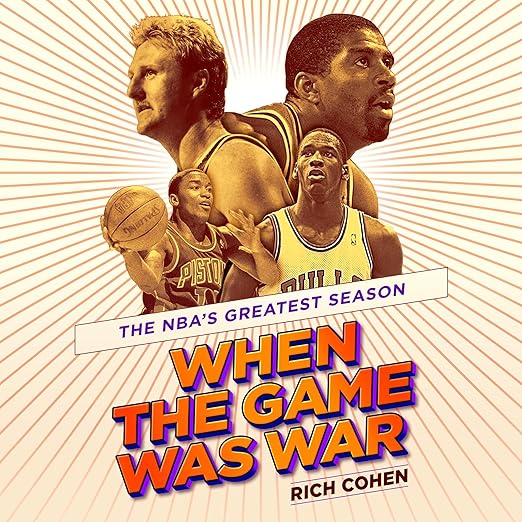
I was not alive for the 1987-88 NBA season. I came to Rich Cohen’s When the Game Was War as someone who knows Magic Johnson, Larry Bird, Isiah Thomas, and Michael Jordan primarily as mythology: names attached to highlight reels and sports documentary moments. What Cohen does, and what makes this audiobook rewarding even for listeners without the nostalgia, is show you the actual human texture of that mythology as it was being made.
The book’s premise is specific: the 1987-88 season was the peak of a particular golden era, the moment when the NBA had the highest concentration of future Hall of Famers competing simultaneously. Cohen uses this season as a frame to tell the origin stories of four men from four very different Americas: Larry Bird from rural Indiana, Magic Johnson from Lansing Michigan, Isiah Thomas from Chicago’s west side, Michael Jordan from Wilmington North Carolina. The biographical back-material is where the book earns its claims.
Our Take on When the Game Was War
Cohen is a literary journalist, not a sports beat writer, and that distinction shows in the prose. One reviewer described the book as being “really about character. About what you’re willing to do, to make yourself do, when everything is on the line.” That’s the right read. Cohen isn’t primarily interested in game recaps. He’s interested in what these men were like and what it cost them to be that good.
The decision to give Isiah Thomas and the Detroit Pistons comparable weight to Bird, Magic, and Jordan has drawn some pushback from reviewers who feel the Bad Boys aren’t quite in the same tier of cultural importance. That’s a legitimate argument about proportionality. But it’s also true that without the Pistons, the season doesn’t have its defining conflict. Cohen’s acknowledged affection for Thomas shapes the book’s emphasis, and at least one reviewer flagged this as bias rather than balance.
Why Listen to When the Game Was War
Cary Hite narrates, and the narration serves Cohen’s writing well. Cohen’s sentences have rhythm and momentum, and Hite doesn’t interrupt that with over-interpretation. The reading is energetic where the material demands it and quieter in the biographical backstory passages. A listener who described waking up eager to continue the book is describing exactly what good sports narrative narration enables.
At eight and a half hours, the book moves efficiently. Cohen covers a lot of territory, and the multiple-protagonist structure means the perspective shifts regularly, preventing any single story from going stale. The secondary characters, Bill Laimbeer, Kareem Abdul-Jabbar, Danny Ainge, Charles Oakley, get enough specificity that they feel like people rather than supporting props.
What to Watch For in When the Game Was War
Several reviewers have raised factual quibbles about specific details in the Magic Johnson section, including claims about Johnson and Norm Nixon that some listeners with firsthand knowledge of that era dispute. Cohen acknowledges at least some reliance on the HBO documentary treatment of the period, and listeners who are genuine experts in the era’s history may find moments where the narrative takes liberties or simplifies.
The profanity in dialogue is another noted element. One reviewer docked a star specifically for the language in quoted dialogue. Cohen is reconstructing the trash-talk and locker room texture of that era, which was not G-rated, and he doesn’t sanitize it. Listeners who prefer clean content should know this going in.
Who Should Listen to When the Game Was War
Cohen’s book works for basketball fans with nostalgia for the era and for general readers who want good character-driven sportswriting and have no particular NBA background. Listeners who lived through the 1987-88 season will get the recognition hits that Cohen has clearly designed into the structure. Those who want strict factual accountability for every claim may want to read alongside other sources. This is journalism that aims for truth through character rather than truth through box scores.
Frequently Asked Questions
Does When the Game Was War require prior knowledge of the 1987-88 NBA season?
No. Cohen provides enough biographical and historical context that readers unfamiliar with the era can follow both the narrative and the significance of each player’s arc. The book works as an introduction as well as a nostalgia piece.
Why does Isiah Thomas get as much coverage as Bird, Magic, and Jordan?
Cohen has an acknowledged affection for Thomas and the Pistons, and the book reflects that. The argument is that without Detroit’s Bad Boys, the season loses its defining conflict. Some reviewers feel the weighting overstates Thomas’s cultural equivalence to the other three.
How does Cary Hite handle Cohen’s more literary, character-driven prose passages versus the game action?
Hite shifts register between the two modes effectively. The biographical backstory sections are read with more measured pace, while the competitive game sequences pick up energy. The narration doesn’t flatten the book’s tonal variety.
Is the book based significantly on the HBO documentary coverage of this era?
At least one reviewer noted similarities between the book’s framing and the HBO documentary treatments of this period. Cohen drew from dozens of interviews with NBA insiders, but listeners who have watched those documentaries may notice overlap in how certain stories are shaped.