Quick Take
- Narration: J.P. Linton brings a measured, documentary quality to the material that suits Hayes’s embedded reporting style without over-dramatizing the wins or the losses.
- Themes: Coaching philosophy, winning as byproduct, adolescent character formation
- Mood: Inspiring without being saccharine, grounded in the specifics of real lives
- Verdict: A sports biography that earns its reputation by staying focused on the human architecture behind an almost-impossible winning streak.
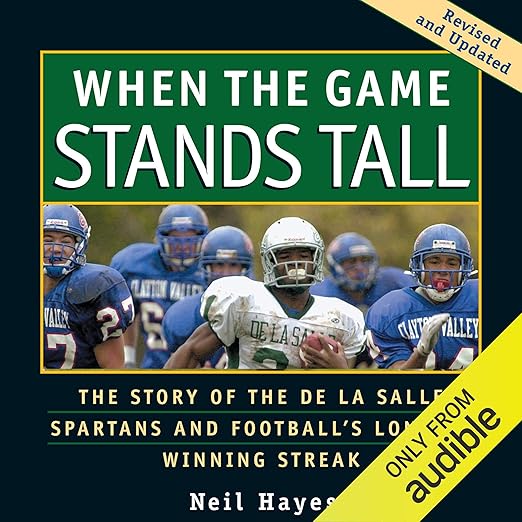
I finished this one on a Saturday morning, sitting with coffee while rain came down outside, which felt appropriately contemplative for a book about what it costs to build something that lasts. Neil Hayes spent years embedded with the De La Salle Spartans of Concord, California, a high school football program that won 151 consecutive games over twelve seasons. That number tends to be the lead in any description of this book, and I understand why, but it is also slightly misleading. The streak is not really what When the Game Stands Tall is about.
What Hayes is actually examining is Bob Ladouceur, the head coach who built a program with a winning percentage of .995, and who consistently insisted that winning was not the goal. The book that results from Hayes’s access is less a sports chronicle than a portrait of a particular philosophy of achievement, one that asks uncomfortable questions about why we keep score in the first place.
Our Take on When the Game Stands Tall
Hayes’s decision to write from the inside is what saves this from becoming hagiography. He had unrestricted access to the team during the 2002 season, which means he sat in on practices, film sessions, and the kinds of conversations coaches have when they think no one important is watching. What he found was a program built less on talent than on accountability. Ladouceur obsessed over commitment cards that players wrote to each other, articulating specific things they would do for their teammates during a given week. The ritual sounds soft on paper. In Hayes’s telling, it becomes the structural foundation of everything the Spartans achieved. One reviewer described it as a story of honesty, friendship, love, and loyalty, which could easily sound like boilerplate praise, but within the context Hayes provides, it holds up.
Why Listen to When the Game Stands Tall
J.P. Linton’s narration is well-matched to the material. He does not reach for theatrical emphasis during the game sequences, which is the right instinct. Hayes’s prose is reportorial rather than cinematic, and Linton honors that by keeping his delivery even, letting the facts carry the weight. At nearly fifteen hours, this is a substantial listen, but it earns that length by weaving together three distinct story lines: the historical development of the De La Salle program, Ladouceur’s personal evolution as a coach and man, and the granular, week-by-week account of the 2002 season. The revised edition also tracks several key players into their adult lives and covers the end of the streak in September 2004, which gives the narrative a satisfying completeness.
What to Watch For in When the Game Stands Tall
One reviewer noted, with honest precision, that it is a damn good book but not quite a great one, and he could not put his finger on why. I think I can. Hayes occasionally pulls back from psychological depth at moments where the reader most wants it. Ladouceur is a genuinely fascinating figure, a coach whose modesty borders on the pathological and whose methods produce outcomes that people with far more ego could never replicate. But Hayes, perhaps constrained by access and respect, does not always press into the tensions that must exist in a man who spent decades treating winning as a side effect. The interviews with Bill Walsh and Jon Gruden add credibility but not much heat. Still, this is a minor structural complaint about an otherwise excellent piece of sports journalism.
Who Should Listen to When the Game Stands Tall
Coaches, teachers, and anyone who manages teams will find this book more directly useful than most leadership titles that make explicit claims to being leadership titles. Sports fans who want something that rewards patience more than adrenaline will also connect with it. Listeners looking for a breezy victory narrative should look elsewhere. Hayes is building something more durable than a highlight reel, and the audiobook rewards that ambition.
Frequently Asked Questions
Does the audiobook cover the end of the 151-game winning streak?
Yes. This is the revised edition of the book, and Hayes specifically updates the narrative to cover the final tumultuous year of the streak, which ended in September 2004, and follows key players and coaches into their lives after.
Is this primarily a football book or a leadership book?
It functions as both, but Hayes never lets the leadership framing become heavy-handed. The coaching philosophy emerges through specific scenes and relationships rather than through explicit lessons, which makes it more durable than most titles that bill themselves as leadership books.
How does J.P. Linton handle the game sequences compared to the character-driven sections?
Linton keeps a consistent, measured pace throughout, which works well for the reportorial style but means the game sequences do not spike in intensity the way a more theatrical narrator might deliver them. It suits the book’s measured tone.
At nearly 15 hours, is the length justified or does the book drag?
Most listeners report the length is justified because Hayes interweaves three distinct threads. The pacing is even rather than propulsive, so listeners who need narrative momentum to stay engaged may find certain stretches slow, but those looking for depth will not feel the runtime.