Quick Take
- Narration: Lynde Houck delivers with the directness that matches Lloyd own writing voice, clean and unaffected, with no attempt to over-dramatize a story that does not need it.
- Themes: Resilience and self-reinvention, the psychology of elite performance, the cost of ambition
- Mood: Candid and motivating, with a competitive edge throughout
- Verdict: One of the more honest sports memoirs in recent years, where the athlete willingness to describe her own failures and the friction within her team makes the eventual triumph feel genuinely earned.
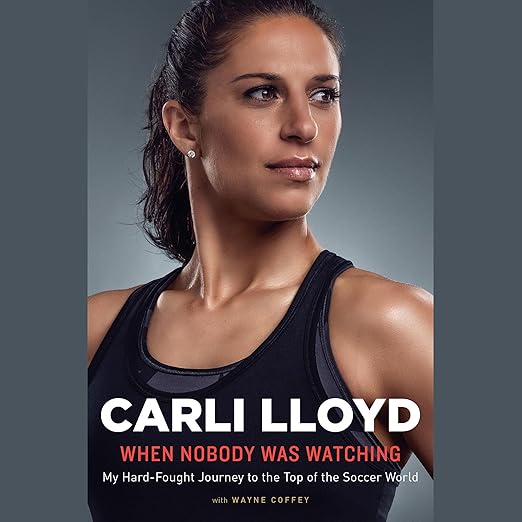
I was on a long drive, somewhere between cities in the early evening, when Carli Lloyd started describing the day she nearly quit soccer altogether. It was 2003, her career at a crossroads, her technical skill outrunning her mental and physical conditioning in ways that made her a frustrating talent rather than a productive one. That moment, the decision point before James Galanis entered her life as a trainer, is the emotional center of When Nobody Was Watching, and Lloyd returns to it with enough specificity to make it feel like a turning point rather than a narrative convention.
The title refers to the hours of solitary training that defined Lloyd development after that low point: the pre-dawn sessions, the work done without witnesses, the gradual accumulation of fitness and mental toughness that eventually made her one of the best midfielders in the world. The arc runs from the crisis of 2003 to the 2015 FIFA Women World Cup final, where Lloyd scored a hat trick in the first sixteen minutes of a game watched by millions. That is a satisfying narrative shape, and Lloyd delivers it without making it feel pre-packaged.
Candor as Competitive Advantage
What separates this memoir from the majority of sports autobiography is Lloyd willingness to be unflattering about herself. She describes moments of weakness, resentment, and poor judgment without the softening qualifications that usually accompany an athlete writing about their own failures. She names the periods when she was benched, when her confidence collapsed, when she and Galanis had to rebuild something that felt permanently broken. The relationship with Galanis is presented honestly: he is not simply a supportive mentor but a demanding presence whose belief in her was always conditional on her doing the work.
Several reviewers noted that the book works beyond its soccer context. One coach described it as essential reading for any athlete who has not yet reached their potential. The mental toughness framework Lloyd describes, the relationship between solitary preparation and high-stakes performance, translates to almost any competitive field, and the book makes that translation available without becoming generically motivational. Lloyd is too specific and too grounded for the self-help register to take over.
Inside the Women National Team
One of the genuine pleasures of When Nobody Was Watching is the access it provides to the internal culture of the US Women National Soccer Team. Lloyd does not pretend it was a frictionless environment of mutual support. She describes competitive tension, the dynamics of playing for one of the most scrutinized women sports programs in the world, and the specific pressure of being measured against other players who were also exceptional. The soccer detail is rich enough to satisfy fans of the sport while remaining accessible to readers who come primarily for the personal narrative.
The author reads the Author Note and Prologue herself, which is a meaningful choice: hearing Lloyd own voice at the outset of the story grounds the audiobook in a way that pure narrator performance cannot. Lynde Houck carries the majority of the text with clean, direct delivery that matches Lloyd own writing style. The prose is not literary in the sense of striving for formal elegance; it is direct and purposeful, and Houck does not impose anything on it that the text does not call for.
What the Book Does Not Do
When Nobody Was Watching was published in 2016 and covers Lloyd career through the 2015 World Cup. Readers looking for coverage of her later career, including the 2019 World Cup and her retirement in 2021, will not find it here. The book is also primarily an interior account rather than a sociological analysis of women sports in the United States, a subject that has attracted excellent writing elsewhere. What it does, and does well, is give listeners access to the mental and physical architecture that makes one particular athlete exceptional, in Lloyd own words and without a ghostwriter smoothing of the rough edges. At eight and a half hours, it is a compact and consistently engaging listen.
Frequently Asked Questions
Does When Nobody Was Watching cover Lloyd career through the 2019 World Cup?
No. The book was published in 2016 and covers Lloyd career through the 2015 FIFA Women World Cup victory. Her later career, including the 2019 tournament and her retirement, would require supplementary sources.
Is this memoir useful for listeners who are not soccer fans?
Consistently, yes. Multiple reviewers who described themselves as not particularly invested in soccer found the book compelling for its account of mental toughness, the trainer-athlete relationship with James Galanis, and the psychology of elite performance under pressure. The soccer detail is present but never dominates at the expense of the personal narrative.
How candid is Lloyd about team dynamics and interpersonal conflicts within the USWNT?
More candid than most sports memoirs allow. She acknowledges competitive friction, the experience of being benched, and the internal pressures of playing for a high-scrutiny program without turning the book into a score-settling exercise. Reviewers consistently praised her directness.
Is When Nobody Was Watching available as a free audiobook?
Yes, the audiobook is listed at /bin/zsh.00 on Audible for eligible members, making it available as a free audiobook. It runs approximately 8.5 hours and includes the author reading the opening Author Note and Prologue herself.