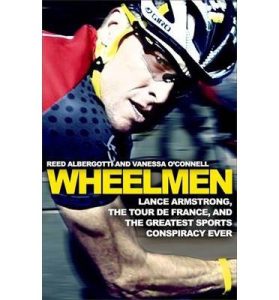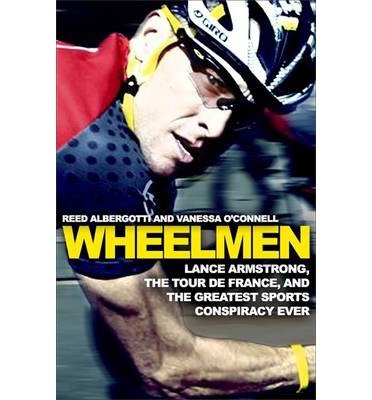
I was a cycling fan during the Armstrong years in a fairly casual way, the kind of fan who watched the Tour's mountain stages and found the story genuinely inspiring without knowing enough to question it. I remember exactly where I was when the 2013 confession broke. What I didn't understand at the time, and what Wheelmen explains with precision that no news cycle could provide, is the full architecture of how the fraud was constructed, maintained, and protected for as long as it was.
Reed Albergotti and Vanessa O'Connell were Wall Street Journal reporters who broke significant elements of the Armstrong story as it developed. Wheelmen is their attempt to tell the complete version, from the origins of the doping program through the business empire Armstrong built on its back, to the eventual collapse under investigation. The result is the kind of journalism book that does what the daily reporting couldn't: it shows you the structure rather than the surface.
Where This One Lands
The element of Wheelmen that most separates it from the many Armstrong accounts that preceded it is its focus on the financial and organizational infrastructure that made the doping program possible. The book introduces U.S. Postal Service Team owner Thom Weisel, who the authors argue orchestrated a systematic power play within American cycling governance, ousting the established USA Cycling leadership to install figures who would protect Armstrong's operation.
This is not a peripheral detail. It is the explanation for how Armstrong could operate for years in a sport nominally subject to anti-doping enforcement without facing meaningful consequences. Weisel's network of financial relationships with sponsors, his leverage within cycling's administrative bodies, and his ability to redirect institutional attention away from inconvenient investigations created the conditions under which Armstrong's team could innovate in doping methodology while remaining effectively untouchable. Understanding this infrastructure is the difference between seeing Armstrong as a uniquely corrupt individual and seeing him as the apex of a corrupt system, and the latter is both more accurate and more disturbing.
The Best Parts of Wheelmen
Albergotti and O'Connell document what they call the Lance effect, the transformation of American cycling from a marginal sport associated with European working-class culture into an upper-income leisure pursuit. Armstrong's success attracted a sponsor class and a participant demographic that had never previously been part of cycling's identity, and both groups had strong incentives to maintain the myth that made their investment worthwhile.
This section of the book is quietly devastating. It explains the widespread complicity, not of knowing participants in the doping program necessarily, but of an entire ecosystem, sponsors, broadcasters, cycling equipment manufacturers, recreational cyclists, who benefited from Armstrong's story and therefore had reasons not to look too closely at its foundations. The book does not let the incidental beneficiaries of the myth off the hook, and it is more honest for that refusal.
What Gives Us Pause
Journalistic narrative books present specific challenges for narrators. The prose style is different from either literary fiction or academic nonfiction, tending toward short sentences, blunt transitions, and a deliberate withholding of authorial emotion that can feel flat without the right vocal intelligence behind it. Fontana handles this well. He gives the material its appropriate gravity without editorializing through tone, and he manages the large cast of characters, many with similar institutional titles and functions, with enough distinctiveness to keep the organizational landscape legible.
At twelve hours and twenty-two minutes, the audiobook is proportionate to the scope of the investigation. The pacing is tighter than many books of this length in the investigative journalism genre, which reflects both the quality of the underlying reporting and a good structural edit. Listeners who have followed the Armstrong story casually will find the full twelve hours consistently surprising. Listeners who followed it intensively will still find the organizational and financial dimensions of the story illuminated in ways that news coverage never managed.
Who Should Listen to Wheelmen
Wheelmen is for anyone interested in sports fraud as a systemic rather than individual phenomenon. The specific cycling context matters but it is not the deepest interest of the book. What Albergotti and O'Connell are really writing about is the mechanics of maintaining an enormous lie inside an institution that theoretically exists to detect and punish exactly that lie. That subject has obvious relevance beyond cycling.
Listeners who want a character-driven narrative focused primarily on Armstrong's personal psychology will find Wheelmen somewhat frustrating, as it deliberately subordinates individual psychology to organizational and financial analysis. This is a feature rather than a flaw, but it means the book reads differently than the USADA report or other Armstrong accounts that focus on the confessor rather than the system. The 4.5 rating from nearly a thousand listeners is well-earned for a rigorous work on a subject that still generates strong feeling.