Quick Take
- Narration: JD Jackson is one of the most trusted voices in nonfiction audio, and his measured authority suits Raveling’s hard-won wisdom without overshadowing it.
- Themes: Mentorship, resilience through adversity, lifelong reading as self-development
- Mood: Warm, reflective, and quietly urgent, like advice from someone who has seen everything
- Verdict: One of the better coaching memoirs of the past decade, with a life story remarkable enough to earn every lesson it imparts.
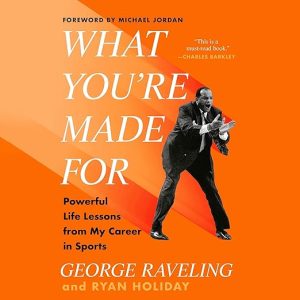
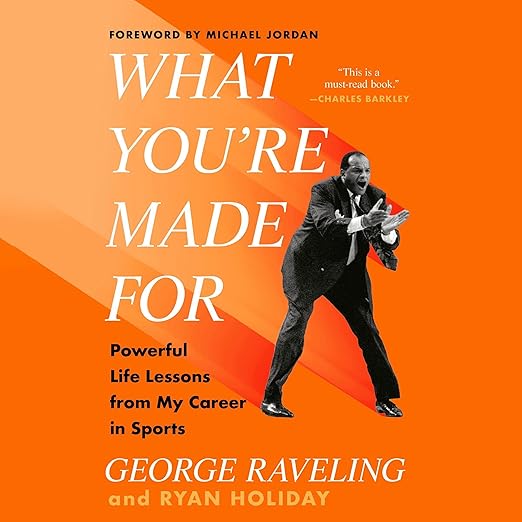
I started What You’re Made For on a Tuesday morning run and was still thinking about the March on Washington chapter by Thursday. George Raveling’s story is one of those that seems improbable even as you are absorbing it: orphaned at thirteen in segregated Washington, D.C., introduced to basketball as a teenager, eventually becoming one of the winningest coaches in NCAA history, a confidant of Bob Knight and John Wooden, the person who convinced Michael Jordan to sign with Nike, and a man who once walked away from the March on Washington carrying the original handwritten text of Martin Luther King Jr.’s most famous speech. The extraordinary keeps compounding.
JD Jackson narrates this, and that matters. Jackson is one of the few narrators whose voice carries genuine authority without performance, and Raveling’s material needs exactly that quality. This is not a book that benefits from theatrical delivery. It benefits from a voice that sounds like it has something worth saying and is not in a hurry to prove it.
Our Take on What You’re Made For
Penguin Audio published this in March 2025 and it carries the marks of a serious production. At six hours and fifty-one minutes, it does not try to be comprehensive about every chapter of a remarkably long career. Instead, Raveling organizes around lessons, weaving biographical narrative with the specific insights he extracted from his grandmother, from decades of reading, from relationships with athletes and coaches who shaped the modern game. The reading habit angle is particularly interesting: Raveling credits his lifelong relationship with books as the single greatest driver of his success, which is an unusual claim from someone who spent his professional life in gyms and on courts.
The Michael Jordan and Nike collaboration chapter alone justifies the runtime. The behind-the-scenes account of how that relationship was brokered and the role Raveling played in it is the kind of sports history that rarely surfaces in coaching memoirs, where the instinct is usually to focus on the games themselves rather than the business and relationship architecture around them.
Why Listen to What You’re Made For
The five-star reviews here, from listeners ranging from coaches to parents to people who simply wanted to understand how someone builds a life of outsized influence, reflect something the book genuinely delivers: it does not feel like a lesson being taught at you. Reviewer Victor Stark noted that it made him more humble, more grateful, and more present, which is a specific kind of effect that requires the author to have actually earned their perspective through lived experience rather than constructed wisdom. Raveling has that legitimacy, and it comes through.
For listeners who work in mentorship, leadership, or education, the sections on how Raveling shaped careers, not just coached athletes, offer genuinely practical thinking about what it means to invest in someone else’s potential over a long time horizon.
What to Watch For in What You’re Made For
The book is marketed as a blueprint for life, and that framing can set expectations for a more systematic self-help structure than Raveling delivers. The lessons are organic to the narrative rather than presented as numbered frameworks or actionable checklists. Listeners who prefer their life advice organized into clear protocols may find the approach too discursive. Listeners who want wisdom embedded in story will find it exactly right.
There is also a degree of reverence for certain figures in the basketball coaching world, particularly John Wooden, that reflects Raveling’s personal loyalties. The portrait of that era’s coaching culture is warm rather than critical, and listeners who know the history of NCAA basketball will notice what gets left at the margins.
Who Should Listen to What You’re Made For
Athletes, coaches, educators, and anyone interested in what an extraordinary life in basketball looks like from the inside will find this rewarding. The 4.8 rating across 265 reviews is not hyperbole. The combination of Raveling’s material and Jackson’s narration produces one of the more genuinely moving listening experiences in the sports memoir genre from the past two years.
Listeners who want a purely tactical coaching manual, focused on basketball systems and schemes, will need to look elsewhere. This book operates at the level of life philosophy first, with basketball as the medium rather than the subject.
Frequently Asked Questions
How prominently does George Raveling discuss his relationship with Michael Jordan?
The Jordan connection, particularly Raveling’s role in brokering the Nike collaboration and his broader mentorship relationship with Jordan, is one of the book’s significant threads. It is not the whole book, but it is treated with enough depth to be genuinely informative.
Is this primarily a basketball book or a broader life philosophy memoir?
Broader life philosophy, with basketball as the central arena. Raveling uses his coaching career as the vehicle for lessons about mentorship, resilience, and the value of reading, but listeners expecting tactical basketball content will find those elements secondary.
Does JD Jackson’s narration suit the subject matter?
Very much so. Jackson’s measured, authoritative delivery matches Raveling’s storytelling register. This is one of those narrator-author pairings where the voice genuinely enhances the material rather than simply delivering it.
Is What You’re Made For appropriate for younger listeners, such as high school athletes?
Yes, and several reviewers specifically mention this. The lessons are framed accessibly, and the story of someone orphaned in adolescence who built something remarkable from that starting point carries obvious relevance for young people navigating difficult circumstances.