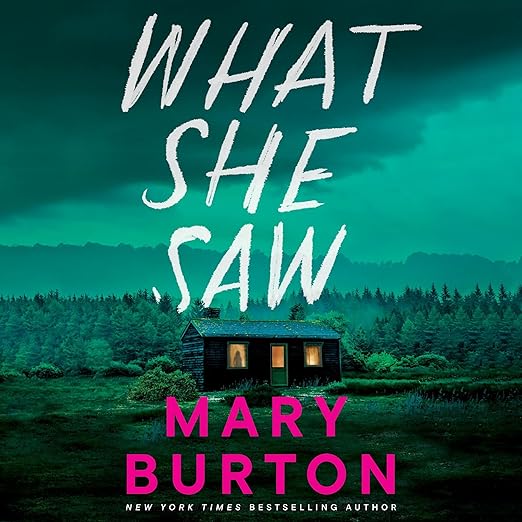
Quick Take
- Narration: Samara Naeymi delivers a clean, controlled performance that suits the cold-case atmosphere, measured enough for the investigative scenes, present enough for the emotional underpinning.
- Themes: Cold case journalism and personal stakes, institutional closure vs. persistent doubt, the price of truth-seeking
- Mood: Deliberate and atmospheric rather than relentlessly propulsive, a slow burn with genuine payoff
- Verdict: A well-crafted standalone thriller that rewards patience, Burton’s experience shows in the structure even when the early momentum is restrained.
I tend to approach Mary Burton’s work the way I approach any bestselling crime writer with a long catalogue, with calibrated expectations. At thirteen published novels with a loyal readership, Burton knows exactly how to construct a mystery. What She Saw, her standalone, arrives with the confidence that comes from deep craft, but also with the particular challenge that standalone crime fiction faces: having to establish everything a series does through accumulated reader goodwill, in a single volume.
The premise is one of the more compelling I’ve encountered in recent crime fiction. Cold case reporter Sloane Grayson arrives in a small Virginia mountain town carrying both a professional mission and a personal wound: thirty years ago, her mother was among four women who disappeared during a music festival. The convicted killer has maintained his innocence throughout his imprisonment and is now approaching parole eligibility. The original sheriff is dead. The bodies were never found. Sloane is, essentially, investigating the case that closed her childhood.
Our Take on What She Saw
What Burton does particularly well here is the distinction one reviewer drew attention to: Sloane is a true crime writer, not a journalist. The difference matters structurally. She doesn’t chase headlines or work under editorial deadline. She investigates with depth and care, a patience that shapes the book’s rhythm and explains why some readers expecting standard thriller pace find the early sections restrained. Burton is building something more careful than a page-turner, and the rewards become clearer as the back half of the book opens up.
The time-jumping structure, the novel bounces between present investigation and the past events around the original music festival, is handled with the craft a veteran author brings to a device that can easily become disorienting. Reviewers consistently note clear chapter marking and clean transitions, which is no small thing for audio, where physical cues like page layout are unavailable. Samara Naeymi’s narration reinforces those transitions through tonal differentiation rather than explicit signaling, which is the subtler and ultimately more satisfying approach.
Why Listen to What She Saw
Naeymi’s performance is one of the audiobook’s real assets. She gives Sloane a quality of controlled emotion, someone carrying grief and determination simultaneously without externalizing either, that’s harder to sustain across ten hours than it sounds. The moments where that control cracks carry genuine weight, and Naeymi earns them by not reaching for them earlier. The supporting cast, including the family members and remaining witnesses Sloane interviews, are differentiated clearly enough to track without becoming distinct enough to distract from the primary narrative.
The setting is worth noting. Burton positions the Virginia mountain town as a place defined by its relationship to an old crime, the music festival murders made it notorious, and the community has spent thirty years in ambivalent relationship with that notoriety. The small-town crime novel is a well-established subgenre, but Burton’s use of the setting as an active presence in the investigation rather than mere backdrop gives What She Saw a slightly different texture from the standard entry.
What to Watch For in What She Saw
The pacing criticism in some reviews is legitimate and worth flagging for potential listeners: this is not a book that maintains relentless forward momentum throughout. The story is deliberate in its first half and accelerates significantly toward the conclusion. Readers who hit the midpoint expecting constant escalation may find the early investigation sections too measured. Burton is establishing the emotional architecture that makes the resolution land, but the patience required is real.
One reader described it as lacking “the twists, turns, and true page-turner momentum” they were hoping for, while another said it “kept them guessing until the end” with genuine surprise at the resolution. Those responses are not contradictory, they reflect different expectations for the genre. What She Saw is a mystery that earns its ending through careful groundwork rather than perpetual shock.
Who Should Listen to What She Saw
Best suited to listeners who prefer psychological and atmospheric crime fiction over relentless thriller plotting. Burton’s long-time readers will find this consistent with her strengths. New readers looking for a standalone entry point into her work will find What She Saw well-structured and complete in itself. Those who read crime fiction primarily for sustained adrenaline should adjust expectations or look elsewhere.
Frequently Asked Questions
Is What She Saw connected to any of Mary Burton’s other series, or is it completely standalone?
It is a standalone novel with no required connection to Burton’s other series. Sloane Grayson is a new protagonist and the Virginia mountain town setting is not shared with Burton’s series work. Readers unfamiliar with her previous books can start here without any disadvantage.
How does Samara Naeymi handle the dual timeline structure in the audiobook?
With tonal differentiation rather than heavy signaling, the past and present sections have distinct atmospheric qualities in Naeymi’s reading, supported by the clearly marked chapter transitions in the text itself. Reviewers note no difficulty tracking the timeline in audio format.
The synopsis describes Sloane as a ‘cold case reporter’ but one reviewer says she’s a true crime writer. Which is accurate?
The true crime writer framing is more precise. As one detailed reviewer explains, the distinction matters, Sloane investigates with depth and patience rather than working under journalistic deadline. The synopsis simplifies this, but the book itself makes the distinction explicit and builds its pacing around it.
Does What She Saw deliver a satisfying resolution, or does it leave significant threads open?
The mystery resolves fully within this volume. The locations of the bodies, the question of the convicted man’s guilt or innocence, and Sloane’s personal stake in the case are all addressed. Reviewers who finished the book consistently describe the ending as surprising and satisfying even when they found the middle sections slower than expected.