Quick Take
- Narration: Elizabeth Knowelden handles the dual-POV structure with clear differentiation between Nina’s controlled menace and Maggie’s restrained desperation.
- Themes: Inherited trauma, the violence of secrecy, how captivity operates in both directions simultaneously
- Mood: Claustrophobic and relentless, with a darkness that does not lift until the final hour
- Verdict: An ITW Thriller Award winner that earns the recognition: structurally tight, genuinely disturbing, and difficult to stop once you have started.
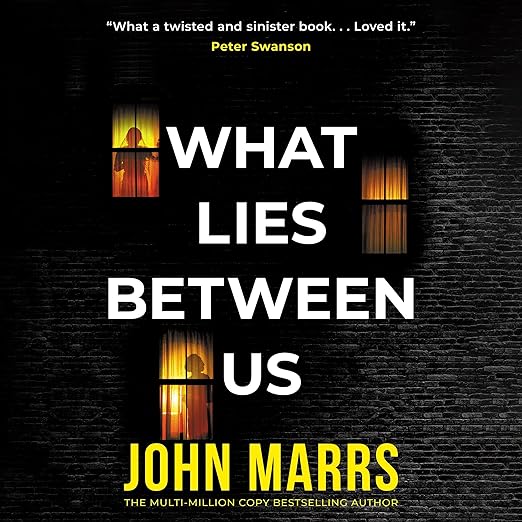
I started What Lies Between Us at eleven o’clock on a weeknight, intending to listen for an hour before sleeping. I did not sleep until I had finished it. John Marrs writes psychological thrillers with a specific quality of dread that is not about jump scares or sudden reversals but about the slow revelation that things are much worse than you first understood them to be. The opening image of Nina and Maggie, their every-other-night dinners, the chain, the attic, is disturbing enough. The book’s achievement is making you understand, chapter by chapter, how something like this becomes possible between two people who once shared a life.
Elizabeth Knowelden narrates the dual POV structure, and the differentiation between Nina and Maggie is handled with precision. Nina’s voice has a controlled quality, a specific kind of careful language that signals someone managing her own story very deliberately. Maggie’s narration is more fragmented, the language of someone who has been living inside a constrained space for a very long time. Knowelden does not oversell the distinction, but it is consistently present, and it matters because the book’s central mechanism is the way each woman’s account of events gradually and incompletely overlaps with the other’s.
Our Take on What Lies Between Us
The setup is built around a question that Marrs withholds the answer to until the structure demands it: what, exactly, did Maggie do? Nina’s certainty that it is unforgivable is established immediately. Maggie’s knowledge that Nina does not have the full picture gives her a strange kind of power even in chains. The tension between those two positions, one character with physical control and one with informational control, is what drives the eleven and a half hours. One reader’s observation that both POVs create a torn feeling, where you shift sympathies without ever fully landing on either side, is accurate. Marrs writes characters whose moral positions are genuinely complicated rather than conveniently distributed between victim and villain.
The darkness of the book is real. Several reviewers flagged the subject matter as overwhelming at times, and one called it engaging but disturbing in a way that required emotional distance. That is an honest characterization. The book does not offer the comfort of knowing who to root for, and it does not resolve in a way that cleanly satisfies the desire for justice. One reviewer wanted a slightly happier ending. I understand that impulse, but the ending the book has is the right one: honest about the way damage propagates through generations in ways no single moment of confrontation can repair.
Why the Dual POV Structure Is the Right Choice
A single-perspective account of this premise would have been either a horror novel or a revenge thriller, depending on whose POV anchored it. Marrs’s decision to give both women equal narrative space transforms the book into something closer to tragedy: the story of how two people ended up in a configuration where both are suffering and neither is simply the wrongdoer. The reveals about Maggie’s secrets come at a pace that makes each one feel earned, and the final revelations reframe the earlier chapters in ways that require mental reconstruction of the whole. That reconstruction is part of the pleasure of a reread, and it is why one reviewer described experiencing it as both an immersive audiobook and a Kindle edition simultaneously.
What to Watch For in the Third Act
The book accelerates in its final two hours in ways that some readers found deeply satisfying and others found slightly rushed depending on their investment in the characters. The question of Dylan/Bobby, flagged by one reviewer as an unresolved moral issue in the resolution, is the most genuinely unresolved element: the place where the book’s willingness to distribute harm without providing proportionate relief is most visible. That irreducibility is not a flaw. It is the argument the book has been making all along about what revenge actually produces and who it fails to protect.
Who This Book Is Built For
Listeners who enjoy psychological thrillers that prioritize character logic over plot mechanics will find Marrs’s construction particularly satisfying. The twists exist but they emerge from the characters rather than being imposed on them from outside. This is not a book for readers who need to know who to sympathize with or who require a clean moral resolution at the end. If darkness as a sustained narrative quality is something you can sit with for eleven hours, What Lies Between Us is among the stronger examples of the domestic psychological thriller form. Skip it if you are reading for comfort; this book offers none of that.
Marrs is also doing something formally interesting with the use of the chain and the attic as a literal device. The physical configuration, Maggie in the attic, Nina below, the chain as the mechanism of control, maps onto a psychological dynamic where neither woman is actually free. Nina is as imprisoned by what she knows and does not know as Maggie is by the physical restraint. The chain holds Maggie in place, but the secrets hold Nina in a different kind of suspension: unable to grieve, unable to move forward, unable to understand her own past. Marrs does not make this parallel explicit, which is to his credit. Knowelden’s narration lets it emerge from the structure rather than from the dialogue, which is exactly how it should work in a book this carefully constructed.
It is also worth noting what makes Knowelden’s narration of Maggie’s sections specifically effective. Maggie is in an impossible position: she has information that could change everything and reasons, some of them survival-based and some of them not, to withhold it. The temptation for a narrator is to play that withheld knowledge as theatrical mystery, lingering on what is not being said. Knowelden instead plays it as restraint, as someone who has learned to hold very still. The effect is that Maggie’s silence feels inhabited rather than performed, which is the difference between a narrator who understands the psychology of the character and one who is simply marking the dramatic beats.
Frequently Asked Questions
Does Elizabeth Knowelden’s narration differentiate clearly between Nina and Maggie, or does the dual POV become confusing in audio?
Knowelden differentiates the two voices through tone and pacing rather than through accent or register extremes. Nina’s sections have a controlled, measured quality; Maggie’s feel more compressed and vigilant. The distinction is subtle but consistent, and the chapter breaks make clear whose perspective is active at any moment. Most listeners find the dual-POV structure clear in audio.
One reviewer read the whole book in a single sitting. Is it genuinely difficult to stop, or does that depend on tolerance for dark content?
The pacing is constructed to prevent stopping. Marrs ends chapters at moments of partial revelation, and the alternation between the two POVs creates a ratcheting effect where each woman’s chapter answers one question and raises another. Listeners sensitive to dark content may find the relentlessness itself a reason to pause; the book does not provide natural relief points.
The synopsis mentions the book won the ITW Thriller Award and the International Book Awards. Does it live up to those recognitions?
The ITW recognition reflects the book’s structural craft: the dual POV, the management of information, the construction of reveals that reframe prior material. It is formally accomplished and genuinely disturbing. Readers who prefer their thrillers lighter or more morally legible may find it demanding rather than rewarding, but the award recognition points to real craft.
Is this John Marrs’s best book, or is there a better entry point into his work for new readers?
Marrs has a catalog of standalone psychological thrillers with similarly complex structures. The One, which imagines a DNA test for soulmates, is often cited as his most commercially accessible entry point. What Lies Between Us is considered by many readers to be his most emotionally difficult and his most formally precise. Which is better depends on what you want a psychological thriller to do.