Quick Take
- Narration: James Lailey handles the British domestic thriller’s particular rhythms with steady assurance, capturing the tension between Christine’s controlled exterior and the unraveling situation underneath.
- Themes: maternal protectiveness and its moral limits, the lies families tell each other, trust eroding under pressure
- Mood: Tense and unsettled, like a dinner party where everyone is carefully not saying the most important thing
- Verdict: A well-constructed domestic thriller that delivers genuine surprise in its final act, though listeners should know it is the eighth in a series.
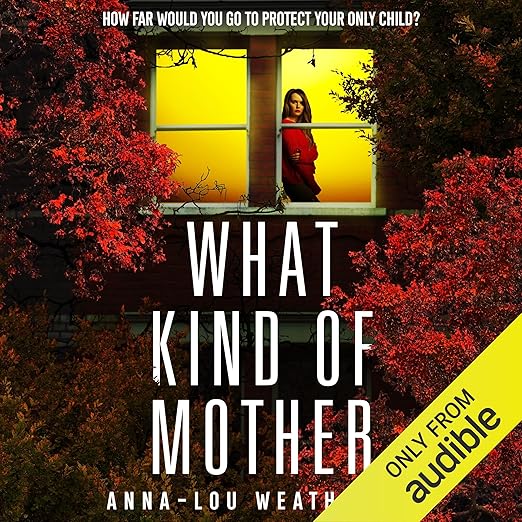
I picked up What Kind of Mother on a flight, which is, I have come to believe, the natural habitat of the domestic thriller. There is something about the contained time and the slight unreality of being between places that makes the best books in this genre click into focus. Anna-Lou Weatherley’s eighth Detective Dan Riley novel gave me seven hours of not putting my phone down in airplane mode, which is the most accurate measure of effectiveness I can offer for a book in this category.
The setup is the engine that drives the entire book. Christine’s teenage son Conor and his girlfriend Paris come to the door one night, their clothes spattered with blood, with the sentence: I think we killed someone. That opening places a specific kind of moral crisis at the center of the narrative: not whether to investigate a crime but whether to conceal one, and which kind of mother Christine is will be determined entirely by how she answers that question. The parallel situation with Paris’s mother Helen doubles the moral weight and introduces the instability that the plot requires, because Helen and Christine do not make the same choices and do not process guilt the same way.
The Domestic Thriller’s Particular Engine
Weatherley is writing in a tradition that includes Liane Moriarty, Shari Lapena, and the British crime fiction establishment represented by authors like Fiona Barton and Sarah Vaughan. The genre’s central pleasure is the exposure of the gap between how families present themselves and what actually happens inside them, and Weatherley deploys it with competence and occasional real elegance. The scenes where Christine is trying to hold her household together while simultaneously trying to determine whether her son has told her the whole truth are the book’s best passages: the domestic texture is specific enough to feel real, and the stakes are clear enough that every small evasion registers.
Helen is the book’s most interesting creation. Several reviewers note that she becomes increasingly unpredictable as the story progresses, turning up unannounced, harassing Christine’s husband, telling lies about Christine’s past. This escalation is well-managed: Weatherley gives Helen enough coherent motivation that her behavior reads as psychological rather than as plot mechanism, and the question of whether Christine can trust her own reading of the situation adds a layer of paranoia that the best domestic thrillers sustain.
James Lailey and the Unfolding Lie
James Lailey’s narration is reliable rather than spectacular, which is the right register for a book that depends on accumulated tension rather than dramatic peaks. He handles the distinction between Christine’s careful internal voice and the more chaotic perspective she applies to Helen’s behavior with appropriate clarity, and the scenes involving Detective Dan Riley, the series’ recurring investigator and apparently something of a fan favorite, are delivered with the right quality of measured competence that the character requires.
The eleven-hour runtime is standard for the genre and appropriate for the material. Weatherley does not rush the revelation of what actually happened the night Conor came home with blood on his clothes, and the decision to delay that revelation while escalating the pressure on Christine is the book’s main structural achievement. The final act delivers the surprise that one reviewer noted they did not see coming, and the resolution, while somewhat compressed according to another reviewer, is satisfying on the terms the book has set up.
The Series Context and Whether It Matters
This is the eighth Detective Dan Riley novel, which raises the question of how much prior series knowledge is needed. The answer appears to be less than you might expect: reviewers who describe themselves as new to the series found the book accessible, and the character-specific elements are reintroduced as needed. Riley functions primarily as an investigative pressure on Christine rather than as a developed protagonist in this volume, which makes the book more accessible to new readers than a character-heavy series entry might be.
The 4.4 rating across nearly a thousand listeners is consistent with a book that satisfied its existing readership while not quite breaking out to become the kind of widely discussed thriller that crosses genre boundaries. Reviewers praise the characters, the writing quality, and the surprise ending, while noting that the pacing is occasionally uneven. That is an accurate summary of a solid entry in a reliable series rather than a breakthrough work.
Who Should Listen and Who Should Skip
Listen to this if you enjoy British domestic thrillers with a maternal focus, or if you are already a Detective Dan Riley series reader looking for the next entry. The moral setup, what kind of mother are you when your child comes to you complicit in a possible death, is strong enough to recommend to genre fans who are new to Weatherley. Skip it if you want a thriller that moves faster in its first act, or if you prefer single-standalone mysteries to series entries with recurring characters and ongoing dynamics.
Frequently Asked Questions
Is What Kind of Mother accessible to readers new to the Detective Dan Riley series, or do you need to read the earlier books first?
New readers can follow the book without prior series knowledge. Riley is a significant presence but not the primary focus of this volume, which centers on Christine. The relevant character history is reintroduced as needed, and the central moral dilemma is entirely self-contained.
How graphic is the violence in this thriller, and is it suitable for listeners who prefer psychological tension over explicit content?
The violence is primarily in the setup and the revelation rather than present on the page throughout. Weatherley focuses on the psychological and domestic consequences of what happened rather than on graphic depiction, which makes this a psychological thriller in the truest sense. Listeners who prefer tension over explicit content will find this appropriate.
Is the dual-mother structure, Christine and Helen, maintained throughout the book, or does one perspective dominate?
Christine’s perspective is primary throughout, but Helen’s behavior is a constant and escalating presence in the narrative. The relationship between the two women and their diverging responses to the same crisis is the structural engine of the book’s middle section. Helen’s increasing unpredictability is tracked through Christine’s eyes rather than through Helen’s own narration.
Does the surprise ending in What Kind of Mother require a reread to fully appreciate, or does it hold up on first listen?
It holds up on first listen. Reviewers describe it as genuinely unexpected rather than retroactively foreshadowed in ways that require a reread to appreciate, which suggests Weatherley prioritized the immediate emotional impact of the reveal over the retrospective satisfaction of planted clues. Some reviewers felt the final sequence moved slightly fast relative to its importance, which may warrant a relisten of the last hour.