Quick Take
- Narration: Robin Miles is one of the most authoritative voices in nonfiction audiobooks, and she brings exactly the gravitas and clarity this material demands without losing its accessibility for younger listeners.
- Themes: Systemic racism, the pattern of backlash against Black progress, civic education
- Mood: Clear-eyed and urgent, written in sorrow rather than rage
- Verdict: A rigorous and essential work of historical analysis made fully accessible to teen readers, and necessary reading for adults who want to understand the architecture of American inequality.
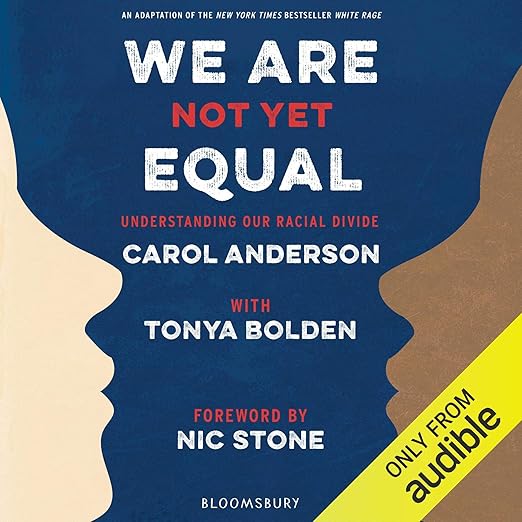
I first encountered Carol Anderson’s White Rage, the adult version of this work, in 2016, and it rearranged something in how I understood American history. We Are Not Yet Equal, the YA adaptation she co-wrote with Tonya Bolden, accomplishes something I did not expect: it is not a simplified version of the original argument. It is a more carefully constructed one, written for readers who may be encountering this history for the first time and who need the connective tissue that adults familiar with the broad outlines can fill in for themselves. I listened to it on a Tuesday morning with a cup of coffee I forgot to drink, and finished it well past noon.
Robin Miles narrates, which is itself a kind of guarantee. She is one of the most reliably excellent audiobook voices working in nonfiction, and her delivery of Anderson’s material, which requires both authority and accessibility, is precise. She reads with the cadence of someone who has thought seriously about every sentence, which reflects Anderson and Bolden’s prose as much as Miles’s skill.
Our Take on We Are Not Yet Equal
The book’s central argument is structural and historical: every time Black Americans have made meaningful progress toward full democratic participation, the systemic response has been a backlash designed to roll back those gains. Anderson identifies five moments where this pattern repeats with what she presents as near-mechanical consistency. The end of Reconstruction greeted with Jim Crow. The Great Migration met with physical barriers to Northern opportunity. Brown v. Board answered by the closure of public schools throughout the South. The Civil Rights Act and Voting Rights Act followed by disenfranchisement laws and a War on Drugs targeting Black communities. Obama’s election shadowed by Ferguson and the subsequent political reaction.
What Anderson and Bolden do in this adaptation is provide the contextual scaffolding that allows each of these moments to be understood not as isolated incidents but as iterations of a single mechanism. This is what one reviewer described as learning that these things are connected in ways that schools and politicians and media have generally not made available. The research is impeccably sourced. The narrative style is approachable without being condescending.
Why Listen to We Are Not Yet Equal
Robin Miles’s narration is a significant part of why this audiobook works as well as it does. Anderson’s argument is dense with specific legislative and judicial history, the kind of material that can become overwhelming in prose but benefits enormously from a narrator who knows how to emphasize the load-bearing details without losing the reader in the supporting ones. Miles does this consistently. Her voice carries the moral weight of the subject without sliding into performance of indignation, which is exactly the register Anderson’s own prose occupies.
A middle school teacher who contributed a review noted using this book with students who were stronger readers, finding it effective for high school as well. The audio format adds an accessibility dimension for students who struggle with dense text, and Miles’s clarity makes the historical specifics land with the precision they require. This is not a book that benefits from vague listening. The details are the argument.
What to Watch For in We Are Not Yet Equal
The YA framing provides additional context that the adult White Rage assumed. For adult listeners reading this as their entry point to Anderson’s work, this is actually an advantage: the scaffolding is there explicitly rather than assumed. For those who have read White Rage already, the argument will be familiar in its structure but the examples are sometimes drawn differently to suit the younger audience, and Anderson and Bolden’s prose choices differ enough to make the comparison interesting.
The book closes with Obama’s election and its immediate aftermath, which means it does not address the full post-2016 period. Given the publication date of 2018, this is a structural limitation rather than a choice, but it is worth noting for listeners who want analysis current through the present moment. The pattern Anderson documents, however, is sufficiently well-established that readers will find no difficulty extending her framework to more recent events themselves.
Who Should Listen to We Are Not Yet Equal
Anyone who wants to understand the mechanics of racial inequality in American history rather than its surface expressions. Parents and teachers looking for material that gives young people genuine analytical tools rather than sanitized summaries. Adult readers who found White Rage too dense or who want the fuller contextual framing this adaptation provides. Listeners who want emotional validation without historical rigor may find Anderson’s approach more clinical than they expect; she is building a case, not offering comfort, and that is precisely what makes the book valuable.
Frequently Asked Questions
Is We Are Not Yet Equal significantly different from Carol Anderson’s adult book White Rage?
Yes. While the core argument is the same, the YA adaptation co-written with Tonya Bolden adds substantially more contextual scaffolding and is written with a different narrative style. Adult readers who found White Rage dense may actually find this version clearer in its construction.
How does Robin Miles’s narration handle the historical density of Anderson’s argument?
Miles emphasizes load-bearing details with precision without losing the connecting tissue of the argument. Her delivery is authoritative and measured, which matches Anderson’s analytical prose and makes the legislative and judicial history accessible rather than overwhelming.
Is this audiobook appropriate for middle school listeners, or is it more suited to high school?
A classroom teacher who reviewed it suggests it works well for middle school students who are stronger readers and for high school students generally. The audio format adds accessibility for students who find dense text difficult.
Does the book cover events after 2018, such as the 2020 racial justice protests?
No. The book was published in 2018 and closes with the immediate aftermath of Obama’s election. However, Anderson’s framework for understanding the pattern of backlash against Black progress is structured in a way that readers can readily apply to more recent events.